
Save Our Local Fire Services
by PAUL MCLAUGHLIN
Helena Dollimore, Labour’s prospective parliamentary candidate for Hastings and Rye, has launched a campaign to fight plans by the East Sussex Fire and Rescue Service (ESFRS) to downgrade local fire services across the town and surrounding villages.
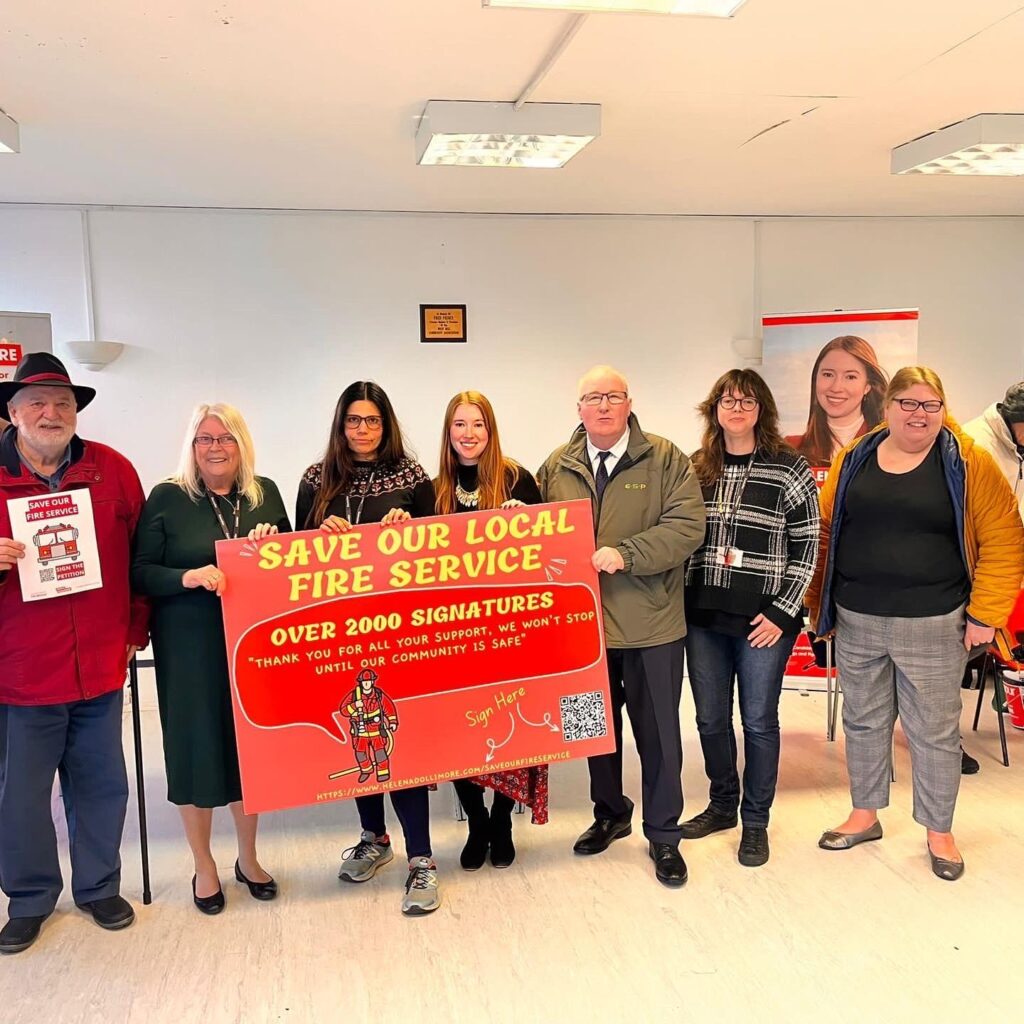
At a crowded public meeting at the West Hill Community Centre on 26 February, she warned local residents that the proposed cuts to the local fire service, particularly the downgrading of the Ridge Fire Station, “would put the lives of local people and fire-fighters at risk” and “must be stopped.”
The ESFRS proposals to change the way the local fire service operates were set out in its Medium-Term Financial Plan, which was published last month. It has a budget gap for 2023-24 of £636,000, despite increasing the Council Tax precept by £5 per annum for an average Band D property – the maximum allowed by the Government without a referendum. The amount required to balance the budget in 2024-25 based on current modelling is £721,000.
That funding shortfall has prompted the fire authority to consider a range of measures to save money. These include plans for the Ridge Fire Station to be only fully manned during the day, with retained fire-fighters on call for emergencies at night. There would also be a reduction in the number of fire engines stationed in the area and in the number of retained duty support officer posts. The number of fire-fighters on board each vehicle may be reduced from five to four
Re-think called for
Leo Cacciatori from the Fire Brigades Union expressed his anger at the proposed cuts. The service, he said, had “already been cut to the bone.” He called for a rethink of the proposals. Councillor Phil Scott, who represents Hollington and Wishing Tree on East Sussex County Council and is a member of the ESFRS, echoed this opinion. He warned that without more resources the local fire service would struggle to cope in the event of a major emergency, putting the lives both of fire-fighters and of the public in jeopardy.

Ms Dollimore said the proposals “threaten the very future of our local fire service”. She said the Ridge Fire Station provided a vital service to both the northern edge of Hastings and its surrounding villages including Guestling, Fairlight, Pett, Pett Level, and Icklesham, as well as Rye and Winchelsea. The plans to downgrade the station “would drastically increase the time it takes for sufficient fire crews to be in place to significantly make a difference, especially in the more rural areas.”
The ESFRS says it will “further develop” the plans ahead of a public consultation in June. But Ms Dollimore intends to use this time to galvanise public support against any downgrade of service levels. Since the launch of the campaign, over 2,750 people have signed a petition calling for revision of the plans, and Ms Dollimore said she was confident that, with such overwhelming support in such a short space of time, it would be forced to back down.
“More extreme weather”
“Now is not the time for cuts,” she declared, “when the demand on our fire service is increasing. Our community is seeing more extreme weather events such as the recent flooding in Priory Meadow, the devastation caused by Storm Eunice last January, and last July’s extreme heat bringing the risk of wildfires, not to mention the recent major fire in George Street in the Old Town and the discovery of a WWII unexploded bomb in Caves Road, St Leonards.”
The recent fires in George Street and Hill Street prompted a number of worried residents to question the ability of the fire service to access much of the Old Town with its narrow streets and obstructive parking in the event of an emergency. There were calls for a specialist, smaller appliance that could manoeuvre the difficult terrain more easily.
Councillor Scott said that, whilst he fully understood the concerns, a smaller appliance was not needed. He said the fire authority had explored and analysed this issue extensively over recent years and always reached the same conclusion that “narrower appliances would be neither an effective nor efficient solution.”
Leo Cacciatori endorsed this view. He acknowledged that, whilst there were parts of the Old Town that were difficult to access, fire-fighters would always get to where they need to be to extinguish fires by running as many hoses as are required to do the job “fire-fighters would always get to where they need to be to extinguish fires by running as many hoses as are required to do the job”.
We hope you have enjoyed reading this article. The future of our volunteer led, non-profit publication would be far more secure with the aid of a small donation. You can also support local journalism by becoming a friend of HIP. It only takes a minute and we would be very grateful.

Leave a Reply