
We Out Here
GARETH STEVENS reviews a groundbreaking exhibition at Hastings Contemporary.
Since the murder of George Floyd in May 2020 and the global upwelling of the Black Lives Matter, there is little doubt that contemporary Art institutions are engaged in a reparative mission to include and celebrate the works of Black artists. Of course, the Frank Bowling exhibition at the Tate Britain a year before Floyd’s passing testifies that, to some extent, this process was already underway.
An American report published in 2018 gave us a snapshot of the situation with regard to this issue. Thirty prominent American museums were investigated, and it was found that only 2.37 per cent of all their acquisitions and gifts and 7.6 per cent of all exhibitions had been of work by African American artists in the decade leading up to the report.
More positively it was found that the number of exhibitions focusing on the work of African American artists at the same galleries had jumped by an astounding 66 percent in 2017. The data suggests fragility; it is indicative that the changing tide could be unsustainable and is definitely one that has not been systemic or structural.
Similarly, there are only around 2,000 works by black artists in the UK’s permanent collections and most of them are not found on display (Black Artists and Modernism National Collection Audit, led by Dr Anjalie Dalal-Clayton).

Thankfully there is a growing shared understanding that Contemporary Art has been riding its own boundary to secure its archaic historical brand. Fortunately, the endemic will for self-preservation and conservatism in the Arts is melting away … and they are becoming less elitist and exclusionary. This is deeply ironic as it seems to me that the innate avant-gardism of contemporary Art should have safeguarded it from such blinkered thinking. And so it is the responsibility of galleries to be innovative risk-taking institutions and to support a more inclusive and forward thinking art ecology.

By setting this context, hopefully I have convinced you of the significance of the We Out Here exhibition currently running at Hastings Contemporary. The show features the work of six Hastings-based artists, and its strength lies in the richly diverse approaches across its contributors. The work spans a wide range of material and technical processes and seeks to engage the visitor with a plethora of global themes to do with climate and racial injustice, identity, migration and colonialism.
On entering the exhibition, I am drawn to Elaine Mullings’ large-scale sculpture Co27: Blue Tears. Comprising a large, climbing frame-like structure, made with black wooden uprights and copper hoops, it is made with clinical precision. Eleven globular figures – made with cobalt pigment-covered clay and latex – surround the foot of the structure. Three struggle to hold their position on the structure itself. We are told that this work represents the calamitous consequences of artisanal cobalt mining in the Democratic Republic of Congo. On paper, the era of colonialism is over in Africa. The truth is, however, that it is flourishing in a range of new guises. There is a 21st century version of the ‘rush for Africa’ – not explicitly by nation states, but by huge multi-nationals, and we are all peripherally complicit. Whether it be because we need cobalt for our smartphone’s lithium batteries or because we need access to the liquefied petroleum gas found in Mozambique to heat our uninsulated homes, we are all connected to the suffering and injustices that the ‘West’s’ greed causes.
Whilst the seriousness of this issue is beyond any doubt, this sculpture doesn’t engage us emotionally with its subject when viewed without any accompanying commentary. Rather literal in nature, Co27: Blue Tears introduces us to the ‘post-colonial’ inequities of unregulated extraction of cobalt, without stirring our emotions or causing any visceral anger.
Maggie Scott’s huge lenticular piece is hugely impressive. Comprising 19 double panels that are over 2 metres tall, it is a relief that requires the viewer to move along its length. Having to physically traverse the piece’s length gives the visitor agency to interact with the piece in a way that best suits them. When you stand at the extreme left of the piece you are confronted by an image of a monstrous landfill site filled with full plastic bags and the detritus of extreme consumerism. Viewed from the other end, you see a gaggle of happy shoppers toting armfuls of branded carrier bags filled with cheap high street clothes.
Named Shopping?, this work of stitched felt and printed velvet, confronts us with the real consequences of the Global North’s addiction to consumerism in the Global South. This chimes with Mullings’ work as, again we see how we not only extract what we need from Africa, but we export our unwanted waste to defile a continent that we can largely put out of mind.
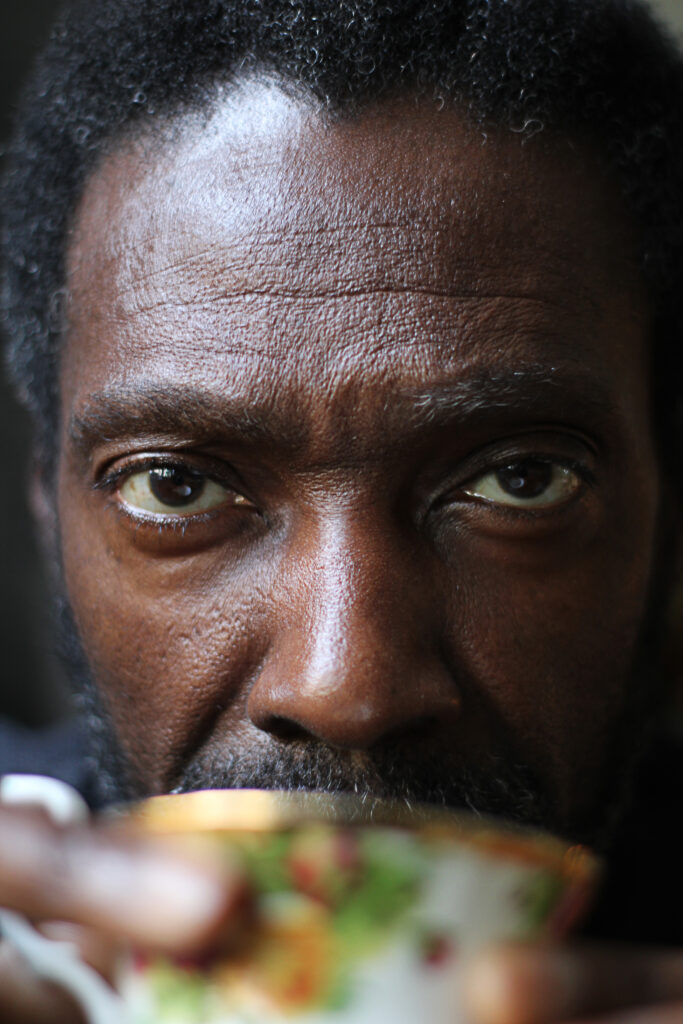
Richard Mark Rawlins piece, Conversation Over Tea, is, for me, one of the most arresting works in this show. Two parallel washing lines are held up by two simply constructed wooden posts. On each line is hung six tea towels on which are printed photographic portraits that all look intently into your eyes. A hugely poignant work, it points to the relationship between the profound and the prosaic activities of doing the laundry, washing up and making tea. More than that it tells of deep kinship, shared experience and the effect of lifelong struggle on the patina of each subject’s face. Rawlins’ large graphite drawing, Jab Jumbie, is another notable contribution to the show. It is less premeditated than other works exhibited and is a more freely expressed riff on the identity of an individual within a distinct cultural context.

The two knitted magazine covers called WE MEK subvert our view of the limitations of the ‘craft’ of knitting. Lorna Hamilton-Brown strips away any preconceptions about knitting being a purely functional process and puts it at the service of celebrating black culture.
“I was hugely inspired by the photos British-Ghanaian James Barnor took for South African DRUM magazine.” Hamilton-Brown says “The magazine was an influential anti-apartheid magazine based in Johannesburg, and Africa’s first black lifestyle magazine.” Commissioned by Dr Karen Patel as part of the Craft Expertise project, this artwork was produced in collaboration with Crafts Council UK and explores inequalities and diversity in the UK professional craft sector.
Each of the two pieces is composed of many symbols and references in combination. For instance, the central figure in WE MEK Knitted Magazine Cover – Issue One is herself knitting. Hamilton-Brown explains that “The colours of the knitting relate to Ghanaian Kente cloth. This celebrates the history of knitting’s links to Africa – which is not often written about.”
Commenting on her role as the curator of this exhibition, Hamilton-Brown says “We Out Here has given me the chance to bring together Hastings-based Black artists who I admire, from a range of disciplines to create a historic exhibition. We have been hidden in plain sight for too long, but WE OUT HERE!”
Whilst this piece does not provide the space to discuss the work of all the show’s contributors, I would strongly recommend that you go along to enjoy this hugely significant show. I should also make mention of the myriad of discussions, workshops and out-reach projects that have been planned to complement the exhibition. A commendable collective effort has been made to include the wider community in this show, and that has to be applauded.
A final word. I know that history has thrown us into silos that are demarcated by race and/or nationality. I understand that under-represented communities have to resist, restate their position and find their voice; but I look forward to a day when affirmative action is replaced by deep systemic change and the end of racism in contemporary Art. I hope for a day when the current irrefutable need for group exhibitions circumscribed by the colour of its contributors’ skin is a distant memory.
We Out Here runs at Hastings Contemporary until 4 June 2023.For more information go to hastingscontemporary.org
We hope you have enjoyed reading this article. The future of our volunteer led, non-profit publication would be far more secure with the aid of a small donation. You can also support local journalism by becoming a friend of HIP. It only takes a minute and we would be very grateful.


Leave a Reply