
Touching Eternity
GARETH STEVENS meets with Babalola Yusuf whose exhibition “The Quality of Eternity is ((is now))” is currently at Flatland Projects gallery in Bexhill on Sea.
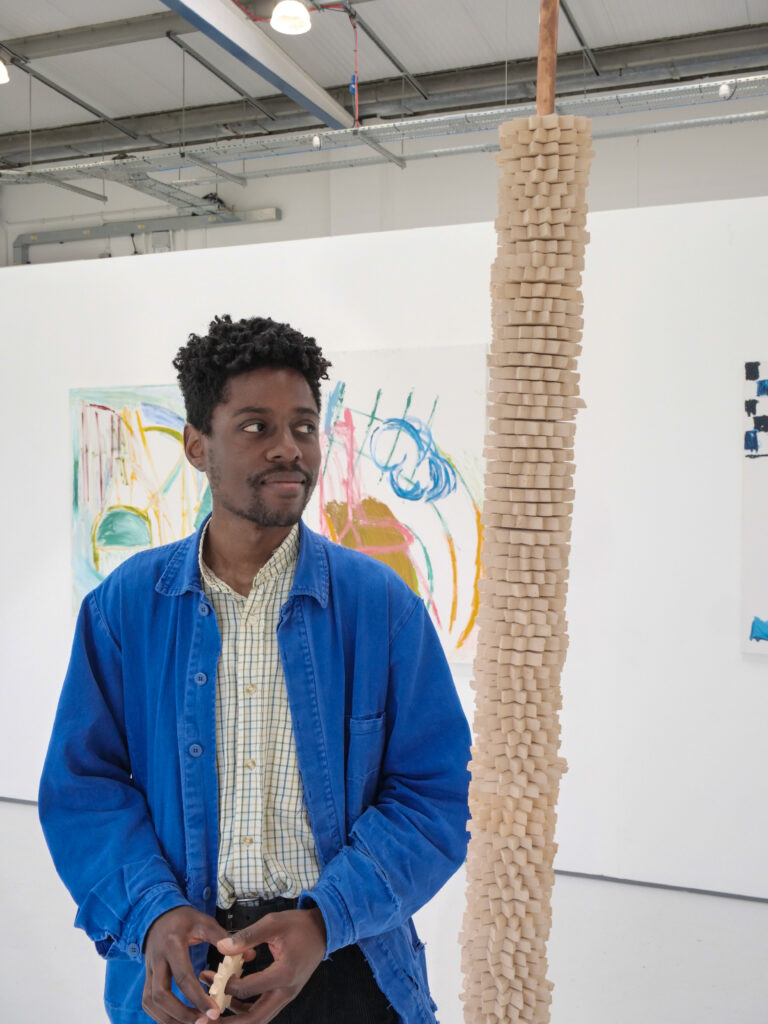
There’s a well-worn trope in the Art world that tells us that Picasso spent most of his adult life trying to free himself from the tips and tricks that had enabled him to draw like Raphael in his formative mid-teens. Despite, nay because of not having received any formal art training, Babalola Yusuf’s work is infused with a profound authenticity and vibrancy that arguably would have otherwise been absent had he been formally inducted into the world of Art. We meet in an empty dimly lit subterranean bar late one afternoon and I am immediately struck by Yusuf’s quiet intensity. I had already visited an exhibition of his recent work at the Flatland Projects gallery space in Bexhill-on-Sea and was intrigued to hear what motivates him to make Art.
Whilst studying building surveying in Bristol, Yusuf shared a flat with a Fine Art student and began to learn about and appreciate the arts vicariously through this experience. Yusuf moved to Hastings in 2018 from Tunbridge Wells. “Being an artist provides a distinct way of seeing the world” he tells me. Citing one moment on an English literature course when he realised the curriculum is fragmented in a way that precludes us from having a holistic and deep understanding of the world around us, he begins to explain how he began to set out on his artistic journey. Yusuf’s teacher was so enthralled by the way he was able to bring elements from his Physics lessons into the context of the study of literature that he began to realise the power of thinking creatively across disciplines. A powerful ‘eureka’ moment; from that day forward Yusuf says he “wanted to see the bigger picture – to appreciate and understand the interconnectivity of the world”.
Yusuf is a busy man. He works as a Youth Worker at a large Hasting high school – a position he holds through his connection with Holy Trinity Hastings church. He is a devout Christian and when describing his spiritual life, it is clear he has gone beyond dogma and is constantly nourished by his faith in a deeply intelligent and pragmatic way. It is powerful when he tells me of how his beliefs support and inform his creative practice. Ever the trans-disciplinarian and without any recourse to proselytising, he convinces me that his work would not be as good as it is without his spiritual endeavour or vice versa. “Art is always future oriented – faith is the conviction of things hoped for and the substance of things not yet seen,” he tells me.
“If an artwork is premeditatedly theorised, then it has already been made and therefore any sense of unexpectedness has been driven out,” Yusuf explains. He goes on to imply that his creative practice helps him to “know what is beyond knowledge”. This almost paradoxical statement gets us closer to the nub of what motivates this humble artist.

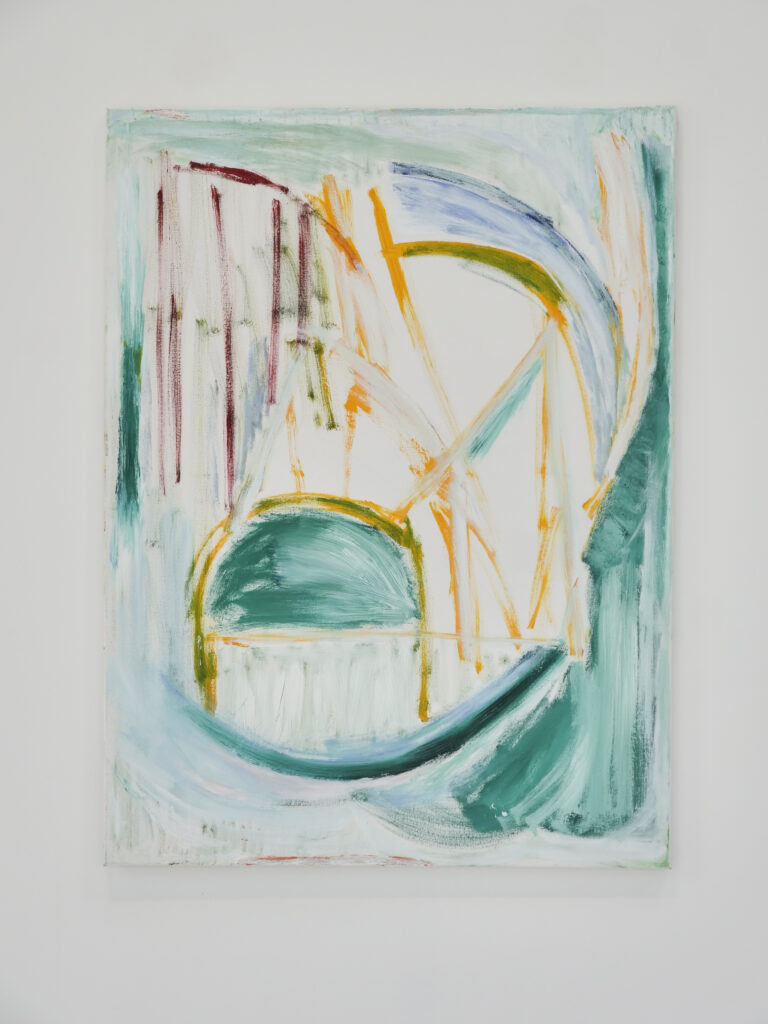
So, what to expect from the exhibition? Well, the paintings are fresh, direct and un-dogged by overthinking. They intuitively connect momentary consciousness with inherited history, archaic doctrines of human knowledge and the endless cycles of nature. Yusuf resists the temptation to work and rework his paintings. He argues that he disallows the ego from getting in the way of a sincere and direct approach. His work comes from a more intangible wordless world that would be sullied by endless revision and over painting. An innate understanding of colour means that he can short circuit rationality and access a world which is beyond fussiness and illustration.
His painting Life is in the Blood (2020) is a meditation on the holy significance Christ’s blood has in Yusuf’s life. The depicted vessel is our conscious, language-bound, self – the ongoing moment that we are biologically forced to inhabit. That said, we can never escape the fact that we are constantly drenched with the bloodline of our ancestors. We float precariously on an endless ocean of infinite divinity. Of this work, Yusuf says: “The boat must submit in some measure to the eternity of the sea.”
Other works portray bowls and pots that are being filled with rainwater. The poetry of the connections and differences between a boat and a bowel gives a Zen koan-like quality to the paintings. Whilst being bound by the present, creating work in the way Yusuf does, helps us to break free from the moment at the same time as reassuring us that we can find our home in that place. Though seated in Heaven we move on the earth is a beautiful fresh painting full of wide gestures and a cool palette. Despite the free brushwork there is a deep sense of stillness due in no little part to its sublime composition.
An exhibition called Stare-case featuring the work of Tommy Camerno is running concurrently with Yusuf’s show in the adjacent space and is well worth a visit. Please take the time to visit in this, its final weekend.
The Quality of Eternity is ((is now)) runs until 7th May. For more information visit flatlandprojects.com
We hope you have enjoyed reading this article. The future of our volunteer led, non-profit publication would be far more secure with the aid of a small donation. You can also support local journalism by becoming a friend of HIP. It only takes a minute and we would be very grateful.

Leave a Reply