
Voices From The East
OLI SPLEEN
Four trailblazers in the realm of klezmer music came together last Sunday at Hastings’ Henry Ward Hall. Two were from Brighton; Merlin Shepherd performed on clarinet and “telenka” (a traditional Romanian wind instrument), and Polina Shepherd – originally from Siberia – displayed her tremendous four-octave vocal range and her skill as a pianist. They were joined onstage by two friends from Berlin, originally from USA and Latvia: Craig Judelman, a fiddler whose influences incorporate American old-time music, and Sasha Lurje, a singer with a range to match Polina’s. Sasha also held down the beat on a poyk (bass drum and cymbal).
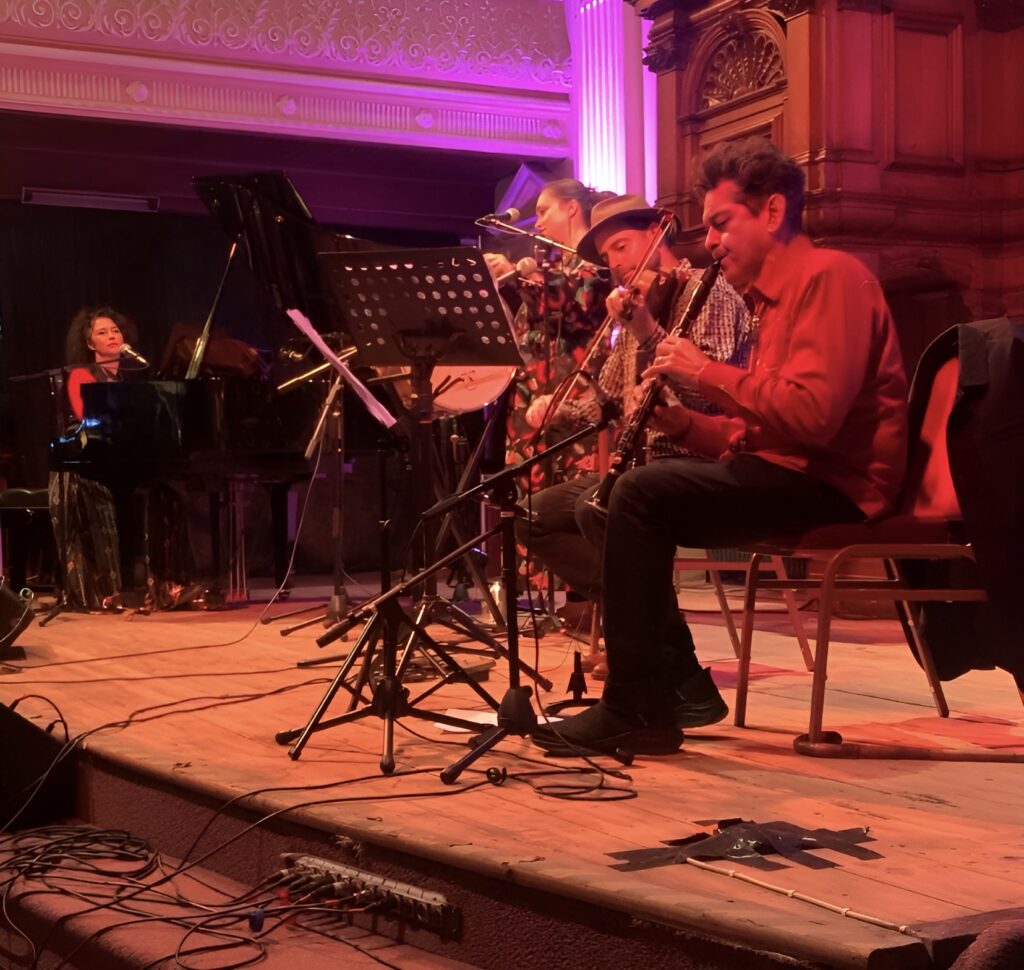
The mesmerising music that we were privileged to see that night was a synthesis of Eastern European influences. The name klezmer derives from a combination of the Hebrew words klei (tools or instruments of) and zemer (melody). Though klezmer is essentially a secular music, it has its roots in the singing of Jewish Orthodox cantors, with the fluid refrain of the violin and clarinet echoing the sigh of the human voice (ani kinor, I am a violin, in the chorus of the Israeli song Jerusalem the Golden, acknowledges that echo). The music evokes the depths and complexity of human emotions; the sorrowful compositions carry a lilt of joy and the joyful ones, the converse. The sound developed among Ashkenazi Jews (of Central and Eastern Europe) where it was popularised as wedding music. In Russia the Yiddish influence fused with the music of the Romani (Romany gypsies): both groups were perceived as outsiders and persecuted by the Russian establishment. Here the music thrived, free from the constraints of musical academies and institutions.
It is hardly surprising that music deriving from people with a history of persecution and hardship should carry feelings of deep sorrow and yearning. That is exactly why this music strikes such a raw emotional chord. To dance and clap along to its refrains is a pure catharsis and a salve for suffering.
There is a noticeable influence of klezmer on American Jazz music – the space that’s given for each musician to experiment and improvise, for instance, as well as the unusual time signatures and tempo shifts. Its influence can be heard in the rising clarinet opening Gershwin’s “Rhapsody in Blue” as well as the stylisations of Artie Shaw and Benny Goodman, and many more since.
Secular though the songs may be, for any listener the experience is spiritually nourishing. I wasn’t the only person in that crowd with tears streaming down my face. “This is a song to end all wars,” Polina intoned at the start of a particularly heart-wrenching composition, and I almost believed, in that moment, that this brilliant music of empathy and unity – a cry of pure emotion that deeply resonates with the commonality of the human condition – could be the force for compassion and healing that is exactly what this divided and troubled world needs.

We hope you have enjoyed reading this article. The future of our volunteer led, non-profit publication would be far more secure with the aid of a small donation. You can also support local journalism by becoming a friend of HIP. It only takes a minute and we would be very grateful.

Leave a Reply