
Seeing the Person, Not the Condition
INGRID ALLAN is a charity caseworker with a background in education, antiquarian books and the aquatics trade, she can often be found on the West Hill, with her dog Bentham

It was a bit of an odd start to the year as new years go. On the one hand, I should have been over the moon, standing in Princes Street Gardens in my hometown of Edinburgh, the Hogmanay fireworks whirring and crackling between the songs of my lifelong favourite band. On the other hand, specifically the right one, at that moment in a brace, 2024 brought many of the same challenges as 2023.
Six months before, I’d been diagnosed with carpal tunnel syndrome, a condition commonly affecting gamers, office workers, archers, and manual labourers (entirely fixable if NHS waiting lists were a little shorter). The brace I’d been given made clapping along to Pulp’s Disco 2000 much less enjoyable (even now it’s slowing my typing speed right down) and has taken some getting used to.
Wrist braces and compression gloves are like any disability aid in the 21st century; form isn’t just secondary to function, it’s more on par with function leaping into a fast car leaving form to shrink to a dot in the rearview mirror.
Yet, for many of us who live with a disability or chronic condition, these devices are a necessary part of day-to-day existence. After noting that I was avoiding large sections of my wardrobe because of my hand, a physiotherapist suggested giving button hooks a try. Unfortunately, looking like the mutant offspring of a bicycle handlebar and a needle-threader, the button hook almost always ended up abandoned in a drawer.
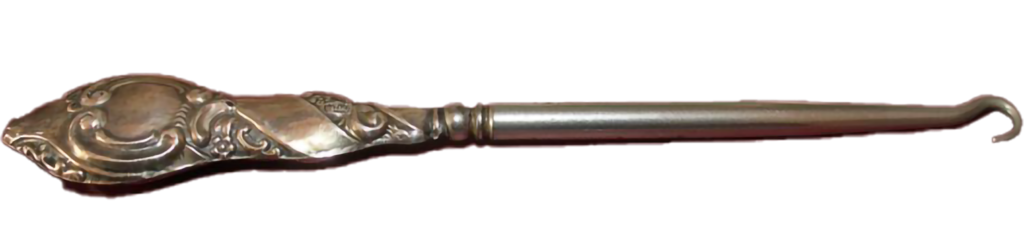
Like many adaptive devices, it carried that same air of no-nonsense functionality which can be profoundly othering. No matter how much thought, empathy and kindness has gone into creating a piece of equipment to make people’s lives easier, it never seems to merit the same level of visual appeal given to all the other stuff we fill our lives with.

Following the recent controversy over disabled children having their aids removed for school pictures, we should recognise we can never, and should never, try to live in a world without adaptive devices. They don’t just help us perform tasks, they allow us to be seen and acknowledged. Having experienced joint problems and coordination difficulties my entire life as a result of my dyspraxia, I was pleasantly surprised when, upon spotting my wrist brace, people began holding doors for me, or offering to lift my bag out of luggage compartments. Even the ubiquitous sunflower lanyards cannot make an ‘invisible’ disability visible the way a physical aid can.
The onus, though, to adapt the adaptations until they feel like something that we, as individuals, rather than a set of symptoms on a form, can comfortably live with, feels like yet another burden placed on disabled people. Sometimes the process can be a joyful one. It’s amazing how much less of a major lifestyle change becoming a wheelchair user can be when it’s got a cheerful paint job and a basket for your dog to ride in, and customising a standard-issue hospital cane with stick-on jewels is surprisingly therapeutic. Some aids, however, test even those with strong imaginations.
Had we never moved to Hastings, the button hook might still be gathering dust in a drawer somewhere, I might still be wearing t-shirts to work, and the whole thing may have been forgotten, but, one ordinary Saturday, a happy accident gave me a whole new perspective.
I spend a disproportionate amount of my weekends perusing the second-hand shops of Hastings Old Town. My inner magpie isn’t just drawn to the glimmer of an unexpected bargain, the objects always seem particularly good for researching the social history of the area. If something makes its way into my home, I want to know where it came from, who made it, who owned it, and why it fell out of use.
Recently I found myself in Courthouse Antiques. While I’m not a regular, the shop manages to strike that perfect balance whereby you can rummage around for hidden treasure, without fearing a teetering stack of something breakable is about to fall on you. And there, in an elegant cabinet of curiosities beside the tills, was an object I instinctively recognised without having ever seen one before: a Victorian button hook.
It was a typical design of its age, stainless steel, with an ornate, silver-plated handle, but it was by far the most beautiful piece of adaptive equipment I had ever laid eyes on. Being no more expensive than the lump of plastic taking up space in my cutlery drawer, I quickly handed over the money, took it home, and spent a while diving down research rabbit holes which led me to the Button Hook Society website.
The Victorians were not particularly famed for their progressive attitudes to disability. Those who were physically impaired were usually denied access to mainstream education, and the likes of Malthus were countering Dickens’ attempts to create sympathy for children left deformed by rickets, by imposing a kind of twisted Darwinism on the working poor (ironic since Darwin’s theories hadn’t been fully accepted by the scientific community at this point).
They were, however, obsessed with putting buttons on everything, since zips hadn’t been invented yet, and buckles were impractical for smaller fastenings. So, in one of those great leaps forward benefitting both the able-bodied and the disabled (see also: word-processing software, emojis, etc.) button hooks became a staple of nearly every household.
They were so commonplace that manufacturers even began making commemorative ones as a form of free advertising. It didn’t matter if you were old and arthritic with trembling hands, or simply too busy to spend hours fiddling with the long string of buttons on your work-boots. These tools were for everyone, and there was no social stigma attached to using them.
No bright-eyed young designer enters the product world aspiring to make ugly things. A love of Victoriana will always be an acquired taste. Yet we need only look at an elegant hardwood commode from a hundred years ago, vs one of those plastic-and-aluminium jobs common in nursing homes, to see the issue at its starkest.
Why shouldn’t adaptive devices and disability aids be useful and beautiful? Why shouldn’t we grant those for whom such things are a necessity the dignity and choice afforded to every other person in a consumer society? Many disabled people are used to forking out eye-watering sums of their own money or hard-won grant funding. Many might choose to pay a small amount extra for a less one-size-fits-all approach.
And, trivial or not, why shouldn’t the carpal tunnel sufferers among us who happen to have a taste for 19th century anachronisms be able to buy an elegant lace wrist brace to go with our ornate silver button hooks? Weirder things have turned up in the treasure troves of Hastings Old Town.
We hope you have enjoyed reading this article. The future of our volunteer led, non-profit publication would be far more secure with the aid of a small donation. You can also support local journalism by becoming a friend of HIP. It only takes a minute and we would be very grateful.

Leave a Reply