
Helena Wojtczak and the Women Sussex Forgot
If you browse the local history sections of any local bookshop, you will inevitably stumble across the name Helena Wojtczak. A recently-elected Fellow of the Royal Historical Society, Helena has spent over twenty years acting as a historical detective. Her work is a deliberate act of restoration: dragging lives out of obscurity, exposing the truths of their existence, and honouring the women of Sussex who were, for generations, suppressed or ignored by the historical record.
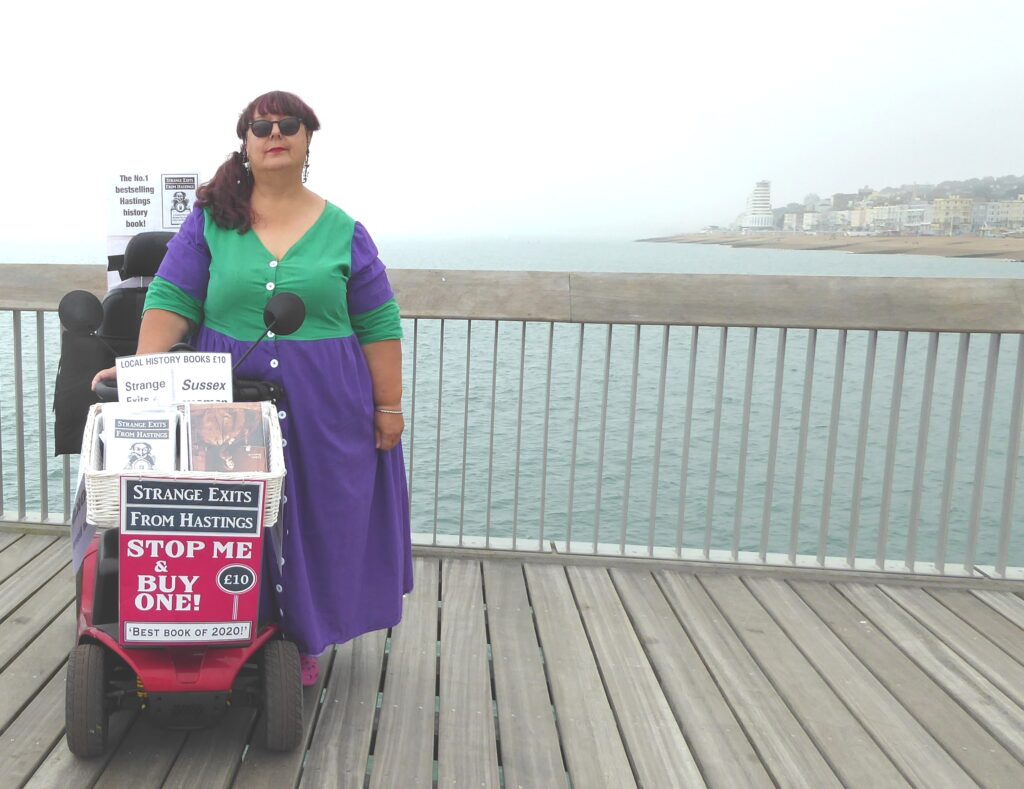
Through her research and her independent imprint, The Hastings Press, Helena has reconstructed the social fabric of Victorian Hastings and Sussex, placing women back into written history, from which they are all too often excluded. One hallmark of Helena’s work is her meticulous research; another is the sheer density of detail. All of her books make extensive use of primary sources – photographs, cartoons, old maps, and news reports – and her writing remains accessible to everyone, avoiding academic jargon in favour of clear, engaging storytelling.
Helena’s journey into our local past began in 2002 with her first two books: Women of Victorian Hastings and Notable Women of Victorian Hastings. While these titles are now out of print, the contents were incorporated into her subsequent, more expansive volumes: Women of Victorian Sussex and Notable Sussex Women. The latter is a monumental resource – a biographical dictionary featuring 580 women, 55 of whom lived in the Hastings area.
MOVING BEYOND THE ‘ANGEL IN THE HOUSE’
One of the most refreshing aspects of Helena’s work is how it dismantles the myth that Victorian women were all either unwaged housewives or downtrodden domestic servants. By digging through census data, street directories and newspaper archives, she has identified over 180 different occupations held by women. Her books expose the ‘Hawkers and Harlots’ alongside the ‘Artistes and Artisans,’ giving us a version of Hastings grounded in reality rather than sanitised nostalgia.
LADIES OF THE RAILS
While her Sussex work is her primary focus for local readers, Helena’s expertise has also encompassed national industrial and trade union history. Her ground-breaking, award-winning 2005 book Railwaywomen remains the definitive account of female railway employees. It encompasses every role from 1830s station mistresses and level crossing keepers to the pioneer guards and drivers of the 1970s. Helena writes not only as a historian but from first-hand experience: in 1977, she made history herself as the first woman to be employed by British Rail as a guard.
THE MACABRE SIDE OF LIFE
Helena has also turned her eye to the darker and stranger corners of Hastings history. Her 2012 book Jack the Ripper at Last? details the life of George Chapman, a notorious triple-poisoner who once lived and worked in the Old Town. Meanwhile, her best-selling two-volume series Strange Exits from Hastings provides a collection of unusual deaths gleaned from coroners’ inquests and news reports between 1740 and 1958. These accounts serve as an ‘accidental’ social history, revealing the everyday dangers our ancestors faced.

‘SLASHER MARY’ AND THE HASTINGS CONNECTION
Helena’s latest book reveals the hidden life of Mary Raleigh Richardson: The Suffragette Arsonist who Slashed the Rokeby Venus. Although Mary was based in London during her militant suffragette days, Helena found a fascinating local postscript: in later life, Mary chose to reside in Hastings, living quietly in a modest bedsit in St James’s Road until her death. This discovery prompted Helena to research and write the first book-length biography of the notorious woman known to the tabloid press as ‘Slasher Mary’.
HASTINGS AND THE FIGHT FOR THE VOTE
Helena is currently writing up her definitive research into the contribution Hastings residents made to the 50-year campaign for women’s suffrage. It is a story that starts with genteel drawing-room meetings in the 1870s and leads to riots in the streets and the 1913 destruction of Levetleigh, the most beautiful and expensive mansion in St Leonards, once the home of local MP Arthur du Cros, who opposed votes for women. By documenting these events, Helena ensures that the radical spirit of Hastings is never forgotten.
More information on Helena as well as her books can be found on her website: hastingspress.co.uk
We hope you have enjoyed reading this article. The future of our volunteer led, non-profit publication would be far more secure with the aid of a small donation. You can also support local journalism by becoming a friend of HIP. It only takes a minute and we would be very grateful.

Leave a Reply