
Rolling Thunder
GARETH STEVENS explores the power and ritual of community drumming and the historical tradition of taking it to the streets.
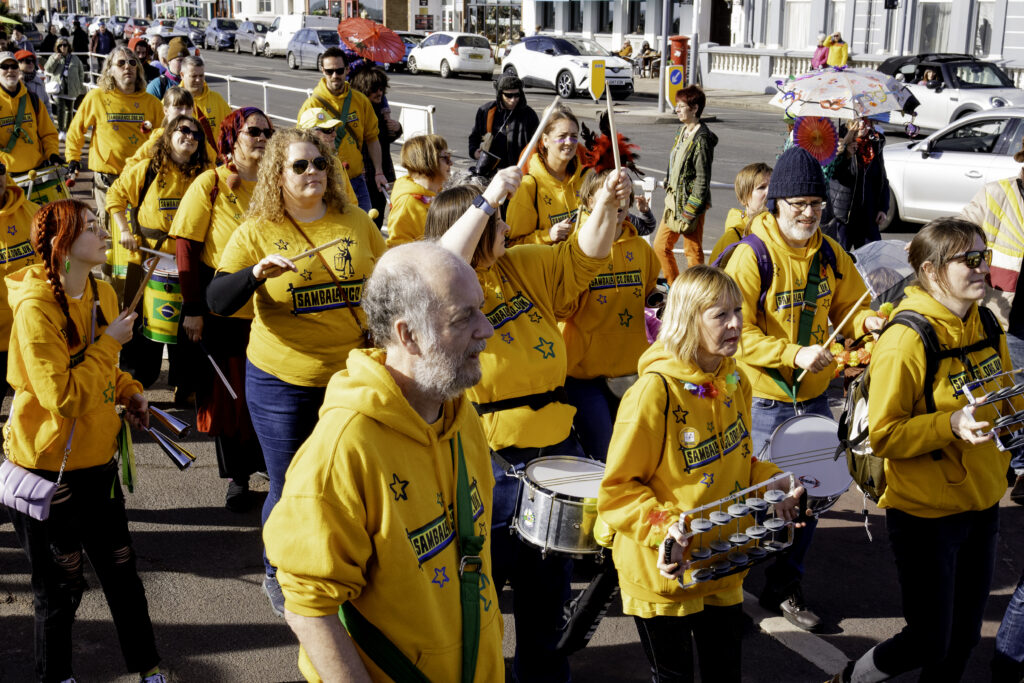
Organising an outdoor carnival parade on a Sunday in mid-February along the seafront in Hastings may appear to some like a brave move. This year, however, it seemed like a piece of genius scheduling. The sky was blue, the air still and the sun “warm”. As the parade began the first of several community samba bands began to play in the distance by Azur. Pat Power – more from him later – and I began to hear the inimitable sound of the surdos; those large Brazilian bass drums that, pitched differently, provide an almost bassline foundation for the rest of the ensemble’s instrumentation. It’s a thrilling sound. If you stand still and allow the parade to pass you the surdos will move air around in a way that an indoor PA can never do. The visceral vibrations seem to have only one intention – to rearrange your internal organs. And so an approaching samba band can sound like rolling thunder – an approaching storm.
This year’s Umbrella Parade was the key community participation event of the Fat Tuesday festival. As some will already know, Fat Tuesday is a direct English translation of the term Mardi Gras. More than that our homegrown music carnival lines up date-wise with New Orleans Mardi Gras and the Rio Carnival in Brazil. Both of these and other carnivals worldwide have roots in christian traditions and have undisputed religious significance. Having said that, there is persuasive evidence that the whole christian calendar was superimposed on top of a pre-existing non-christian schedule of festivities.
Fat Tuesday is a celebratory carnival that leads up to the beginning of the period of fasting and penitence that we now know as Lent. It gets its name from the practice of consuming foods that would be forbidden during Lent, leading up to the beginning of the fast on Ash Wednesday. However, it developed out of pagan spring and fertility rites dating back to prehistory.
In a similar way, whilst carnival has its origins in European culture in mediaeval times and the rise of the Roman Catholic church, the last few hundreds of years has seen its form being conflated with African musical forms. Whilst it has always been inclusive, at its core it has become an outpouring, a celebration of community unity in poor neighbourhoods. A benign show of power and resilience in the face of adversity.

For the people, from the people
As Hastings’ very own parade reached the White rock Theatre the YYPPFDs (Yeah Yeah Party Party Freedom Drummers), a percussion troupe led by Julian Humphries, greeted us with a thunderous set of live percussion. I spoke with Julian and asked him how he came to spend most of his adult life as a community drumming organiser and music educator.

“About thirty years ago I was busking and someone came up and asked me if I would take my drums to their youth club. That’s where it all started. Ever since then I have taught in schools, led drumming workshops and formed percussion bands.” He still works with students with special educational needs one day a week and has in the past been employed by East Sussex Musical Services teaching drums for five years. Julian has been Involved every year in Fat Tuesday since its inception.
The YYPPDs were named after Julian saw the slogan during the Freedom To Party campaign when raves were being shut down in the 1990s.
“In 2016 I found myself with enough time and funds to visit Brazil. I had been teaching Samba and community drumming for so many years and had visited West Africa and India, so it was just insane that I had never been anywhere in South America to experience Samba in its true form and in the very communities that gave rise to it.”
“I spent three months in Brazil and took lessons every day, Monday to Friday.” he tells me. “One thing led to another and eventually I was welcomed to play with one of the oldest Bloco Afros called Cortejo Afro. I then went on to play in several carnival parades with them.”
“I remember when the pandemic struck, I thought how are the people in Salvador going to survive? Carnival is so much a part of their lives. It drives their economy, their sense of cultural identity and spirituality. The whole of the Brazilian summer is one festival after another and it is hard to imagine how it could exist in a state of lockdown”.
Julian stresses that, whilst the YYPPDs take their inspiration from traditional Brazilian music, he makes no claim that their sound is one hundred percent authentic. Rather they respectively honour its tradition whilst fusing it with other musical traditions developed outside of South America.
“The driving force behind my musical work in the community is that fact that it is folk music in the sense that it is for the people, from the people.” Julian goes on, “It is an incredibly powerful thing for the people playing the music. Irrespective of musical ability you get to be part of something bigger than yourself and in this music the whole is much bigger than the sum of the parts.” In that sense Julian argues that his music is a metaphor for collective effort and unity within communities.
Carnival Collective
Pat Power formed the now legendary Brighton-based Carnival Collective and now leads another big community percussion band called Barulho. He lives in Hastings and joined me for the Umbrella Parade. Like Julian he is inspired by rhythms from all over the world and the spirit of carnival. It is fair to say that in the 90s he was an innovator – he was one of the first to splice samba with Hip Hop and Drum and Bass. One of the highlights from CC’s early set was a samba-inflected version of ‘Witness’ by Roots Manuva. Played by over 30 people very loudly, it was overwhelming to hear.
Pat tells me that he has always been drawn to music that mixes two essential ingredients – play and participation. “We have been accustomed to just sitting back and consuming music and I wanted Carnival Collective to break that down”. Whilst he says that getting into CC was not just open access, “as long as you were good enough, nice enough and keen enough you were in. This has remained my admissions mantra with all my community bands over the years.”
On the meaning of carnival Pat says “Humans have always been hard wired for ritual; they have a collective need for ceremony. Whilst the demise of organised religion and the loss of collective worship have left a gap, our need to come together and celebrate is still there.” More than that he says that “Carnival is a pressure release and there is an inverse correlation between the levels of poverty and adversity in a culture and the intensity and joy of their carnival.”
Pat laments the fact that many carnivals worldwide have become manicured and corporatised. “To some extent sound system culture is replacing live community music. There have been attempts to take Notting Hill carnival off the streets,” he says, “to ring fence it and charge tickets. Even now its music has to shut down at 6pm. This is antithetical to the spirit of carnival.”
To sum up Julian explains “Every time a community drumming band plays, it is an act of defiance and an expression of free will. When we go out into the street and unashamedly come together and make noise we are in some way taking back control of our culture and community.” It seems to me that this just about sums up what Fat Tuesday is about.
Our caps should also be doffed to the wonderful Sambalanco and Dendé Nation who also performed at the parade and on the White Rock stage. The fact that our small hamlet has spawned three sizable samba troupes shows that the spirit of carnival runs deep in the Hastings psyche.
We hope you have enjoyed reading this article. The future of our volunteer led, non-profit publication would be far more secure with the aid of a small donation. You can also support local journalism by becoming a friend of HIP. It only takes a minute and we would be very grateful.

Leave a Reply