
POLE POSITIONS APPROVED
5G Masts Getting the Nod From Council Planners
HUGH SULLIVAN
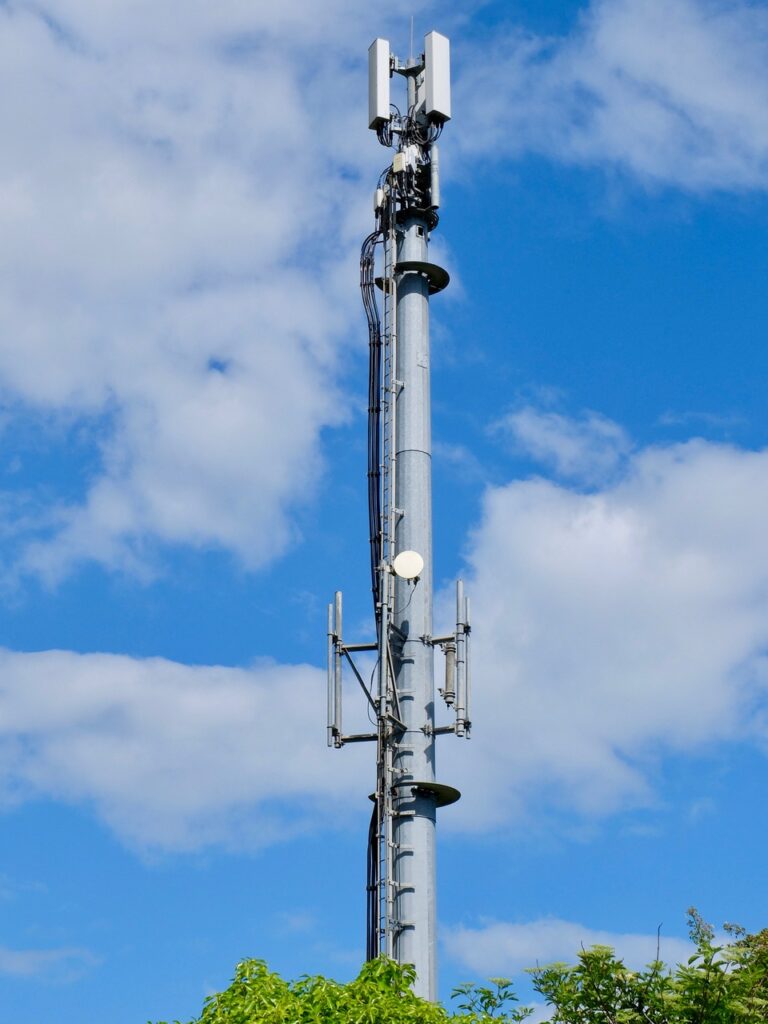
Halton mast
Seven separate planning applications have been approved by Hastings Borough Council (HBC) over the past 13 months for the erection of 5G masts at locations across the borough. Each will be between 15 and 20 metres high. Two more, both at 15-metre height, are awaiting consideration as the mobile phone industry seeks to equip the roll-out of its latest technology.
However, permissions to site free-standing BT ‘street hubs’, incorporating ultrafast Wi-Fi and small cell 4G/5G capabilities with illuminated advertising screens on each side, were refused earlier this year at three central locations – Robertson Street, Wellington Place and Queens Road
Proponents of 5G claim that the technology will provide game-changing benefits: exponentially faster download speeds, reduced congestion and lower latency (the delay in transfer of data following an instruction). It will also be possible to have many more devices working reliably, securely and uninterrupted in the same area. Consumers will gain enhanced capacity for mobile streaming and virtual reality gaming; it will enable large-scale factory automation, video surveillance, driverless cars, and more.
Opponents argue that 5G is unnecessary, and allege that it threatens significant health risks from overexposure to electromagnetic fields, including for the large proportion of people who have metal in their bodies – from surgical plates to cervical coils, and from dental implants to body piercings. The guidelines on limiting exposure issued by the International Commission on Non-Ionizing Radiation Protection (ICNIRP) don’t, they say, take this factor into account.
Paragraph 115 of The National Planning Policy Framework (NPPF) states that councils should aim to keep the number of telecommunications installations to a minimum consistent with the efficient operation of the network and that existing masts, buildings and other structures should be used unless the need for a new site has been justified.
However, paragraph 114 of the NPPF advises that planning decisions ”should support the expansion of electronic communications networks”, and paragraph 118 states that local planning authorities must determine applications on planning grounds only. “They should not seek to prevent competition between different operators, question the need of an electronic communications system, or set out health safeguards different from the International Commission guidelines for public exposure.” All that an applicant has to do is to submit a pack of supporting information which includes a declaration of conformity with these guidelines.
Thus the planners are in effect limited to assessing the siting and appearance of proposed installations on the character and appearance of the area and on the use of an open space, then weighing any adverse effects against what it describes universally as “the social and economic benefits” provided by improved coverage and capacity for the local community.
Where a mast, even one much shorter in height and less obtrusive, has been in place for some years, applications have generally been granted. At Crowhurst Road, for instance, a 9-metre mast and cabinets had been in place for about 20 years on the grass verge outside Latch Cottages between the highway and the pavement. An 18-metre replacement was duly approved.
By contrast, the proposed installation of a freestanding BT Street Hub at Wellington Place was rejected by HBC Planning Service Manager Eleanor Evans as being “incongruous with the surroundings and harmful to the visual amenity of the surrounding streetscape”. It would also “harm the historic setting of Hastings Town Centre Conservation Area”.
Under current consideration are applications for 15-metre poles at Warrior Square Gardens (near the Queen Victoria statue) and on Battle Road (outside Wychnor Cottage).
Permission for an 18-metre pole in a similar position at Warrior Square was turned down last year, and it’s difficult to see why the reduction of three metres should persuade HBC to reverse its view. A formal objection lodged by local resident Liz Bygrave, who has been attempting to co-ordinate opposition to the 5G roll-out across multiple locations, points out that the Hastings Planning Strategy EN1 document places “a presumption in favour of the conservation of heritage assets and their settings”.

The mast sought for Battle Road seems more likely to be approved, though there is already approval for another only 200 metres away on the roundabout outside Bannatynes.
HBC planners have expressed a belief that the local population will gradually absorb the scenic changes. As they comment in relation to another application: “By their very nature, to be effective, masts are required to be taller than the surrounding structures (buildings and trees). Telecom masts are essential infrastructure within the street scene and have become established features in the UK built environment, much in the same way as pylons and wind turbines have become established landscape features.“
We hope you have enjoyed reading this article. The future of our volunteer led, non-profit publication would be far more secure with the aid of a small donation. You can also support local journalism by becoming a friend of HIP. It only takes a minute and we would be very grateful.

Leave a Reply