
Sewage Leak: Pump Up the Volume
PAUL McLAUGHLIN
The Pumphouse in Alexandra Park was packed last week (14 July) for a meeting to discuss the recent sewage pollution of the Old Roar Gill. There was a strong turn-out too from Hastings Borough councillors: six from Labour and three Greens were in attendance.
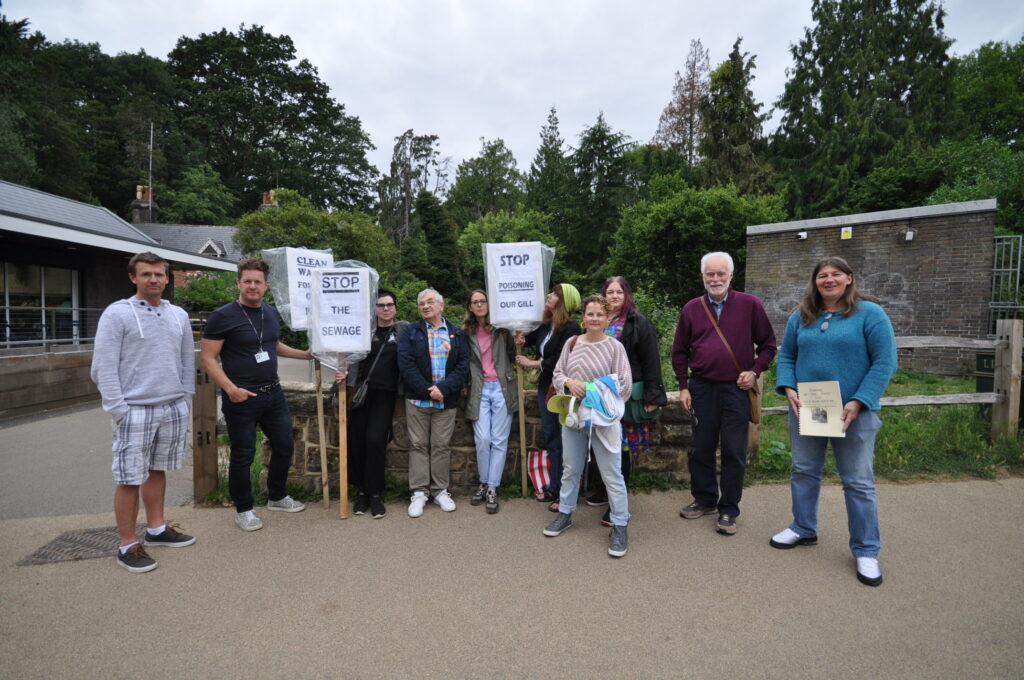
Pumphouse meeting
Myriam Lengliné from the local activist group, Sewage Contamination in Alexandra Park & Old Roar Gill, spoke with passion about the sewage leaks which, she said, had turned the stream that flows into the Buckshole Reservoir into a “giant open sewer”. She claimed that the most recent leaks, which date back to mid-May, had “poisoned wildlife and left pet dogs suffering bouts of vomiting, diarrhoea and seizures.”
There was palpable anger from many of those in attendance at the lack of communication from both Southern Water, who are responsible for the sewage network within the park, and from the council, which owns the park. Both faced stinging criticism for their failure to act in an open and transparent manner in the face of what a number of people described as an “environmental and ecological disaster” with serious health and safety risks to children and animals. There were complaints that there were still no warning signs around the park and woods to warn visitors of the dangers.
Council leader Paul Barnett acknowledged the scale of the sewage leaks. He proposed setting up an on-going group to protect the Gill and called on local residents to join in and help the council to gather detailed information which could then be properly assessed to “discover who did what, when, and how this has impacted local ecology since May.”

Pointing to the number of local councillors present, he said the protection of the Gill was a major priority for the council and added that he and his colleagues “were all determined to hold Southern Water and the Environment Agency to account.”
Damning results
As if right on cue, Becca Horn from the Hastings and St Leonards Clean Water Action Group read out damning results of water samples taken from the Old Roar Gill which appear to contradict information presented by Sue Cobb, Southern Water’s head of Stakeholder Engagement.
In an email dated 11 July, Sue Cobb stated: “Following a report of a possible pollution in the Buckshole Reservoir area, a team attended on site last night. We tested in three different places including two surface water outfalls. A sample was also collected from the downstream watercourse and there were no issues found in any of the samples”.
However, water quality samples taken by the Clean Water Action Group on 12 July and tested at the Envirochem Analytical Laboratories Ltd in Fareham and paid for by local people, found “extremely high levels of E-Coli.” There were 8,800 cfu/100 ml (colony-forming units per 100 ml of water) against a bathing water standard set by the Environment Agency of up to 500 cfu/100 ml.
The Group believes the quantity levels of bacteria were the result of sewage pollution and they have urged the Environment Agency to “undertake a full, independent investigation to determine the source.”
The Environment Agency publish a water quality data archive. The sampling figures for the “East Confluence by Tennis Courts” in the park taken on 29 June 2023 show extremely high levels for E-Coli and intestinal enterococci. There were 6,900 cfu/100 ml against a bathing water standard up to 185 cfu/100 ml. This suggests that there has been a serious discharge or, more likely, an on-going misconnection into the water course which joins through the culvert running under St Helens Road between the junctions at Ashford Road and at Dordrecht Way.

In the wake of these new figures, Cllr Heather Bishop has called for signage to be put up by the council to warn people to keep their dogs away from the water. She has also called on Southern Water to investigate another misconnection in the park.
It will be of interest to Paul Barnett and local residents to know that the detailed water quality information he wants help in gathering is freely available through the DEFRA data services platform on the Environment Agency Water Quality Archive.
To date, Southern Water have still not released any detailed water sampling data.
We hope you have enjoyed reading this article. The future of our volunteer led, non-profit publication would be far more secure with the aid of a small donation. You can also support local journalism by becoming a friend of HIP. It only takes a minute and we would be very grateful.

The EA water qulity archive test results that are available show that high levels of Ecoli and EI have been found over the years at various locations within the park watercourses. The current pollution incidents are just the latest in a long series.
Only the west confluence and east confluence (near the tennis courts) sampling points have been measured consistently over the last 10 years. The west confluence is fed from the streams coming from Old Roar and the Esst confluence from the Ore Valley stream up to Speckled Wood.
The west confluence has 262 samples taken between 2023 and 2010. Around 21% of samples(56 samples out of 262 samples) exceeded the poor bathing quality levels for internal waterways (Ecoli > 900 or EI > 330). 7% (19 samples) exceeded these limits 6 fold. On the 20/06/19 Ecoli was measured at greater than 100,000!
https://environment.data.gov.uk/water-quality/view/sampling-point/SO-E0004914
The East Confluence is far,far worse. 262 samples taken between 2023 and 2010. 95% of the samples exceeded the poor bathing quality levels for internal waterways (Ecoli > 900 or EI > 330). 68% exceeded these limits 6 fold. Ecoli was measured at greater than 100,000 6 times. Peaking at 620,000 on the 12/10/2022.
https://environment.data.gov.uk/water-quality/view/sampling-point/SO-E0004912
St Helens Road Surface Water Outfall had 121 samples taken between 2016 and 2013. Most of the samples exceed the poor bathing quality levels for internal waterways (Ecoli > 900 or EI > 330). Peaking at > 1 million on the 30/06/15 https://environment.data.gov.uk/water-quality/view/sampling-point/SO-E0007093
King Edward Avenue Outfall had 123 samples taken between 2016 and 2013. ALL samples exceed the poor bathing quality levels for internal waterways (Ecoli > 900 or EI > 330). Peaking at 3.1 million for Ecoli on the 30/06/15.