
Surreal Manifesto or What?
Perceptual and Conceptual Hastings artist Ba Kode declares his/her manifesto for a new Art movement: Pre-Post Surrealism
Inspiration can strike when you least expect it. Though perhaps it should come as less of a surprise if it hits you while you are looking at an exhibition of Surrealism at the Tate.
And what, you reasonably ask, was the inspiration in question? Well, it was more a realisation than an inspiration. I realised that the works I had been making for some while were straight out of the Surrealists’ playbook. In short, I might be a Surrealist without ever having known it.
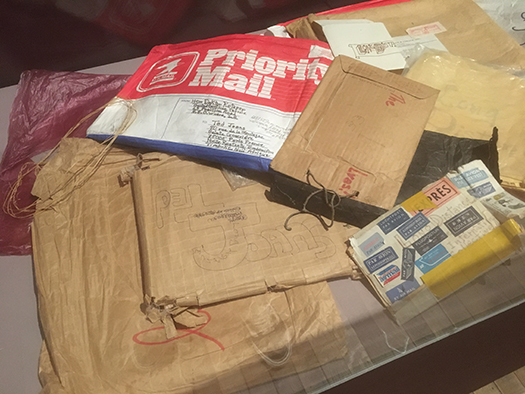

A: Jumble of Old Envelopes? B: Venerable old tools?
Too late to be a part of it
Just how, I will demonstrate in a moment. But initially a couple of problems presented themselves following this bombshell. First was that the surrealist movement started in the 1930s and reached its apogee after the second world war. So, being born in 1953 I was basically too late to be a part of it. Perhaps I could claim that, in my mother’s womb I had, by some osmotic process, imbibed whiffs of its heady essence. Secondly it was clear from the Tate’s exhibition, that to be a Surrealist you had to be part of a local cadre – be it in Buenos Aires, Cairo, Lisbon, Mexico City, Prague, Seoul, or Tokyo. But it seemed that the crucial factor was that, in forming or joining a group of like-minded people you simply had to declare that you were a Surrealist in order to be one. Once your self-identification was made, you would automatically be admitted to the hallowed halls. Just as long as you were working in Paris or Buenos Aires, Cairo, Lisbon, Mexico City, Prague, Seoul, or Tokyo… which I wasn’t, hadn’t been, nor was immediately likely to be. But for heaven’s sake surely Hastings could, and should, join this august list?
And surely the timescale could be adjusted? After all we’ve had pre-Raphaelites coming long after Raphael. And post-impressionists coming after the pre-impressionists or, for that matter, the impressionists themselves (though that being, perhaps, less surprising).
So the answer was clear. Staring me right in the face of a melting Dali clock. I would form the post-Surrealist movement of Hastings. There’s always a certain cachet to being the leader of an art movement and this could only be to my advantage. Except … except I was too late. There is already a post-surrealist movement. It was formed in 1934 (appropriately enough BEFORE the main surrealist movement really took hold) by two Californians who wrote a manifesto explaining their desire to use art to convey the relationship between the perceptual and the conceptual. (You see what I mean. You have to self-declare and be from somewhere in order to be either a Surrealist or a Post-Surrealist).
So there is basically only one thing for it. My Hastings’ movement will have to be Pre-Post Surrealism – albeit coming nearly a hundred years after the start of the movement itself – or of course after the post-movement movement.
To subvert reality
To further burnish my credentials I need only quote from the Tate exhibition:
“Surrealism is not a style – but a state of mind. It aims to subvert reality. To find the uncanny in the everyday. To tap into our unconscious desires and bring dreams to life. And for many artists around the world, it has been a way to challenge authority and imagine a new world.” Excellent. That’s me to a ‘T’. I certainly aim to subvert reality (and generally succeed after the fourth or fifth glass of wine of an evening). I obviously wish to challenge authority (I once refused to pay a parking fine), and I am ever imagining a new world – one without Tories in it.

But, look, I know perfectly well that artists rise of fall not on their manifesto, not the name of the movement they may or may not have created, not on refusing to pay a parking fine or getting sloshed on cheap plonk. No, they are judged on the nature and, frankly, the quality of their work. So I now present you with a simple test. Which of the two accompanying pictures is of a work currently in the Tate, and which is mine?
Is it a) a jumble of old envelopes? b) an assortment of venerable old tools?
Oh, come one! You weren’t really expecting me to give you an answer were you? That wouldn’t be in the playbook at all. But the Hastings Pre-Post Surrealism Movement (HPPSM?) does, surely, need a manifesto. Probably best to check if there have been previous Surrealism movements in Britain and ‘borrow’ from them. A quick Google, and yes there it is, an exhibition at the Dulwich picture gallery a couple of years ago called simply British Surrealism which included works from Leonora Carrington, Francis Bacon, Henry Moore Paul Nash and Graham Sutherland – I move among the masters!
It bursts out in the 1930s
But wait a moment. The curator David Boyd Haycock himself says this wasn’t really a ‘movement’ and wasn’t really new in Britain: “It bursts out in the mid-1930s, but in some ways it’s bursting out of something that’s been here as a latent experience.” Reviewers cited gothic novels like Dracula and writers such as Jonathan Swift and Lewis Carroll as the precursors of British Surrealism. So we have a problem. No British movement and no manifesto.
Back to basics then. Back to France in 1924 and a Surrealist manifesto is written by André Breton and published in a booklet (Editions du Sagittaire). It defines Surrealism as:
Psychic automatism in its pure state, by which one proposes to express—verbally, by means of the written word, or in any other manner – the actual functioning of thought. Dictated by thought, in the absence of any control exercised by reason, exempt from any aesthetic or moral concern.

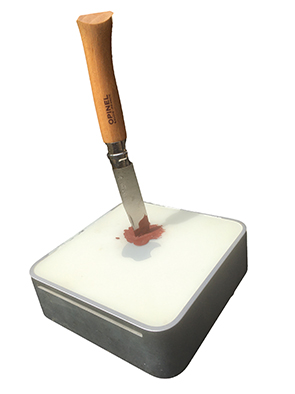
Left: Ba Kode’s Mac Fountain (after, or possibly before, Duchamp); Right: Knife the Mac – Ba Kode’s submission for entry to the HPPSM

The anteriority of Surrealism
Excellent. No one will have the faintest idea of what any of that means so the HPPSM can import it wholesale. But hang on. What is this? Factionalism already? Wikipedia tells us there were actually four Surrealist manifestos. The next two, published in October 1924, were written by Yvan Goll and the leaders of rival Surrealist groups. In response Breton published his second manifesto for the Surrealists in 1929. Hmm. So which to go with? Goll or Breton? Back to Wikipedia: “Though the quarrel over the anteriority of Surrealism concluded with the victory of Breton, the history of surrealism from that moment would remain marked by fractures, resignations, and resounding excommunications, with each surrealist having their own view of the issue and goals, and accepting more or less the definitions laid out by André Breton.”
Nah, this is all getting too complicated. Surrealism surely was a protest movement increasingly concerned about the political situation – in Europe and elsewhere – in the 1920s and 30s. The sort of inchoate concern that is beating in the hearts of most of us today. And the personification of current political surrealism must, surely, be Alexander Boris de Pfeffel Johnson. That’s the answer. I’ll ask him to be president of our HPPSM. After all his premiership has been utterly surreal. And he’ll soon be looking for something new to do. Result!
For honorary membership of the Hastings Pre-Post Surrealism Movement please email your entry submission to
[email protected], enclosing a self-addressed envelope to ensure safe return.
We hope you have enjoyed reading this article. The future of our volunteer led, non-profit publication would be far more secure with the aid of a small donation. You can also support local journalism by becoming a friend of HIP. It only takes a minute and we would be very grateful.

Leave a Reply