
Snails in the Mizzle
Inspired perhaps by Sigourney Weaver’s portrayal of Dian Fossey in Gorillas in the Mist, B.A RIEU offers this amateur study exploring the geotranslocational abilities of the common garden snail, Cornu aspersum, in relation to the dynamics of conflict and coexistence between that species, we humans, and Mrs Thrush
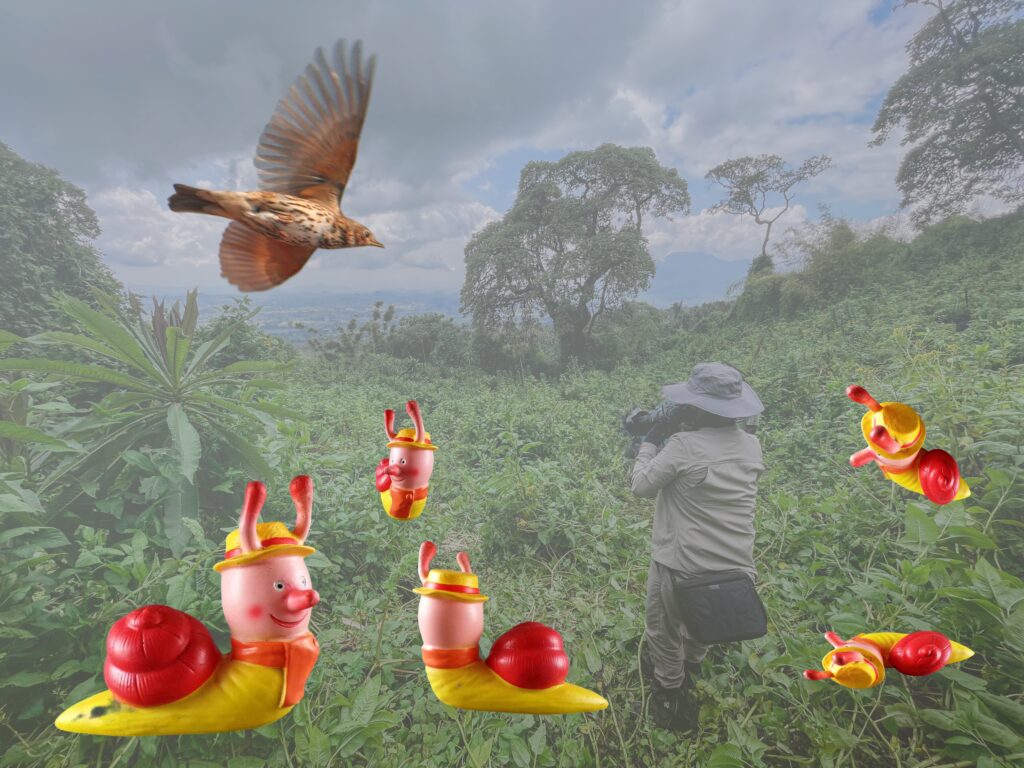
Year: 2024 / Time: Early morning / Location: Sussex Coastal Conservation Area Number 3 Fossey Road, Hastings / Weather: warm breeze, light mizzle.
I discovered that it is possible to reach the snails today by entering their territory on their terms and by gliding towards them very, very, slowly. I’m also learning at a similar pace that it is indeed possible to live alongside an escargatoire in peaceful harmony. It necessitates a modicum of understanding and effort so as not to be perceived as a threat, and an approach that should not trigger the fear of blue pellets, saucers of beer, nor moats of egg shell.
A thorough planning phase lasting weeks, if not years, has led me to this experiment to examine the success of natural relocation on the homing locomotion of Gastropoda. This trial was the first under controlled conditions and will assess movement patterns. If successful, further experiments will be conducted to observe response to different environmental factors. For now, mizzle can be assumed.
The local experts at Number 1 warned me that, without the morning mist, estivation or prolonged torpor would have occurred. This is fortunately not catastrophic and might provide a stay of execution – although whether for snail or the zinnia bedding plant I am as yet uncertain.
They are creatures often disregarded in the grandeur of nature’s spectacle. The snails, that is, not those at Number 1. As I inspected the muddy pots on my morning rounds the back yard was gently rinsed by rain and the unmistakable, yet weirdly imperceptible, sound of muscular feet, moving (if god would still have it) underfoot. Each step is a deliberate dance to avoid disturbing the fragile balance of life beneath my own feet.
And there, I observed, amidst the glistening foliage, or what was left of it, the remains of Madame de Bouchard, and a myriad of snails, their shells adorned with intricate patterns that speak of centuries of evolution – the apexes of which, soon to be forever preserved in dayglo pink.
‘Sheldon’ is identifiable by his over-extended radula as a young male, though snails are of course hermaphroditic. Accustomed as I am to the gender-non-neutrality of the English language I call him ‘he’ despite the clear insufficiency of the pronoun. Few other options seem available. ‘S/he’, as favoured in the feminist press, is inadmissible since the creature is not one or the other, but both he and she – though that description is simply clumsy. ‘His/hers’ similarly fails the test of accuracy. ‘They’ is numerically incorrect since Sheldon is one creature, not two or more, and I may wish later to distinguish between the actions of a single snail and those of many. For these reasons, ‘he’ must remain my preferred pronoun; in the absence of further evidence, I can only hope that it is his also.
Anyway, to return to my observations. As I crouched down to study the rasping tongue of Sheldon on young Salvia, I suddenly spotted the prime patriarch or matriarch – see comments above – Ernest/Ernestina sailing into my peripheral vision.
I marvel at his resilience and adaptability in the face of adversity. Despite his diminutive size, albeit larger than most of his kind, he traverses the terrain with a quiet determination, unmatched by anything other than my own. He is the largest, oldest and most dominant snail in the escargatoire. It seems a shame to paint over his distinctive markings, but the experiment has to take precedence for their own sakes [note numerically correct and gender-neutral use of pronoun here].
Pink, of course, carries cultural baggage as a colour. An association with effeminacy, emasculation and perhaps, even homosexuality. Pride in being pink? I mean to ascribe none of these to Ernest or Ernestina unless the creature self-identifies as such; it was simply that pink was the only nail (shell?) varnish available in my local branch of Boots that was sufficiently distinctive in hue to show up against a background of live or rotting vegetation.
So I sit delicately painting the shells of these unassuming creatures, finding solace in the simplicity of their existence – a reminder that even in the darkest corners of the yard, life flourishes in all its diverse forms. Each snail – there are ten in this first trial – will become a symbol of patience and perseverance, silent companions on my journey of discovery. How long will they take to return? Will they return at all?
Parameters of distance, terrain, availability and quality of available food supply at their place of involuntary exile – all of these factors will play their part in the attempt, or indeed the completion of, the return journey. Motivation too will come into it. So also, perhaps, may the psychology of the individual. Will Sheldon be more sick for home amid the alien nettles than Slinky, Swift or Whorl? Will Tenacious prefer the unfamiliar new diet of tender dandelion to the altogether pricklier foliage of Mme de Bouchard, which has been his birthright and sole mess of pottage up to now? Nor is the journey home without hazard. Turdus philomenus, aka Mrs. Thrush, has her nest, and her nestlings, in the thick laurel hedge that must be traversed ere the exiles return.
As the morning sun breaks through the black elder, casting dappled shadows on the herbaceous border, I bid farewell to my fellow researchers, leaving them to continue their timeless journey, through the air and into the wild, where nature’s chaos reigns unchecked at Number 5. And as I retrace my steps back to the kitchen, no longer needing to employ the well-rehearsed Pas de Deux and, passing by the forever grateful Mme de Bouchard, her buds simpering and whimpering their thanks, the Pod’s memory lingers in my heart: a whispered promise of the beauty that awaits those who dare to break down garden boundaries. Those who are courageous enough to brave the journey to faraway lands (Number 5) and see beyond the blue pellet to embrace the wonders of the natural world, bearing the pink mark of Cain forever upon their housetop as they go.
“Even though I walk through the valley of the shadow of death, I will fear no evil, for you are with me; your rod and your staff, they comfort me.” Until we meet again: Sheldon, Ernestina, Snailbert, Slinky, Swift, Whorl, Tenacious, Resilience, Endurance, Endeavour, Scott, and Oates. Until we are reunited.
We hope you have enjoyed reading this article. The future of our volunteer led, non-profit publication would be far more secure with the aid of a small donation. You can also support local journalism by becoming a friend of HIP. It only takes a minute and we would be very grateful.

Leave a Reply