
Blue Humans
DAVID MILTON takes a well-defined view of Edge at Hastings Contemporary
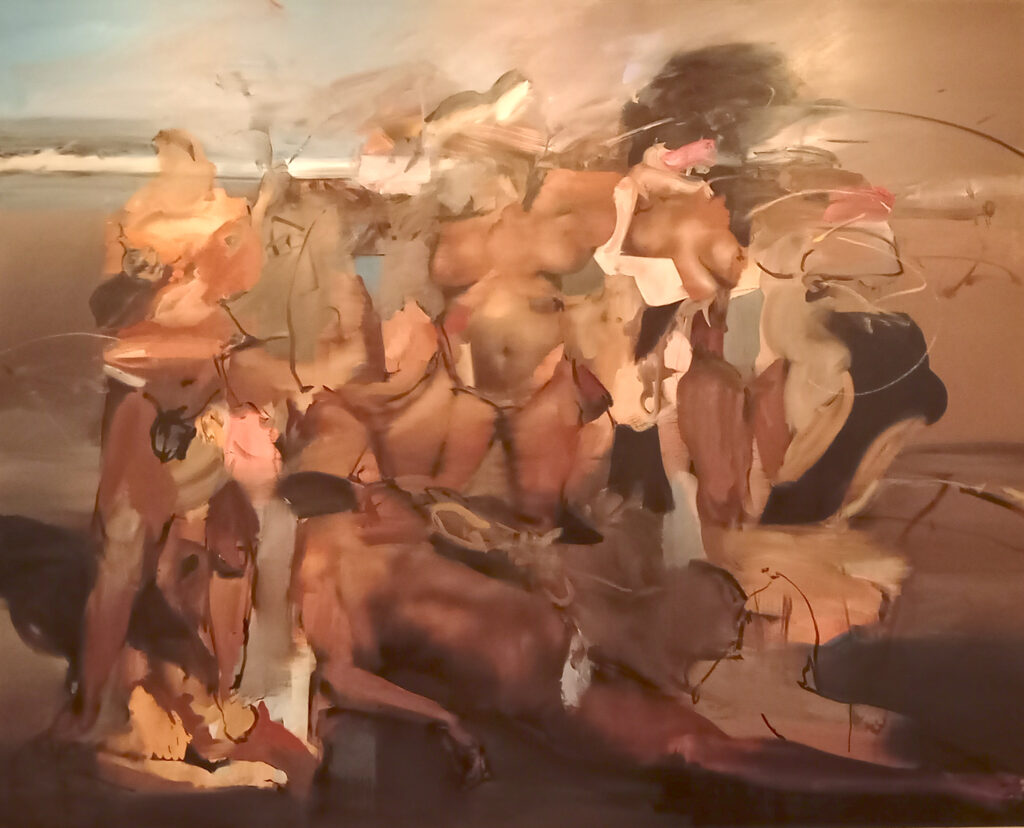
George Rouy, The Witness
Cool college kids chew the fat about it. Ambitious young curators fixate upon it. Gretna-green gatherers and neo-Nazi nativists alike gnash their teeth at the very thought of it – while like angler fish, the rest of us still swim in deep oblivion, blissfully unaware of ‘the blue humanities’.
That’s the term used to describe a heady contemporary theoretical current which draws attention away from green issues towards the blue: to focus on the importance of water – as source of life, as colonial pathway, as hidden depths, real and metaphorical. It embraces such high-end academic ideas as ‘transcorporeality,’ Stacy Alaimo’s notion of the human body as intermeshed with the material world (for instance via the plastic waste we absorb through what we eat); Timothy Morton’s disorienting concepts of ‘dark ecology’ (a probing perspective which approaches environments as ‘either unimaginably deep or having no depth at all’) and ‘hyperobjects’ (things so massively distributed in time and space as to defy clear perception – global warming, for instance); and Karen Barad’s ‘agential realism’ which suggests that independent entities don’t exist in and of themselves so much as come into being – or at least into perception – through ‘intra-action’ (mutual entanglement which typically entails a perceptual bias: culturally and as a species we don’t and can’t sense everything).
Like I said. Heady.
SOIL FOOD

Wolfgang Tillmans, End of Land 1, 2002
These are complex and radical ideas which point us simultaneously towards an understanding of the multiple scales at which we live as well as the instability of our identities in the raging torrents of 21st century data technologies. As ideas they are not necessarily new: think Jackson Pollock or Zootropolis for distortions of scale; Dr Jekyll and Mr Hyde or Gunther von Hagens for transmogrified bodies; the unnoticed arrival of Captain Cook’s ship in Botany Bay or Faulkner’s As I Lay Dying for perceptual partiality. But they are present in the work of a significant strand of forward-looking emerging artists and can also be seen in the rearview mirror where now established creatives vie for a place in what’s left of history.
It’s the latter that feature predominantly in Edge: Where the Land Meets the Sea at Hastings Contemporary till New Year. The exhibition of 40 artists ranges from overlooked late-19th century landscape painter Theodore Roussel through influential inter-war years educator and horticulturalist Cedric Morris to acclaimed present day practitioners including Turner Prize nominees Tanoa Sasraku and Thérèse Oulton and winners Wolfgang Tillmans and Gillian Wearing. It’s co-curated by The Land Gardeners, an evangelical duo with one foot in the art world and another in ‘soil advocacy,’ presenting soil as ‘the foundation for all life’ – although the exhibition suggests the sea could equally lay claim to such a title.
EBBS AND FLOWS
As usual with institutional art shows there’s a payload of legacy landfill and a lot of conservative rot to plough through, here in the form of the dreary daubs of the sexually Stochastic, stylistically stagnant Duncan Grant with his ditchwater dull Dieppe and the garish swirls of the ghastly Maggi Hambling whose Wall of Water XXXII looks like a horse has pissed on a poster for Toilet Duck. The childishness of Susie Hamilton’s soft-boiled Lime Beach is outdone only by Jo Pearl’s winsome ceramics of microscopic ‘mudflat heroes,’ Intertidal, each competing for faux-naïf family friendly approval. Anya Gallaccio’s Days that cannot bring you near comprises a half-arsed Arte Povera installation of clods of local earth. It’s unoriginal and utterly underwhelming. You’d have a more profound contemplative experience cleaning your boots after a wet Sunday walk in the park.
By way of contrast, Wolfgang Tillmans’s End of Land 1 offers a sudden jolt to the senses with its cliff top scene of (politicised) suicidal ideation, while fellow photographer Jem Southam’s Whale Chine diptych looks askance at the vast and existentially forbidding form of a collapsed rock face off the Isle of Wight. The sense of scale here, temporal and physical, and of starkly impactful profundity in the absence of the human figure, is immediately expressive. Whale Chine is a split-second but infinite time piece; a monument and a ruin; a stark statement of the irrelevance of the human race and a meditation on gravity as eloquent as Newton’s apple.
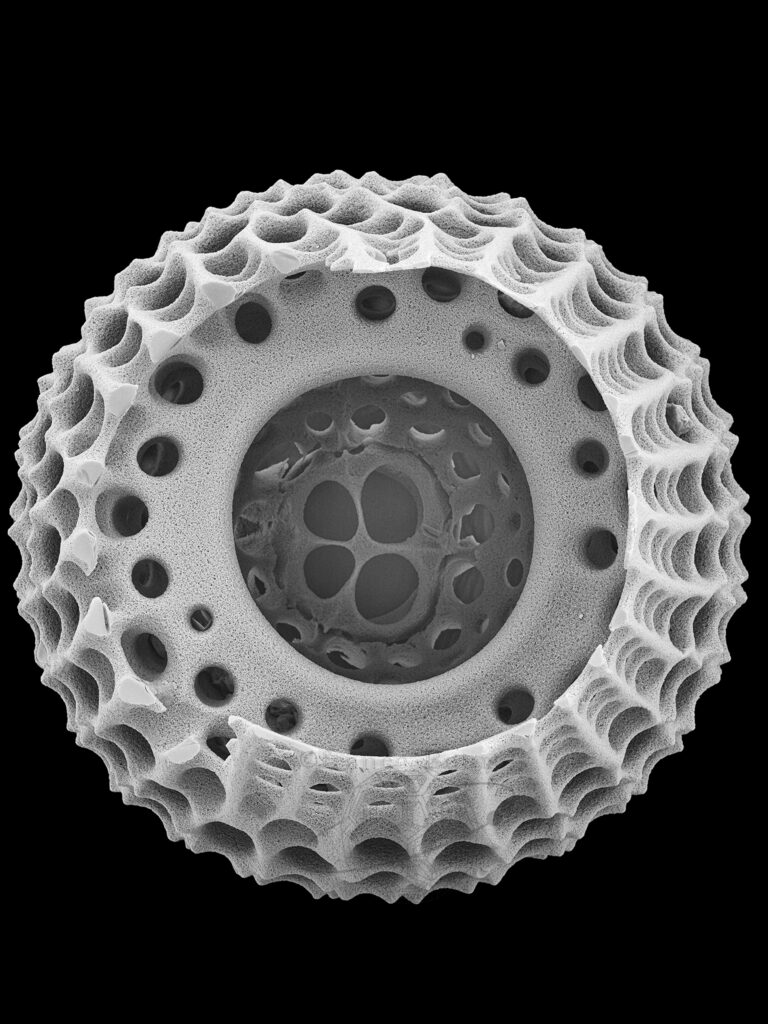
France Bourely Imago Mundi, 2025
At another extreme, self-styled contemplative biologist France Bourély’s skills with the electron microscope inform her forensic snapshots of nanospatial structures invisible to the human eye, subatomic sci-fi matrixes coolly rendered in metallic monochrome. Despite the abundance of material detail it is impossible to tell whether these mind-boggling images are of objects in some sense eternal or whether, like soap bubbles, their existence is over in an instant.
Faversham’s favourite fashionista George Rouy’s assured and vibrant The Witness blasts a lot of the more delicate art right out of the water. Edge’s edgiest work is a deconstructed muscle beach party of dissolute Francis Bacon-stamped bodies bathed in Daliesque sunlight. Its slickly rendered technical accomplishments are those of an artist who eschews clunky YBA conceptualism (here represented by one of Gillian Wearing’s sub-Pennebaker photoshoots) and instead harks back to 20th century modernist masters. With his shiny, glitchy scenes of blissfully Ballardian gym-bunny ballet, Rouy is surely on his way to being established as the enfant terrible of tech bro chic.
In such company some of the big guns go off sadly half-cocked. Land-art legend Andy Goldsworthy’s Rockweed video is an endurance piece, for both artist and audience, as he covers himself in seaweed and takes a lie-down beneath a gentle tide for half an hour or so. Cornelia Parker’s White Cliff Crossings is a slight work by another major artist, using chalk from the cliffs of Dover to obscure a little window. A mere footnote to her earlier Brexit-era Island, it’s a conceptual stretch too far to make this feeble faxed-in filler fit with the exhibition’s epochal aims.
HERE AND NOW

Andy Goldsworthy, Sand brought to an edge. To catch the light and incoming tide
Edge is soaringly ambitious and abounds with provocative ideas. But it’s heritage heavy and implies that there’s an undercurrent we’ve all been missing in the work of the assembled artists, as if they were custodians of some deep hidden lore but were keeping it to themselves out of politeness. That’s curatorial wishful thinking. What’s absent from the show is anything by palpably 21st century artists, by funky Gen Z visionaries whose perspective is physically, psychologically and politically informed by contemporary theory. Who are actually living it and can tell us what they think. None of those who are featured are under the age of 30 and it’s here that Edge starts to feel a little disconnected from here and now.
The exhibition might be brought instantly into the cutting-edge present through the inclusion of the work of, say, Gesiye, whose eerie All That I Touch I Change combines video, tattoo and submersive performance-art in a visceral post-colonial danse macabre that draws on a seemingly bottomless lake of pitch in Trinidad (discovered or at least first exploited by pirate, plunderer, potato-head Sir Walter Raleigh); or the limpid photographs of Alfie Barnes whose What The Tide Might Take presents fluid self-portraits shot in the hyperobjective ocean and whose emblematic Touch Without Contact reconfigures Botticelli’s Birth of Venus as a stoically beatific blue human origin myth.
As the world burns and mad men fight over the ashes, it’s such works, neither hidebound by history nor compromised by the Frieze-adjacent market, that stop the term ‘contemporary’ from becoming a mere aesthetic flag of convenience. A less earnestly reflective, less didactic vision than that articulated by Edge might boldly posit art itself as a hyperobject and take a few more risks with exactly who and what is represented.
Exhibition runs: 26 September 2026 to 3 January 2027, Wednesday to Sunday and Bank Holidays, 11am to 5pm. Hastings Contemporary, Rock-a-Nore Road
We hope you have enjoyed reading this article. The future of our volunteer led, non-profit publication would be far more secure with the aid of a small donation. You can also support local journalism by becoming a friend of HIP. It only takes a minute and we would be very grateful.

Leave a Reply