
HIP BOOK REVIEW: Unashamedly Subjective and Personal
Sheila: Portrait of an Unknown Artist
By Teresa Thornhill
Published by Dornberger books, £14
REVIEW BY FELICITY LAURENCE
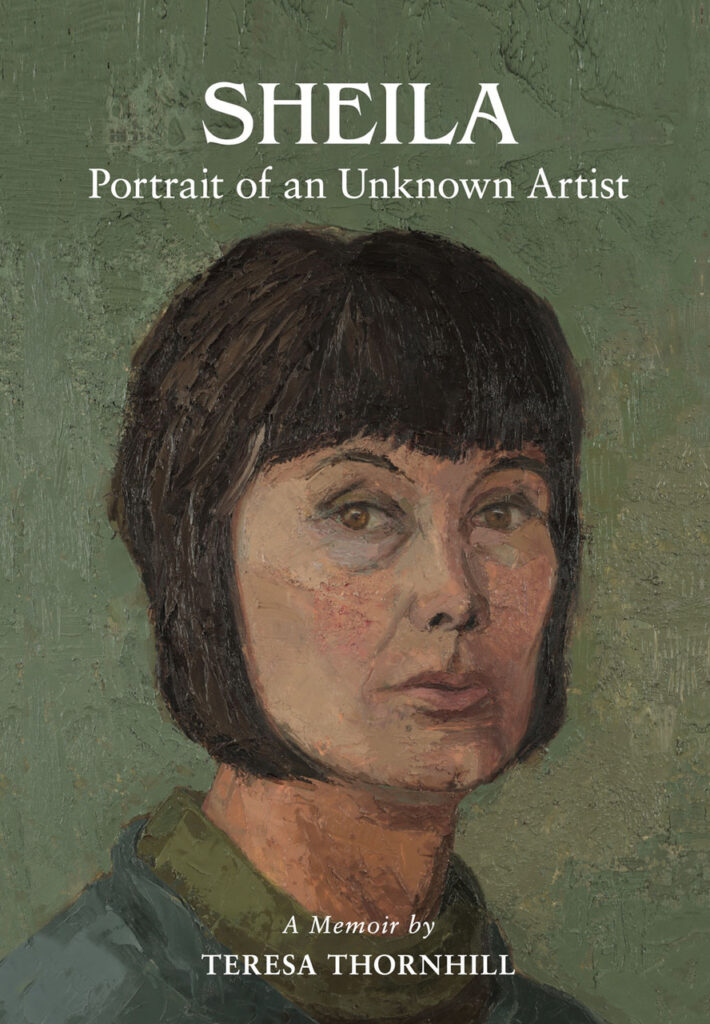
Sheila Denning was a brilliant painter who lived during the twentieth century, from 1920 to 2015. This memoir recounts her life as seen from the perspective of her daughter Teresa Thornhill, and gives accordingly a unique view with points of illumination no one else could have offered. While there will inevitably remain parts of Sheila’s life to which Teresa had then and has now no access, this somehow adds to the appeal of the book – it is unashamedly subjective and personal, as proclaimed in its very title: Sheila: Portrait of an Unknown Artist (through the eyes of her daughter.) It is further enriched by excerpts from Sheila’s autobiographical notes, and from her letters and poems. These in turn give us, in Sheila’s own voice, repeated and eloquent glimpses of how it was for her in real time – the kind of direct testimony that is so compelling to read now. And at the core of the book, threaded throughout, is the collection of colour reproductions of many of Sheila’s paintings, in particular her wonderful portraits. Thornhill, herself a painter, delves into each of the paintings to provide background and to share a way of looking at them. These are undeniably exquisite works of art, so that we can see for ourselves what it was that Sheila had to offer, and through them, that passion that kept her painting in the face of all of the obstacles that Thornhill recounts.
DESTRUCTIVE CRITICISM DELIVERED BY MALE ARTISTS
Like so many women of her generation, and despite her extraordinary talent, Sheila was overlooked in her time. She was caught in the societal mesh that affected the lives of these pre-and post- second world war women – notwithstanding some incipient achievement of rights gained around the time they were born – as they struggled to achieve their rightful place in the world beyond the kitchen and the children of whose nurture they so often ended up as sole providers. Things are a little better now, at least for some women who have been able to push at the boundaries that confined those captive souls before us; and we, their children and grandchildren, can perhaps look back at their lives, and compare them with our own, and ask ourselves, ‘what if?’ – and wonder, ‘if only’.
Sheila studied at Camberwell School of Arts, but found little encouragement there. Although her talent was occasionally and perhaps grudgingly noted, overall the experience was profoundly damaging. As Thornhill notes: “Destructive criticism delivered by male artists in positions of authority was something experienced by many young female painters of Sheila’s generation.” Soon married to the author’s father, she found her life as a painter relegated to the background with his own artistic needs and career taking priority in their lives together. Eventually they separated, and her new situation as a single parent bringing up Thornhill and her sister was not a comfortable position either financially or socially in that period, during those decades immediately after the second world war. Through all this, she continued to paint.
HITHERTO HIDDEN FROM PUBLIC GAZE
A further strand woven throughout the book concerns Thornhill’s relationship with her father, and this adds yet another dimension from which we can understand Sheila’s own life. There are also vivid reminiscences of Sheila’s experiences during the second world war, which again bring to life the reality of living through a time when a beloved brother is killed, and other young men who might otherwise have become life partners also disappear.

Thornhill’s devotion to her mother permeates the book and gives it a singular authenticity, while her commitment to bringing Sheila’s work back into the light at last underpins it throughout. Furthermore, Thornhill’s specific perspective as Sheila’s daughter provides an intense immediacy which will surely resonate with many women who watched their own mothers try to cope with, and tackle, the constraints that prevailed in the post-war period in the 20th century and which so often suppressed or ignored their talents. For myself, Sheila’s story evoked memories of my own mother, also talented and curious and wanting to get right out into the world and in fact make it a better place – but who found herself in the kitchen with a steady stream of progeny for some decades ( I was the first of six, and it was my advent that put a definitive end to her medical training). In this way, the book is multi-layered: a view of an artist and her beautiful works of art hitherto hidden from public gaze: a compelling expression of love for the person who nurtured her daughter from her first moment on this earth and who never gave up on her children: and a story of a childhood and its complex family relationships, which again will resonate with so many of its readers.
This tender account thus touches its reader on many levels. As I put it down, I had two main reactions: on the one hand, the resonating memories of my own mother that were so powerfully evoked, and on the other, a strong desire to see Sheila’s paintings ‘in real’ – perhaps sometime, somewhere, there could be an exhibition of them to accompany this compelling book.
Sheila: Portrait of an Unknown Artist is available at Hastings Contemporary art gallery or through tinyurl.com/Buy-Sheila
We hope you have enjoyed reading this article. The future of our volunteer led, non-profit publication would be far more secure with the aid of a small donation. You can also support local journalism by becoming a friend of HIP. It only takes a minute and we would be very grateful.

Leave a Reply