
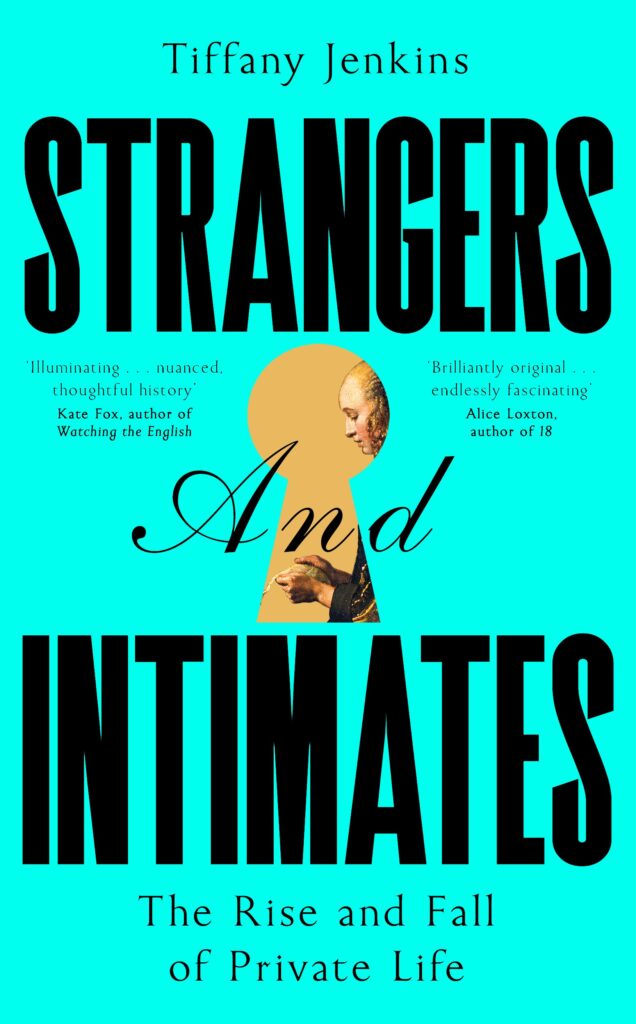
HIP BOOK REVIEW Strangers and Intimates: The Rise & Fall of Private Life
By Tiffany Jenkins
Published May 2025 by Pan Macmillan, hardcover, price £15
REVIEW BY VICTORIA KINGHAM
In 1948, when George Orwell published 1984, he imagined the Thought Police. That is, he imagined a form of surveillance where those whose personal thoughts displeased the Party were hounded out by the State and punished. To Orwell, to his readers then and now, the attempt to suppress everything that did not conform to Party lines, whether merely mentioned, or discussed in public or private places, was the most heinous aspect of despotic control. Big Brother was watching everyone, whether they liked it or not.
STATE CONTROL AND INDIVIDUAL OPINION
Tiffany Jenkins is a historian, writer, journalist, and broadcaster living in Hastings. Her powerful history, Strangers and Intimates, takes us back to the time before Henry VIII and his self-serving declaration of the separation of Church and State. The rule of God was paramount and a man’s individual ‘conscience’ immaterial, if it existed at all. The Monarch was God’s appointed and the Church and the State and the Law and the Individual were all one. There was not a word for ‘private’ until the beginning of the sixteenth century.
It’s a sobering thought: don’t we often concur that as individuals we have formed our own life-rules, our own convictions about what is right and what is wrong? But our right to our own opinions, and a private space where we can do and think what we like, was pretty well unknown, Jenkins points out, even until Victorian times. People “had interior lives. They did retreat for reflection. But against the structures of power, the demands of society and the community, there was no…aspect of life where others could not legitimately intrude.”
In her extensive examination of the distinction, in a final summary chapter, ‘Saving private life’, Tiffany Jenkins argues passionately for society to retain the distinction between the two spheres. “It is important to recognize and accept” states Jenkins, “that we naturally present ourselves differently in public and in private. Both modes of behaviour are authentic: neither is fake.”

The word ‘naturally’ here worries me slightly, since the bulk of the book refers not to nature but to public legislation. Jenkins certainly made me aware, through successive historical chapters, that actually our thoughts are not our own, that the way we imagine events, the rules we live by, our ‘internal’ consciences, are formed through hundreds of years of collective cultural conditioning. Our belief in our right to private lives and opinions has been ingrained, and enshrined in Law, so that, until recently, it was difficult to imagine a life where a citizen’s privacy was not inviolable. Events and technological developments over the last fifty years have, however, affected the boundaries.
THE DESTRUCTION OF OUR OWN INDIVIDUAL RIGHTS?
Jenkins argues, through examination of a succession of public events, that the private sphere is in danger of breaking down. Examining specific historical developments, she works through an early example of a Big-Brother type programme called An American Family, to the Clinton/Lewinsky exposé and its knock-on effects (one wonders whether in the Trump era this would be a cause for celebration rather than presidential resignation), to the very public row between Boris Johnson and Carrie Symonds, Prince Harry’s kiss-and-tell, and the general demand, in the name of transparency, for the publication of the private text messages of public figures.
Massive technological developments like the invention of photography, TV and, subsequently, the internet, have been instrumental in this change. There’s a whole telling section of the book beginning with the vision of Steve Jobs and the launch of the Apple Mac in 1984. “1984,” he announced, “won’t be like 1984.” Now, messaging services like WhatsApp have eroded our assumption of privacy in ways that even Orwell did not imagine. Even sex, a hitherto relatively private act, can now be viewed by millions on any social media, if people bother to look. For Orwell’s book, this would have been more satisfactory to the State than any private act of love between consenting adults. Have we used technology to engineer the destruction of our own individual rights? Time will tell.
We hope you have enjoyed reading this article. The future of our volunteer led, non-profit publication would be far more secure with the aid of a small donation. You can also support local journalism by becoming a friend of HIP. It only takes a minute and we would be very grateful.

Leave a Reply