
HIP BOOK REVIEW: Escape From Germany – Another Side
You Can Go Now…
But Leave the Butter
By Barbara Schultz
The Book Press, £10.99
REVIEW BY VICTORIA KINGHAM
A few weeks ago we previewed Barbara Schultz’s memoir of her mother, who escaped from the GDR in 1953 at the height of the Soviet occupation. The very successful book launch took place at Crown House on 20 June.
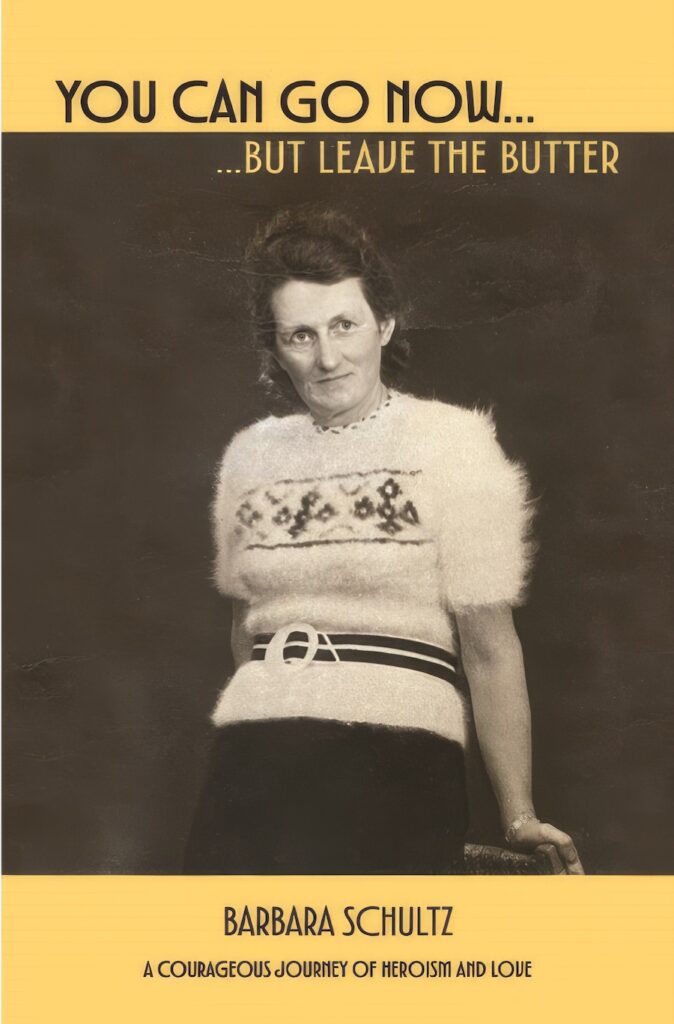
There’s more to be said about it: It functions not only as a personal memoir, but also as an unusual window into the social history of East Germany. Memoirs and fiction, or autobiographical writing, about escape from Germany predominantly foreground the excruciating hardships of Jewish (and subsequently Polish) people managing to evade the Hitler authorities and escape death, leaving for Europe or the Americas. These extraordinary stories indicate resilience, courage, and ingenuity in the face of the alternative – extermination. From Anne Frank through Primo Levi to recent works by Michael Calvin and Naftali Schiff, they rightly document an appalling and unforgettable period of history.
Schultz’s book, however, highlights something perhaps less frequently acknowledged (at least by the Allied victors), the hardship and penury inherent in the lives of fairly ordinary residents of rural East Germany through two world wars, then afterwards in the restrictions set up by the Soviets in the name of Collectivism and enforced by the Stasi (Ministry of State Security). As in the Chinese equivalent, almost anyone in town or village communities could have been recruited or pressganged into secretly spying on their neighbours, resulting in an unimaginable lack of personal freedom.
PLANS FOR ESCAPE
These Machiavellian controls, and the ban on leaving the country, coupled with her (rather late) acknowledgement of the horrors of the Nazi administration and subsequent guilt at membership of the vile party that had once been thought to embody progress (Make Germany Great Again?), caused Schultz’s mother to organise an escape from her small village farming life. Her husband, captured as a POW by the British in 1945, had subsequently made his home here, in Basingstoke. So over two years, after being knocked unconscious and permanently wounded by the butt of a Russian soldier’s gun, her mother (Elzbeth) formed plans to leave the GDR, along with her three children, and join her husband. Her escape, her interrogation and knock-back, only to try again and succeed, are documented in the last few chapters.
An escape from a country where you are effectively a captive is necessarily laced with drama and trauma. But the prose description, in these latter chapters, is no more dramatic than at any other point. By the time Elzbeth actually managed her exit, the action was just one more in a long line of incidents in a life of endurance and rather gruelling subsistence.

PIGS AND POTATOES
There were undoubtedly people in the village who were worse off; her farmer husband Willi had been a paeon of individual enterprise from a young age. Elzbeth brought with her things from her own mother, from her old, relatively bourgeois, life in a small town. She describes good china, ‘good’ clothes, embroidered tablecloths, nice furniture. She has to adapt to pig farming, chicken cleaning, saving pig waste for manure, planting, sowing, reaping, and ensuring through the spring and summer that they will have enough supplies (particularly of potatoes) to last them through freezing winter months. Her children are all recruited to help as they reach ages four or five, and the elder sister Karin appears to have acted as a mother’s help in raising the two youngest, twins Barbie and Bernd. It’s interesting that though the book is written by Barbara, there’s some emphasis on Bernd, who is clearly marked out as his mother’s favourite. Whether this is true or mere authorial licence is impossible to know; it’s apparent from the narrative but documented, by his twin, seemingly without resentment.
Schultz writes predominantly from Elzbeth’s point of view, using source material from her mother’s journal. As her contribution to village life, Elzbeth had brought with her plays written by her father, and produced and staged them with the other occupants for a number of years. These are not further described in Schultz’s memoir but it does tell of the fact that she had friends and family in the village or nearby, to aid her eventual exit. Aside from personal courage and enterprise, the book documents courage, determination, hard winters, and (surprisingly, in the face of everything that needed to be done) an abiding love of the countryside.
We hope you have enjoyed reading this article. The future of our volunteer led, non-profit publication would be far more secure with the aid of a small donation. You can also support local journalism by becoming a friend of HIP. It only takes a minute and we would be very grateful.

Leave a Reply