
Ashford No Longer International
By Mark Sullivan
The legendary headline ‘Fog in the Channel – Continent Cut Off’ has reappeared in a new form. Due to management and financial troubles of the Eurostar rail company, France and Belgium have been cut off from Kent and Sussex by the withdrawal of train services via Ashford.
In a letter sent last week to the Chairman of the House of Commons Transport Committee, Huw Merriman, MP for Bexhill & Battle, Eurostar CEO Jacques Damas admitted that there is no “near-term” prospect of restoring any service to Ashford or Ebbsfleet. He cited a combination of factors: financial losses sustained by the company from the huge reduction in travel during the Covid pandemic; a shortage of train maintenance engineers; and a slowdown in post-Brexit border controls that limits how quickly passengers can be handled. The strange result is that Eurostar cannot now meet demand, and is putting up prices to reduce it. The extra cost of serving Ashford (and Ebbsfleet) does not justify the return in income from the company’s viewpoint when the trains it does manage to run are already full between London and Paris.
The cross-channel train service is not covered by any law that requires stations to be served, and unlike the ordinary railway no closure procedures are required if stations are closed. The ‘international’ part of Ashford International station has in effect been closed, and its trains withdrawn. On any other line in Britain, this would require a long legal process, rights to object, hearings, a report, and a decision by a Transport Minister. There is no such protection for users of Eurostar via Ashford.
Why bother with Ashford?
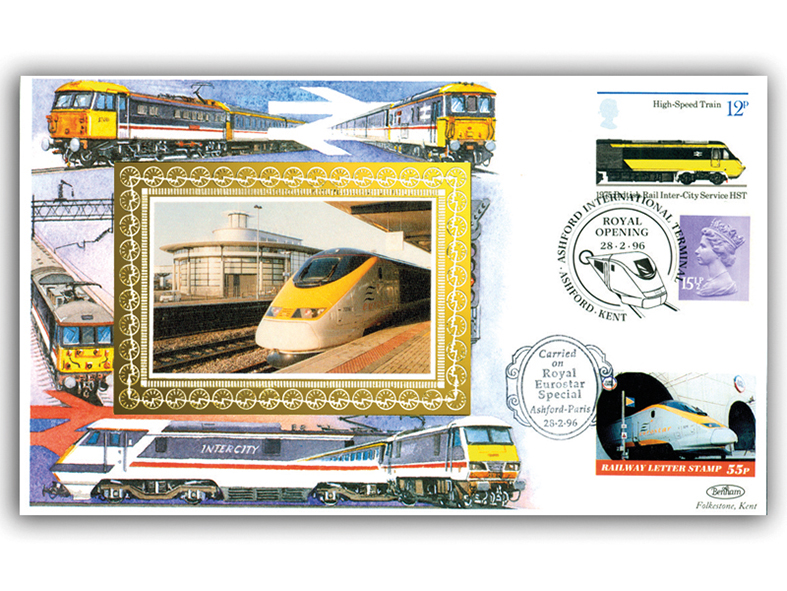
Why has the once much-vaunted service through the Channel Tunnel, which started in 1994 and first served Ashford in January 1996, come to this? In truth, Ashford and thus Kent and Sussex were always seen as a minor market. In early planning of the rail service through the Channel Tunnel, planners and government questioned why Ashford should be served at all. Eurostar has always seen itself as competing with airlines for city-to-city travel.


CREDIT: Matt Buck/Creative commons
It was local political pressure which obtained the station and its funding. From its opening by Queen Elizabeth II in 1996 until 2007, when she also opened the Kent high-speed line into St Pancras, Ashford had seven trains a day to Paris and five to Brussels. But when Ebbsfleet station (near the M25 Dartford crossing) was unveiled, Ashford’s service was cut back. Five years ago, even before Brexit or Covid, there were only two trains on weekdays from Ashford to Paris, plus one to Lille and Brussels; there was one more each way on a Sunday. The reverse journey from the continent to Ashford was no more frequent. The limited timetable seemed intended to deter travel even then. Moreover, Eurostar never offered cheaper tickets to Paris from Ashford than from London, despite the distance being 60 miles less, another indication that it did not really want the business.
Yet Ashford station is where five lines meet, the hub of Kent’s railways. With one change there onto Eurostar, the people of Maidstone, Thanet, Canterbury, Deal, Dover, Rye, Hastings, Eastbourne and Brighton were to have quick, comfortable travel into France and Belgium. This was the promise, and was what caused councils and MPs in Kent and Sussex a generation ago to support the Tunnel and Ashford International station. The demand from these towns together could and should have supported a good service beneath the Channel all day. Kent has a population of 1.6 million, and East Sussex 560,000. But it was never marketed, and instead the region was always treated to a minimum service. What brings people to use rail is frequency and the ability to take a train when they want one, all day – as they can do at Hastings in all directions.
Not wanted
By contrast, the Eurostar service offer to Kent and Sussex people was always grudging and second-rate – and now it has gone completely. Despite Eurostar’s troubles, its trains flash through Ashford every hour at 185 mph between London and Paris. It just doesn’t want the business of people in the counties between London and the Channel.
The result is a reduction in the value of the local train services to Ashford: the economics of the service between Hastings and Ashford especially is depressed by the lack of Eurostar connections. The line itself narrowly avoided closure in 1974, and was saved because it was seen as a future feeder route to the Channel Tunnel. How much more use would it have today if there were trains from Ashford to Lille and Paris all day?

Is there a solution? An ‘open-access’ train operator would see the market for a competing regular service serving the intermediate stations while providing a lower fare than Eurostar for London to Paris travellers. A train from London St Pancras every two hours all day, calling at Stratford (East London), Ebbsfleet (for West Kent), Ashford, Calais-Frethun, Lille, Haute-Picardie (for Amiens) and Paris would attract people in all those places to the railway. French Railways is replacing its old TGV trains, which are being scrapped despite having years of life left in them. Why not buy some and put on such a service, to the benefit of people in both countries?
We hope you have enjoyed reading this article. The future of our volunteer led, non-profit publication would be far more secure with the aid of a small donation. You can also support local journalism by becoming a friend of HIP. It only takes a minute and we would be very grateful.

Leave a Reply