
Ambitious New Housing Strategy
Paul McLaughlin
Hastings Borough Council has launched its first housing strategy since 2019. The 2025-2030 plan makes confronting the town’s “severe and worsening affordability crisis” its top priority.
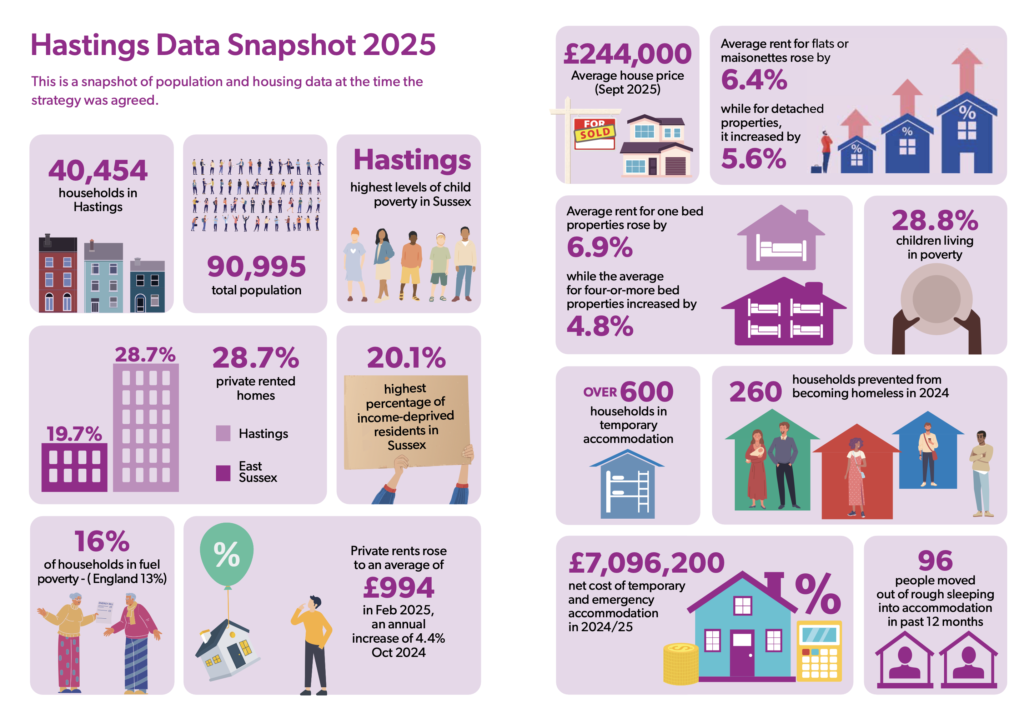
Council Leader Glenn Haffenden said the “ambitious” strategy was “achievable with a considerable push”, with its main goals being to dramatically boost affordable housing supply and improve the safety and security of existing homes. He emphasised the need for a concerted effort from all housing partners and, crucially, support from central government.
The strategy directly links the town’s acute housing pressures – including high deprivation, low incomes, and a critical shortage of affordable rents – to the parallel statutory Local Plan. An upcoming consultation on the Plan in early 2026 provides a pivotal opportunity – and a challenge – to align new home locations with the strategy’s social objectives.
Homelessness Pressure
The strategy is informed by a detailed independent homelessness review, revealing a system under immense strain. While annual homeless applications have remained stable at around 1,100, the number of households in privately procured temporary accommodation (TA) has doubled since 2021. As of late October, 535 households were in such placements, with an additional 124 in council-owned properties.
The most recent rough sleeper count across Hastings and St Leonards identified 29 individuals, with the council aware of eight more regular rough sleepers.

Public Consultation
The council undertook a near 12-month public consultation to develop the strategy with a series of events and meetings held across the town. This was led by a steering group with a wide range of housing expertise, including private developers, landlords, social housing providers, property managers and housing and homelessness campaigners, as well as social housing and private rental tenants.
The extensive public consultation led to several key amendments to the draft strategy. These included residents demanding a clearer definition of ‘affordable housing’, stronger action on short-term lets, and explicit links to the Local Plan. There was also strong support for community-led housing, increasing accessible homes, tackling empty properties, and ending rough sleeping.
The council also used this period of consultation to address what it termed the “misconceptions about the role of immigration” on housing pressures, highlighting instead structural issues like the Local Housing Allowance, which has not been increased by the government since 2011 and is often 40% lower than average local rents.
A Five-Pillar Action Plan
The strategy has five core priorities:
Building the Homes We Need:
The strategy sets a major expansion of social rented housing as its top priority. Achieving this, however, is contingent on the council successfully lobbying for government capital funding. In parallel, the council plans to activate a long-delayed empty homes strategy to repurpose vacant properties.
End Rough Sleeping and Homelessness:
A central aim is to drastically reduce the numbers of rough sleepers in the town and cut the use of TA in half by 2030. TA cost the council £7.8 million in 2024-25, almost a third of its entire budget. The council will continue to push the government to increase the Local Housing Allowance rate, arguing that an increase in the LHA rate could inject an estimated £1.4 million into local coffers.
Key actions include delivering the Single Homelessness Accommodation Programme (SHAP), which will provide 25 new homes with support within the borough to prevent rough sleeping. A new homelessness forum is planned to unite partners to shape future services, while volunteer recruitment will be expanded to offer personalised support for those moving out of homelessness. The council also vows to continue lobbying for essential multi-year government funding.
Fixing the Rented Sector:
With over 30% of homes in some wards being private rentals and a high concentration of Houses in Multiple Occupation (HMOs), Hastings faces an acute challenge. The borough has one of the Southeast’s highest rates of ‘non-decent’ homes, often older properties with poor energy efficiency.
The incoming Renters Reform Act is expected to have a “big impact”, offering greater tenant stability by ending Section 21 ‘no-fault’ evictions, limiting rent increases to once a year, and strengthening anti-discrimination rules. The council will actively monitor local letting agency practices and act against breaches and create a new “local housing association compact” to act as a “critical friend,” challenging associations to improve tenant satisfaction, meet decent home standards, and resolve issues like damp and mould faster.
Housing for Health and Independence:
The strategy recognises housing as being “at the heart of almost every form of inequality.” It commits to ensuring a range of housing that allows people to receive support at home, rather than having to move. In a stark admission, the council notes there is currently no refuge provision in Hastings for victims of domestic abuse, a gap it pledges to fill. The council also highlights its effective use of Disability Facility Grants, which funded 240 adaptations last year at a cost of £1.95 million.
Greener, Climate-Resilient Homes:
With Hastings highly vulnerable to coastal flooding, the strategy recognises the need to build climate resilience into the planning system. The goal is for everyone to live in a well-insulated, affordably heated home. The council will support the development of a forthcoming East Sussex-wide retrofit strategy and promote greater access to warm home checks for residents.
The Hastings Housing Strategy represents a comprehensive attempt to tackle deep-rooted housing problems. Whilst no one can doubt the commitment of all those who have contributed to the process, its success will depend on two critical factors: securing increased, sustained funding from central government and a consensus by local politicians as to both the number and, most contentiously, the location of new homes. The Housing Strategy is expected to be approved by Full Council at its next meeting on 14 January 2026.
We hope you have enjoyed reading this article. The future of our volunteer led, non-profit publication would be far more secure with the aid of a small donation. You can also support local journalism by becoming a friend of HIP. It only takes a minute and we would be very grateful.

Leave a Reply