
Oil Spill in Solid Form
PHILIPPA BOGLE was among the first of the hundreds of volunteers helping clean up millions of plastic beads released by Southern Water which are polluting our beaches – working alongside the environmental charity Strandliners and professional plastic removal firm Nurdle
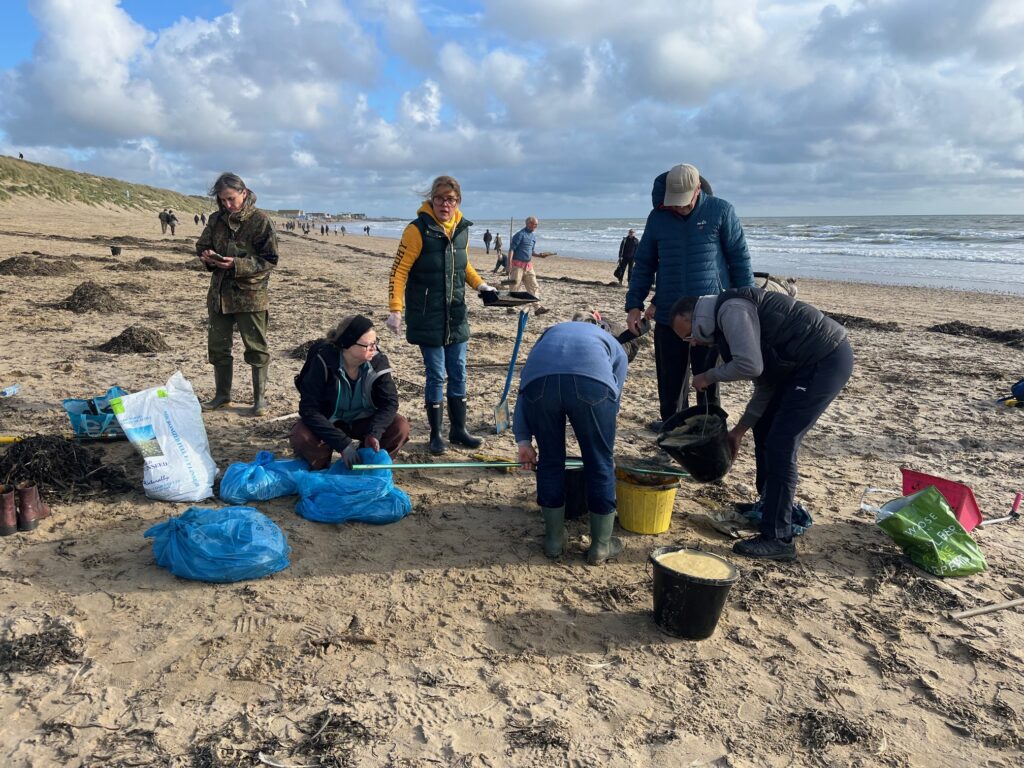
Volunteers at Camber
When I first arrived on an empty Camber beach clutching a dustpan and brush on a wet and blustery Sunday morning, there were just a few people off in the distance from Strandliners and Nurdle. I arrived at the same time as three paid ‘volunteers’ from Southern Water which hadn’t yet taken responsibility and who seemed to know nothing about the spill or even the sewage system.
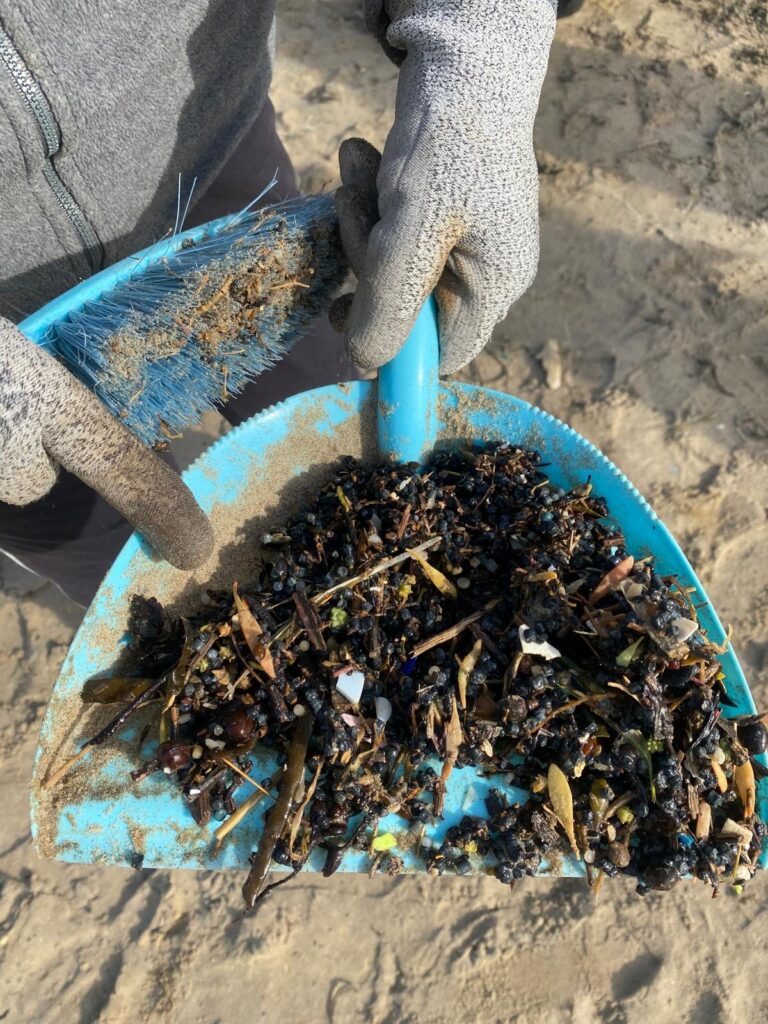
At first glance the wide stretch of sand looked as beautiful as ever. But as I gradually realised the little black spots on the strandline were not tiny pebbles but plastic pellets, the full horror of the spill revealed itself. There was a dead seal on the beach nearby and a higher-than-normal incidence of dead wildlife has been reported. As a nature lover and sea swimmer, I felt a stab of sadness.
Gradually, volunteers of all ages began to turn up, armed with humble household tools – dustpans, sieves and rakes. Some had come from as far away as Lewes, aware that we share one coast and one ocean. County boundaries are meaningless to nature, after all.

Joel, the friendly and concerned coastal officer, single-handedly wrangled us – with the instruction to brush or pick up the peppercorn-sized pellets by hand. Consumed with a sense of futility, given the industrial effort required, I and some others began experimenting to find a better system. We bucketed-up seawater – worked out that the beads float, and began scooping sand into a fishing net over an empty bucket, pouring water over, and sifting out the beads. Like panning for gold.
It felt more gratifying, though depressing, to be gathering tens and hundreds of beads at a time than picking them up individually. Our small team collected several bin-bags of beads in a 3-hour period before we got too cold and retreated for lunch. It was heartening to see so many concerned citizens out working together for nature. We sat on our coats and shared around coffee and lemon drizzle cake and swapped numbers.
PUBLIC MEETING
“While it’s not Piper Alpha…”, as a participant admitted at the subsequent meeting in Rye to discuss the bio-bead spill, it is undeniable that the incident is a major environmental disaster – an oil spill in solid form. The meeting had been organised by Helena Dollimore MP with the Environment Agency, Rother Council and Southern Water – who only admitted to causing the spill two weeks after it happened.
There was a tense atmosphere and an undercurrent of anger from the beginning of the meeting, but Ms Dollimore’s call for respectful engagement – as “that’s how we do things in Rye”, subdued any emotional outbursts – though there was a collective groan when she announced that beads had been found in Rye Harbour Nature Reserve.
My cohort of beach cleaners – new friends made when we first trooped down to Camber Sands on 9th November after the call-out from Strandliners, felt deflated and unsatisfied after the meeting, soft-soaped with apologies and stultified by management-speak. As my esprit de l’escalier – the predicament of thinking of the perfect comment too late – kicked in, I thought perhaps it may have been better if we’d been a little less civil, even angry, on behalf of Nature who cannot speak for herself.
With the beads likely to litter beaches for years, even decades ahead, we will need our collective and righteous anger to fuel the clean-up effort. This may be the worst plastic pollution incident in the country – ever. Some progress has been made, spearheaded by Strandliners and Nurdle, with help from community volunteers but there is much back-breaking work ahead – millions of beads (of an estimated 160 million were spilled) are still out at sea, embedded in sand and seaweed and hidden in shingle – washing in and out with each tide. It can feel overwhelming.
Now, our group of new friends, from Rye Harbour and Hastings, have a ‘Pollution Pickers’ WhatsApp group and intend to do weekly beach cleans to make a drip-drip contribution to this Sisyphean task. We were there again with local hotel, The Gallivant, whose staff first discovered the beads on 4 November on one of their regular community beach cleans. Organiser, India Williams, told me that when she first saw them, they were so thick on the ground she thought they must be seeds or seaweed.
Normally they collect litter, packaging and plastic debris such as cotton buds and ‘fishermen’s kisses’ – offcuts from fishing nets – from the high tide mark. This time we rustled up plastic containers, shrimping nets, colanders and sieves, and got our amateur filtration system going, but it was tedious work. The beads are now diffused across the beach and the coastal officer told us that they are waiting for 6 December’s spring tide to float the beads up the beach where Nurdle plans to collect them, with the help of volunteers.
Working alongside us were teams in high-vis from subcontractor Adler & Allan using largescale sieves – one mesh filters out debris, then a finer mesh catches the beads and lets the sand fall onto the beach. “Sieving on an industrial scale” they said. Well, progress – but not exactly the spinning jenny. We need engineered solutions to this problem – and urgently. This is an SSSI, so conservationists are wary of simply digging up sand and seaweed and disturbing the fragile strandline ecology, home to many invertebrates.
NEGOTIATING A CEASEFIRE
Of course, the public section of Camber Sands is only a fraction of the length of the Dungeness peninsula. What about the long stretches fronting the MOD-controlled firing range and Dungeness nuclear power station? The coastal officer told me they are negotiating a ceasefire to assess the situation. Beads have been spotted on Dungeness beach and beyond – and inevitably they will find their way onto French beaches, as they have in previous spills, and into the wider ocean, leaching PCBs and causing untold damage to wildlife.
At the Rye meeting, John Penicud from Southern Water implied they could not have foreseen this spill – caused by the physical failure of a stainless-steel mesh “containment screen’, supposed to prevent beads escaping into the sea. Given their delayed response, they certainly don’t appear to have an adequate risk management or disaster plan in place for such an event. But it seems it was in fact foreseeable, given that this is not the first bio-bead spill from a sewage facility, with bio-beads polluting the environment for years.
I recently witnessed a dense mat of microplastics – bio-beads, pellets used in making plastic products called nurdles as well as polystyrene in the high tide line at Cuckmere Haven saltmarsh (which may soon be flooded by The National Trust) on a clean-up with Bhass Explore (Beachy Head And Seven Sisters Extreme Plastic Object Removal). This could be the legacy of the 2010 and 2017 spills in Cornwall, where South West Water continues to use bio-beads to this day; just this year, in September, Welsh Water spilled larger bio-discs along the Gower Peninsula. An outright ban on the use of all such plastics in our water systems seems long overdue.
I did question Southern Water at the meeting – and may have let some anger enter my voice as I asked about the logical inconsistency of their reporting. Surely, they either did not know about the spill until alerted by external parties – in which case how could they accurately identify the date of the incident and estimate the number of beads spilled? – or they knew earlier and chose not to report it. The answer given was that they did know the screen had cracked around the 27 or 28 October as daily inspections revealed it.
The Environment Agency told us there is an active investigation of Southern Water’s actions so they could not comment. Further questions clearly need to be asked of the company and its ultimate owner Macquarie who, in 2021, told Ofwat it would be “a responsible long-term steward of Southern Water”. Ms Dollimore, who has been doing excellent work on this issue, assured us she will be holding them to account. In the meantime, I’ll be counting bio-beads in my sleep.
HOW YOU CAN HELP
Report sightings

Report sightings of newly washed-up beads to the Environment Agency on 0800 807060 quoting reference 2440833.
Report dead wildlife ASAP as they can only autopsy for beads before decomposition.
Report a dead seal or cetacean – whale, dolphin or porpoise – to Cetacean Strandings Investigation Programme (CSIP) 0800 652 0333 + [email protected]
Report a dead bird to Defra 03459 335577 + [email protected]
Join a beach clean
10am – 7 days a week at Camber.Volunteers meet daily in Camber Central car park for briefing. Especially needed after the spring tide – 6 December. Bring gloves, dustpans, brushes, sieves, colanders/nets and buckets for seawater to filter beads.
Lobby for change
Demand that Southern Water cease using bio-beads in all its facilities.
Lobby for a ban on all use of bio-beads and bio-discs in water treatment.
Lobby for re-nationalisation of the water companies.
Lobby for Extended Producer Responsibility for manufacturers of bio-beads and nurdles – requiring them to mark beads with unique identifiers so pollution can be tracked.
Write letters –
demand improved standards
Southern Water : FAO Lawrence Gosden, Chief Executive Officer [email protected] / 0845 272 0845
Macquarie Asset Management (owner of SW’s holding company Greensands Holdings): [email protected], FAO Leigh Harrison, Macquarie Infrastructure and Real Assets, Ropemaker Place, 28 Ropemaker Street, London, United Kingdom, EC2Y 9HD
Helena Dollimore MP: [email protected] – quoting your name and address as a constituent. Request she lobby for the re-nationalisation of water companies.
Environment Agency: FAO Richard Penn, Environment, Planning and Engagement Manager [email protected]
Defra (Department for Environment Food and Rural Affairs): [email protected] FAO: Emma Hardy MP, Parliamentary Under-Secretary of State (Minister for Water and Flooding). Request re-nationalisation of water companies.
Independent Water Commission [email protected], FAO: Sir Jon Cunliffe, Chair – request the commission be reopened to address the specific issue of bio-beads.
Ofwat (Water regulator): FAO: Iain Coucher, Ofwat Chair, [email protected]
Consumer Council for Water (CCWater): [email protected]
National Trust: Object to the NT planning application plan to flood Chyngton Brooks at Cuckmere Haven as bio-bead pollution will be further disseminated and footpath access lostplanningpublicaccess.southdowns.gov.uk
What Can You do personally
Reduce – not just recycle. Use and buy less plastic; reduce single-use products; buy less packaged food; buy local and package-free (e.g. Wonderfill); never litter; get your friends to volunteer!
Other Contacts
Strandliners:
Insta: @strandliners
strandliners.org/bio-beads-at-camber
Nurdle: micro-plastic removal charity. Build your own bio-bead collector (trommel):
nurdle.org.uk/trommel-portal
The Gallivant: bi-weekly cleanups – with free coffee and cake after!
thegallivant.co.uk/events/community-beach-clean-25
Rother District Council: Sam Stone the coastal officer rother.gov.uk/news/coastline-clean-up-continues-following-pellet-pollution-incident
Cuckmere Haven area:
cleanups every Saturday and Sunday with Norm and Pam of Bhass Explore
facebook.com/bhassexplore
Sussex Wildlife Trust:
Rye Harbour Nature Reserve
sussexwildlifetrust.org.uk
Clean Water Action Hastings
facebook.com/cleanwateractgp
Surfers Against Sewage:
sas.org.uk
Marine Conservation Society:
mcsuk.org/what-you-can-do/join-a-beach-clean
CleanupUK:
cleanupuk.org.uk
We hope you have enjoyed reading this article. The future of our volunteer led, non-profit publication would be far more secure with the aid of a small donation. You can also support local journalism by becoming a friend of HIP. It only takes a minute and we would be very grateful.

Leave a Reply