
The Fatal Attraction of a Helpless, Sinister Monster
DAVID EP DENNIS
During the First World War, Germany had 351 submarines (U-boats), and of these, around 178 were lost during the war, leaving 173 to be disposed of by dismantling or used as demolition for gunnery practice by the Allies.
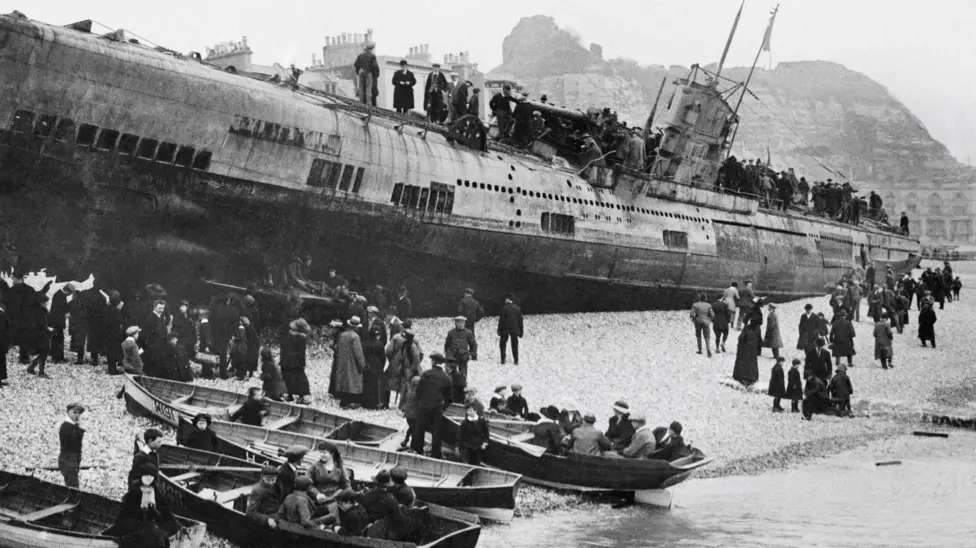
SM U-118 was a Type UE II mine-laying U-boat, commissioned on 8 May 1918 under Kapitänleutnant Herbert Stohwasser, commanding four officers and 36 men. During its sole wartime patrol (part of the First Battle of the Atlantic), U-118 sank two Allied vessels. On 16 September 1918, it torpedoed the British steamer Wellington and, overall, 16 crew were lost in a rescue attempt – the USCG cutter Seneca put a volunteer party aboard the damaged Wellington, but the ship ultimately sank – 11 American Coast Guardsmen and five British sailors perished in the incident. Then on 2 October 1918, U-118 sank the British tanker Arca (4,839 GRT) with the loss of 52 British crew.
Herbert Stohwasser (born 15 Dec 1886) was U-118’s sole commander, serving from May 1918 until the Armistice. A career naval officer (Naval Academy class of April 1904), Stohwasser had risen to Kapitänleutnant in 1915 and took command of U-118 after completing U-boat training. Stohwasser survived the war (died 1960) and remained in the naval reserve service into the 1920s.
Surrender
At the Armistice, U-118 surrendered to Allied forces at Harwich, England on 23 February 1919. The crestfallen German crew were in no mood to clean or maintain the vessel before handover. The Allies allocated U-118 to France for scrapping at Brest, and the French destroyer François Garnier was ordered to tow the submarine to the breaker’s yard.

On passage through the English Channel, a great storm arose, and the tow snapped in the gale. Realising that the submarine was drifting towards Hastings beach, the captain of the French escort opened fire, shelling the drifting hulk to try and sink it before it beached.
However, in the early hours of 15 April 1919, U-118 ran aground on the Queen’s Hotel beach at Hastings. Contemporary accounts describe the startling sight of the huge U-boat on the beach – one local newspaper called it a “helpless, yet sinister monster” rolling in the surf just yards from the promenade.
The stranded U-118 quickly became a popular attraction for sightseers. Thousands of curious visitors flocked to Hastings, especially over the Easter holidays of 1919. They marvelled at the beached U-boat and Hastings local authorities, under Admiralty supervision, even allowed people to climb onto the submarine’s deck for a small fee, turning the wreck into an impromptu exhibit. Over the two weeks after its beaching, nearly £300 was raised from these visits (equivalent to £13,470.00 in today’s money) – funds that were used to help host a ‘Welcome Home’ event for returning local soldiers.
A Fatal Attraction – Death Below Decks
However, the excitement was not without danger. Two Royal Navy coastguards, Chief Boatman William Heard and Chief Officer W. Moore, were assigned to escort VIP guests on tours inside the submarine’s interior.

By the end of April 1919, after only a few guided visits inside the submarine’s hull, both men fell gravely ill with severe internal pain and respiratory symptoms. Their mysterious sickness worsened rapidly. Initially, the cause was unclear – at first it was suspected that the men had been sickened by the vile stench of rotting food (putrefying potatoes, meat, and onions) lying in stagnant water inside the U-boat’s compartments. The submarine had been abandoned for months, and the decay of organic stores in the poorly ventilated confines could have created a nauseating miasma.
Despite medical treatment attempts, Chief Officer W Moore and Chief Boatman William Heard succumbed. The true cause of their agonising illness only became clear after William Heard’s death, when an inquest was held on 16 February 1920. Surgeons at the inquest testified that initially they had mistaken his condition for pneumonia. Still, they then concluded it was due to inhalation of a “very pungent and noxious gas, possibly chlorine”. This toxic gas had caused large abscesses to form on the men’s lungs and even on Heard’s brain, ultimately leading to their deaths.
The likely source of the gas was the submarine itself. U-118’s battery cells had been damaged by seawater, which can produce poisonous chlorine gas when saltwater reacts with lead-acid batteries. Essentially, the confined air inside the U-boat was a trap of toxic gases. These coastguards, spending extended time in the U-boat’s chambers during the tours, inhaled these fumes.
Once the men became ill, all tours inside the submarine were immediately halted, although tourists continued to come and view the U-118 from the outside. The U-boat’s unexpected visit had thus proven a fatal attraction in a literal sense.
Heard and Moore
Both William Heard and W Moore were experienced servicemen with long careers in maritime defence. Chief Boatman William Charles Heard was 47 years old in 1919, and he had served for 20 years in the Coastguard (which was part of the Royal Navy). His service was distinguished enough that he had been awarded the Long Service and Good Conduct Medal, a recognition of his two decades of exemplary duty. Heard lived with his wife, Eliza (Elizabeth), at the Coastguard Station on Marine Parade in Hastings. He was originally born in Walmer, Deal, Kent, but by the end of the First World War he was posted to Hastings as part of the Coastguard force. Like many Coastguards, he likely had been mobilised into the Royal Navy during World War I (the Coastguard was largely absorbed into the Navy for the war) and then returned to Coastguard duties on the home front.
Chief Officer W Moore was Heard’s colleague tasked with the U-118 tours. He, too, was a seasoned coastguard. Both men were Hastings-based – part of the local coastguard contingent at the Marine Parade Coastguard Station that took charge of U-118 when it washed ashore.
Funeral and Community Response
The tragic deaths resonated deeply in the Hastings community. These two men had survived the World War, only to lose their lives at home in a peacetime incident, which many found poignant and heartbreaking. Both men were honoured with military burials in Hastings. William Heard, for example, was laid to rest in Hastings Cemetery (Sussex) in February 1920, and W Moore was likewise interred in the same cemetery after his death in late 1919.
Contemporary accounts indicate that many people attended their funerals to pay respects. The men’s suffering and sacrifice were widely mourned. The Hastings and St. Leonards Observer and other papers reported on their deaths, underscoring the community’s regard for these men who had literally given their lives in service. Coastguards, Royal Navy personnel, local officials, and residents joined in large funeral processions, reflecting how deeply the town sympathised with the families. The fact that Heard’s Coastguard station address and service were formally recorded on war casualty rolls shows the esteem in which his duty was held.
Final Fate of U-118 – What Lies Beneath?
After a few weeks, the question arose of what to do with the massive steel hulk on Hastings beach. Attempts to refloat the submarine or break it apart with naval gunfire had already failed (it was lodged too close to the town centre, so explosive methods were deemed too risky).
Ultimately, on 21 May 1919, the British Admiralty sold U-118 for scrap to the James Dredging Company for £2,200. Salvage work continued through late 1919 into 1920; by the beginning of 1921, U-118 had been largely broken up and removed.
The submarine’s large deck gun was left on the shore for some time (the town even considered keeping it as a relic), but it too was taken away. However, according to local records, a portion of U-118’s keel may still lie buried beneath the sands of Hastings beach. What had once been a formidable weapon of war ended its days as scrap metal, after briefly serving as a tragic seaside spectacle.

The Bulverhythe Event
Just as the scrapping of U-118 was coming to an end, yet another submarine under tow was washed up – this time at Bulverhythe. In January 1921, the SM UB-131 broke free during a storm and washed ashore at Bulverhythe beach area near the wreck of the Amsterdam. Unlike U-118, the UB-131 incident did not attract much publicity or crowds, and UB-131 was quickly salvaged and dismantled on the spot. Maybe people realised that going below decks was a deadly hazard. They had learned a sad lesson.
Postscript: Phoenix Rising
On 3 September 1941, a new submarine vessel, also named ‘U-118’, joined Hitler’s Wolf Pack as a mine-laying submarine. This warship destroyed 26,934 gross tons of Allied shipping and killed many more Allied crew members.
We hope you have enjoyed reading this article. The future of our volunteer led, non-profit publication would be far more secure with the aid of a small donation. You can also support local journalism by becoming a friend of HIP. It only takes a minute and we would be very grateful.

Leave a Reply