
Coronation Fever
KENT BARKER charts the involvement of a prominent Hastings civic dignitary at the coronation of George II in 1727

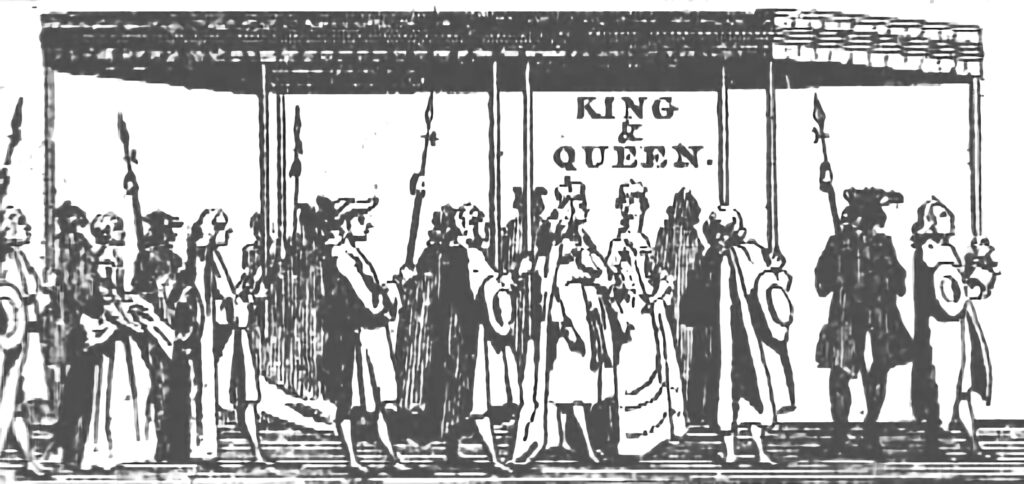
Hastings had been one of the original Cinque Ports – probably founded sometime before the Norman invasion. It accorded the town certain privileges, one being that all freemen had the right to be termed ‘Barons’. But a more important tradition had prevailed possibly since the reign of Edward the Confessor, but certainly since that of Henry III: any Baron could claim the privilege of bearing a canopy over the King and the Queen at their coronation.
The first of the Hanoverian Kings, George I, had suffered a stroke in his native Hanover and died at Osnabrück on 11 June 1727. He was to be succeeded by the Prince of Wales and preparations were quickly put in place for the coronation.
Each Cinque Port elected a small group from among their number for the coronation duty. In 1727 John Collier, who served as mayor of Hastings in 1719 and 1722 and was a local lawyer and town clerk, formally applied:
The Barons of the Cinq Ports having made the following claim, viz:- to have the usual office of carrying two canopies … sixteen Barons to a canopy, to have the said two canopies for their fee … To have the privilege of dining in the Hall at a table on the right hand of the King’s table. (WV Crake)

John Collier, Baron of Hastings
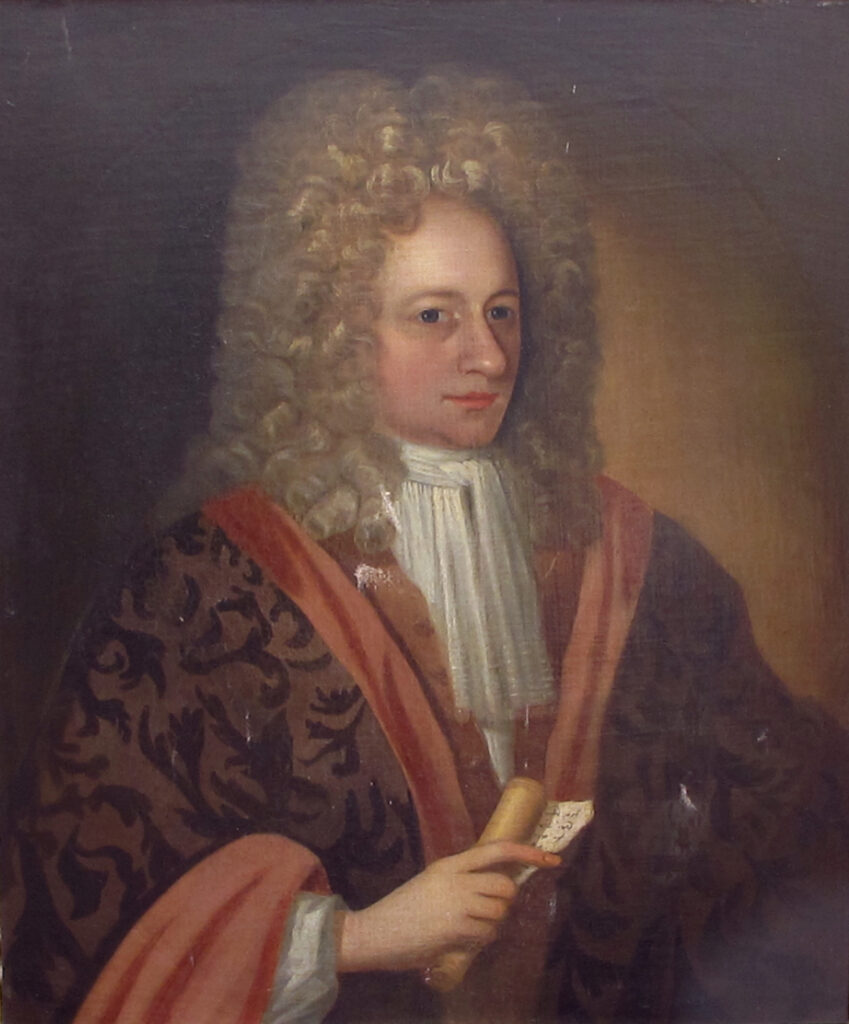
The certificate was duly granted, and John Collier was elected to be one of the six Barons from Hastings to assist in the duty. This was, clearly, an enormous honour as he wrote to his wife Mary on 5 October 1727:
It is expected that the coronation will exceed all that ever were in Magnificence & Grandeur. The Queen’s Cloaths is to be the richest possible, & all Covered with Diamonds.
In the same letter he gave what details he could of the arrangements:
I have not been able to learn many particulars about our Coronation affair … there is to be a meeting of the Barons next Munday to settle who are to support over the King and over the Queen in p’ticular. I have made no progress on my robes, nor shall not till I see what Others provide …
As a result of that meeting it was determined that another oft-elected mayor, Edward Dyne, along with MP Sir William Ashburnham and Thomas Pelham of Stanmer, would help carry the King’s Canopy, while Collier, along with the town’s other MP, Thomas Townsend, and Colonel Pelham, would be among those carrying the Queen’s.
There is a fascinating little detail also contained in this letter which provides a window into the world of Georgian London:
Candles are risen 2s 6d a Dozen just at this time, on account of the Vast Quantity bought up for the Coronation Illuminations…

The question of his ‘robes’ for the ceremony was clearly exercising Collier a good deal. Whatever was decided would inevitably be expensive. He noted that a full bottom wig in his ‘complexion’ would cost ‘15 Guineas’. A not inconsiderable sum given that his salary as Town Clerk was still around £10 a year, and he told Mary he would be ‘much vex’d’ if he was forced to buy one. So borrowing or even hiring one was a preferred option:
I am in a little Dilemma about my robing, but Lord Ashburnham yesterday offered me a Shirt and neckcloth for the Ceremony, that is to lend it to me, which I accepted …we have Scarlet Robes lined with crimson Sattin, Waistcoats of the same Sattin, breeches of the same cloth, Scarlet wosted Stockings because silk will not take soe good a dye, black velvet shoes with red heels, black velvet Caps, white Gloves, of which the Topps are faced with Crimson, we are to wear swords …
It was obviously a momentous occasion and Collier quickly wrote again to Mary in Hastings to give her the full details:
…the whole was of the Greatest Splendour and magnificence it’s possible to be thought of. I was at the Queen’s canopy, much to my satisfaction, and the procession was very agreeable tho’ vastly fatiqueing and I had the happiness of escaping without a cold …I can’t forbear telling you that the Queen was exceedingly obliging in the procession & talked very much to our corner of the Staves, viz Pelham and Townsend & so I came in for my share. Her train was born by 7 ladies, (3 of them Princesses), Dressed a fine as it is possible to be thought of & in coming back the 3 young Ladyes … put on the same obliging airs & were very merry.
Simple, but elegant.
Part of the tradition was that, in lieu of any fee, the Barons would keep both the canopy and the silver staves that held it aloft. The Hastings contingent decided that the metal should be melted down and turned into a ceremonial bowl for use at Corporation functions. The work was carried out by a London silversmith, Joseph Ball, and the result is simple but elegant, with inscriptions round the sides:

This silver bowl was presented to the Corporation of Hasting ye premier Cinque Port by ye gentlemen whose names are hereon inscribed who had ye honour to be unanimously elected ye Barons of ye said town to support ye canopy over their sacred royal Majesties King George ye 2nd and Queen Caroline at the solemnity of their inauguration at Westminster the eleventh day of October 1727. And ye same was made out of their shares and dividend of the silver staves &c belonging to the said canopy.
For many years the bowl was used at civic functions. But by 1824 William George Moss in his history of Hastings noted:
as punch has long ceased to be a fashionable liquor, and the corporation preferring wine at their public festivals, a framework of wood has been made to fit inside the bowl to hold decanters.

Even that function fell into disuse, and the bowl was then, for many years, exhibited at the Hastings Museum. But curators there eventually deemed it insufficiently interesting for visitors and it was removed to a vault in the council offices. Now, upon application, it is occasionally brought out to be viewed or photographed.
Read more in Mister Hastings – a biography of John Collier, Kent Barker, 2022. Letters quoted from The Correspondence of John Collier, WV Crake 1902.
We hope you have enjoyed reading this article. The future of our volunteer led, non-profit publication would be far more secure with the aid of a small donation. You can also support local journalism by becoming a friend of HIP. It only takes a minute and we would be very grateful.

I have just read Mr Hastings by Kent Barker. The book is a great read about one of the most interesting characters of Hastings. It has a wonderful flow starting and ending looking with Collier through the lens of West Hill. There are regular references to Collier’s correspondence, political tactics, the Amsterdam crises and the war on smuggling. Enjoyed it immensely.