
Designed to make you feel helpless and powerless
Miranda Cleland and Ayed Abu Eqtaish from Defence for Children International – Palestine recently addressed a packed meeting at the White Rock Hotel. KATY COLLEY reports.

At her talk in Hastings, Miranda Cleland calmly described the ill treatment meted out to Palestinian children by the Israeli military. There was no need for emotive language – the facts spoke for themselves.
“We’ve documented cases of children held in solitary confinement for 39 days,” she said. “Children talk about how distressing it is, how small the rooms are, how bad it smells. The lights never go out, they’re always on. No windows.”
Miranda, a Defence for Children International – Palestine (DCI-P) Advocacy Officer from Washington DC, and Ramallah-based Ayed Abu Eqtaish, spoke at a meeting organised by the Hastings and Rye Palestine Solidarity Campaign (H&RPCS) at the UK launch tour for the No Way to Treat a Child Campaign (#NWTTAC). The campaign is supported by partner organisations Amnesty International, War on Want, Unison and the national Palestine Solidarity Campaign, among others.
#NWTTAC
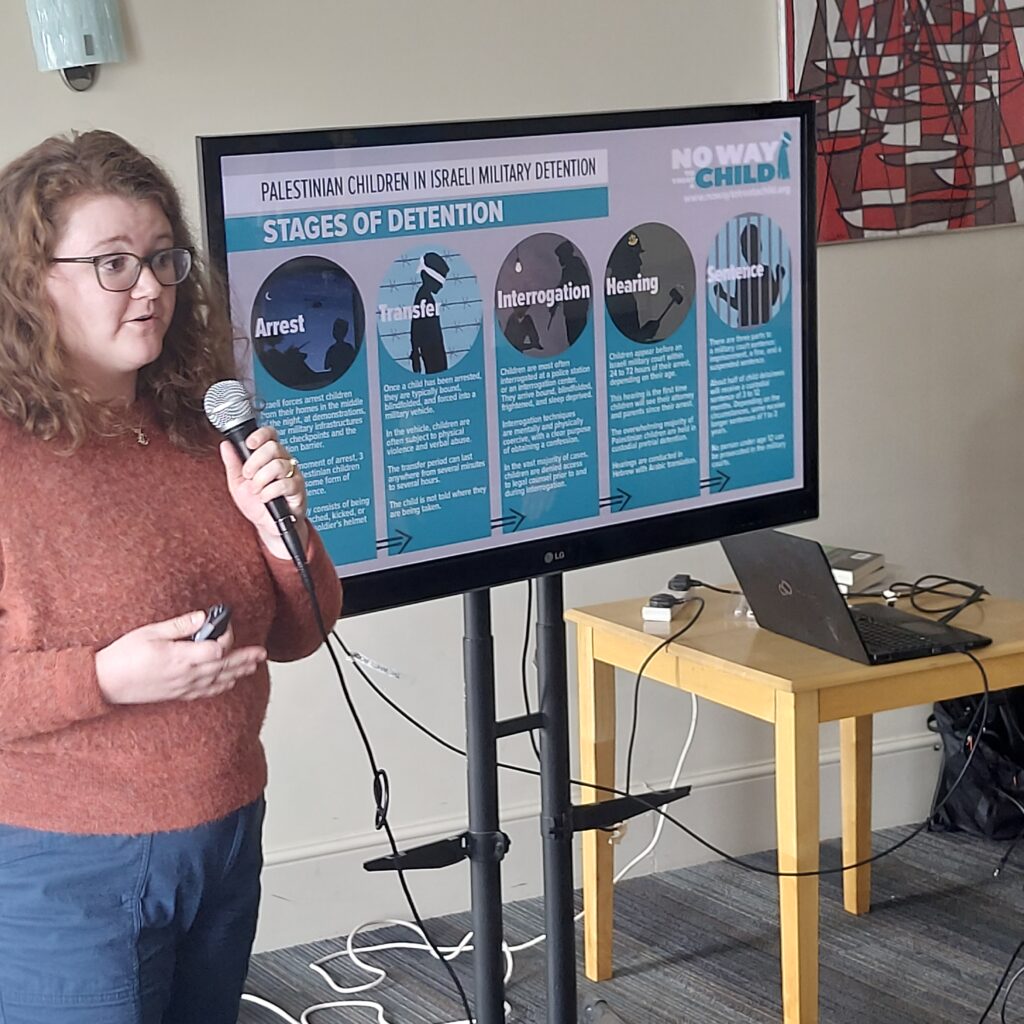
The #NWTTAC campaign draws particular attention to the abuses suffered by Palestinian children held in military detention, documented through 766 sworn affidavits. Each year the Israeli military detains around 700 children through the military courts; it is the only country in the world that systematically detains children in this way. Miranda outlined this process step by step.

Of the children arrested, close to 60% were taken from their homes in the middle of the night and 75% suffered physical violence at the hands of Israeli forces while being detained. “They are often beaten, kicked, punched, sometimes slapped with the soldier’s helmet or the stock of his rifle,” said Miranda. “This whole system is designed as a system of control. It is not a justice system.”
Once arrested, the child’s hands are bound with zip ties (97%), they are blindfolded (89%) and then forced inside the back of a military vehicle. They are then transferred to an interrogation centre. ‘The child is not told where he is being taken, the parents are not told either,’ said Miranda.
Children are strip-searched
On arrival at the interrogation centre, most Palestinian children are strip-searched (80%) and then interrogated. “Interrogation techniques violate most human rights you can think of. The children are denied access to a lawyer, denied access to having a parent with them. Sometimes they are verbally harassed, physically beaten, and sometimes subjected to stress positions. Solitary confinement is used as a tool of interrogation. “It is used in a pernicious way to extract confessions from children”.
Accountability Programme Director Ayed said young children are particularly susceptible to mental damage from this technique. “Every child who passes through this experience will be psychologically affected,” he said. “The level of impact depends on the age of the child when they have been arrested, the type of ill treatment and torture he is exposed to in addition to time spent in solitary conditions.”
Impact of solitary
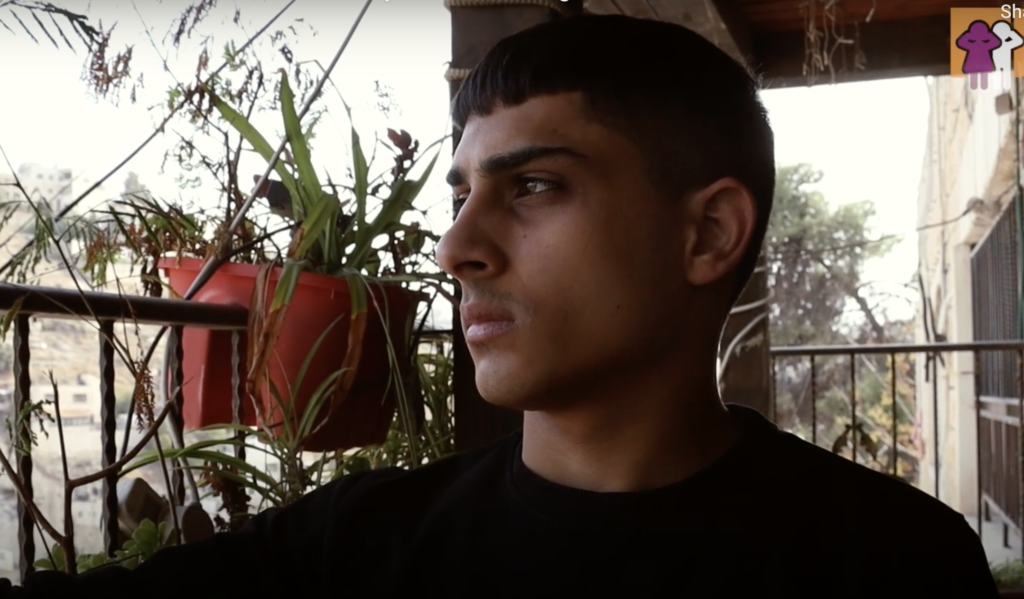
Worryingly, Ayed says solitary confinement is being used more and more frequently on children. “The whole idea of these techniques is to put as much pressure as possible on the child and to keep his resistance as low as possible.” he explained.
“When they start physically abusing somebody, he will collect all his strength in order to resist. But when he is placed in solitary confinement, the person will not be able to make the connection between the miserable situation he is under and the military interrogators. So, he collapses from within. He starts to blame himself and to say, ‘I’m in this situation from my own doing.’
“The majority of children placed in solitary confinement give confessions to the Israeli military interrogator because they fear they cannot get out without writing one.”
Miranda added: “When we say a ‘military court’, that means every single person participating in that courtroom is an Israeli soldier – the judge, the prosecutor, translator, all of these people are soldiers. They speak in Hebrew, which is a language most Palestinian children don’t understand. So, the whole system is designed to make you feel helpless and powerless, and that everything is out of your control.” Many children take a plea deal because it is fastest way to get out.
Military detention sits alongside the practice of ‘administrative detention’ where both adults and children are detained without any charges or evidence. In other words, imprisonment without trial. Currently, there are 11 Palestinian children being held by Israel in administrative detention. “Their detention is based on secret evidence that is not disclosed to them, their parents or their lawyer,” Miranda explained. “If you don’t know what you are being charged with, it is impossible to prepare your own defence. This is a tool we’ve seen Israeli authorities use to extend a child’s detention indefinitely.”
Since 2015 more than 60 Palestinian children have been subject to administrative detention. In a short video shown to the meeting, Mohammad Mansour, 18, described being held aged 16 in administrative detention for more than 400 days as: “like a life sentence”.
Homes demolished

Miranda and Ayed went on to describe another aspect of military occupation: home demolition. In certain areas like East Jerusalem, it is almost impossible for Palestinian families to obtain a building permit, so they are forced to build homes without them. These are subject to sudden and arbitrary demolition orders. “They will show up and demolish your house right in front of you, sometimes with as little as 10 minutes warning,” said Miranda. “If a family receives a demolition order, they will make you pay to demolish your own house.”
In a second video, six-year-old Manal talks about the day the Israeli soldiers demolished her home. “When the soldiers came, I got scared. I was crying and I was very sad and upset,” she said. “I thought they were going to take my dad away.” Manal was forced to watch as her home was bulldozed: ‘When I saw them destroy my room and my cabinet and my toys, I was very upset. This was my house and I loved it very much.”
A terrorist organisation?
DCI- P’s advocacy work, drawing attention to these violations, has prompted an extreme reaction from the Israeli authorities. In 2021, alongside five other prominent human rights organisations, they were designated a ‘terrorist organisation’ by the Israeli military and stripped of their legal status. In August last year, their offices were raided, the doors welded shut and their work deemed illegal.
“Now there is uncertainty because we don’t know what will happen,” said Ayed. “They may arrest our staff, seize our assets or do whatever they want because they declared it terrorist and illegal. The main purpose of this move is to disconnect us from international support and solidarity.”
However, levels of support for DCI-P’s work have remained constant. Miranda says they have been amazed by the huge outpouring of solidarity. “I’ll never forget the day we were designated a terrorist organisation,” she said. “We started getting these emails from all over the world. They just kept coming and coming for weeks. Groups from all over the place emailed us to say – we saw this happen; we stand with you. This was a huge escalation by the Israeli authorities.”

DCI-P will be working with their partner organisations to call for action later in the year as it seeks to put a Private Member’s Bill and Early Day Motion to the House of Commons. In the meantime, Miranda asks supporters to keep up the advocacy by visiting the #NWTTAC website where there are resources to host a film screening or event.
To find out more about the campaign and how you can get involved, visit nowaytotreatachild.org and join your local PSC branch here: hastingspalestinecampaign.org
We hope you have enjoyed reading this article. The future of our volunteer led, non-profit publication would be far more secure with the aid of a small donation. You can also support local journalism by becoming a friend of HIP. It only takes a minute and we would be very grateful.

Leave a Reply