
Is it OK to Be Black?
VICTORIA KINGHAM on Hastings Contemporary’s latest coup
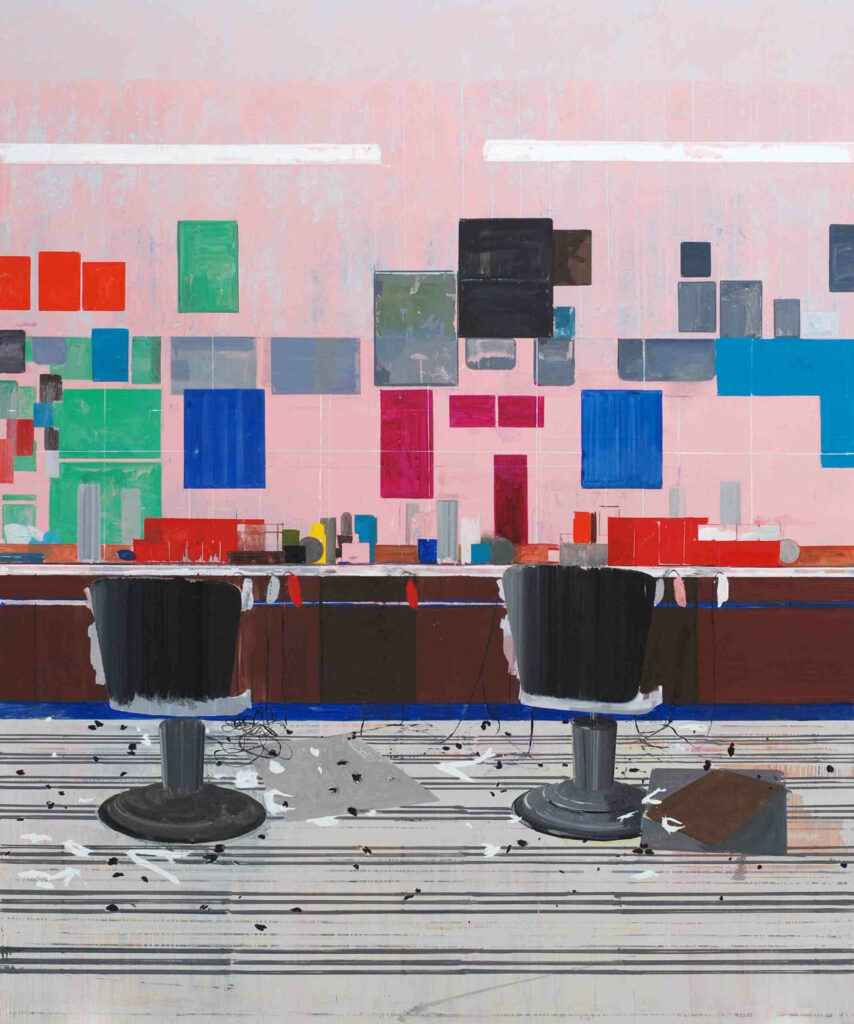
Hurvin Anderson, Flat Top, 2008
‘Is it OK to Be Black?’ is the title of one of Hurvin Anderson’s slightly enigmatic paintings, currently on view at Hastings Contemporary. It consists primarily of rectangles, and in comparison to the other paintings in this exhibition, verges on the monochromatic. There’s an interesting arrangement of bottles and containers at the lower edge with a blue stripe below, looking oddly like a modern cityscape – “A few people have said that”, he muses. Above are the walls of a barber shop with portraits – Marcus Garvey, Malcolm X, Martin Luther King, and a faceless, outline picture of a boxer that looks very like the famous one of Cassius Clay (once Mohammed Ali) in all the beauty of his prime.
The title of the picture is a play on words – ‘Is it OK at the back?’ and could be part of every barbershop conversation. And this series of ‘salon paintings’ in the exhibition represent a long-time fascination, for Anderson, with the interior of one particular Afro-Caribbean barbershop, the kind of space it is, the kind of culture it represents, the kind of conversations it encourages. Anderson himself was born in Birmingham to Jamaican parents, and to him the shop represents part of his childhood culture. But because he has painted and repainted, sketched and abstracted, meditated and re-thought the image over a long period, this series of paintings has become, as he says, as much about the act of painting as it is about the subject matter. Further, because of the way the paintings are hung in the space of Hastings Contemporary, because of their different juxtaposition, he is yet again considering them anew.

Hurvin Anderson, Is It Ok To Be Black?, 2015.
This very particular series also enables the viewer to consider, clearly, a great deal more than its content. They of course have that instant compositional perfection that renders them, like all great art work, microcosmic. The meta-painting element becomes apparent on closer consideration – the rectangles hang in the space of the picture in Mondrian-like splendour, yet at the same time the viewer is made aware of perspective, depth, place. Some of the application of paint in the later paintings is intentionally incomplete: in Miss Jamaica, for example, the postcard of Miss Jamaica stands against a background of strong black and yellow rectangular object-shapes, above a counter which becomes more and more faded and indistinct as one’s eyes travel down the picture.
Schooled through Wimbledon School of Art and the Royal College of Art, Anderson is quietly reflective, hesitant. He is, though, a prolific painter, whose copious, multifaceted body of work represents British art at its thought-provoking best. The exhibition includes preparatory drawings and sketches and, to an extent, allows us into Anderson’s creative process and indeed the subject matter illuminates a significant section of British culture. Not to be missed.
‘Hurvin Anderson: Salon Paintings’ , organised together with the Hepworth Gallery and Kistefos Museum, Norway, is at Hastings Contemporary until 3 March 2024.
We hope you have enjoyed reading this article. The future of our volunteer led, non-profit publication would be far more secure with the aid of a small donation. You can also support local journalism by becoming a friend of HIP. It only takes a minute and we would be very grateful.

Leave a Reply