
Bramah, Blue Orchids and 21st Century Etiquette
BEN THOMPSON
As post-punk pedigrees go, Blue Orchids’ backstory is hard to beat – they formed when then partners Martin Bramah and Una Baines broke away from the original line up of The Fall, John Cooper Clarke helped them choose their name, and they later toured as the backing band to Velvet Underground chanteuse Nico in her career’s chaotic Mancunian twilight. But it’s their current burst of creativity that really catches the eye.
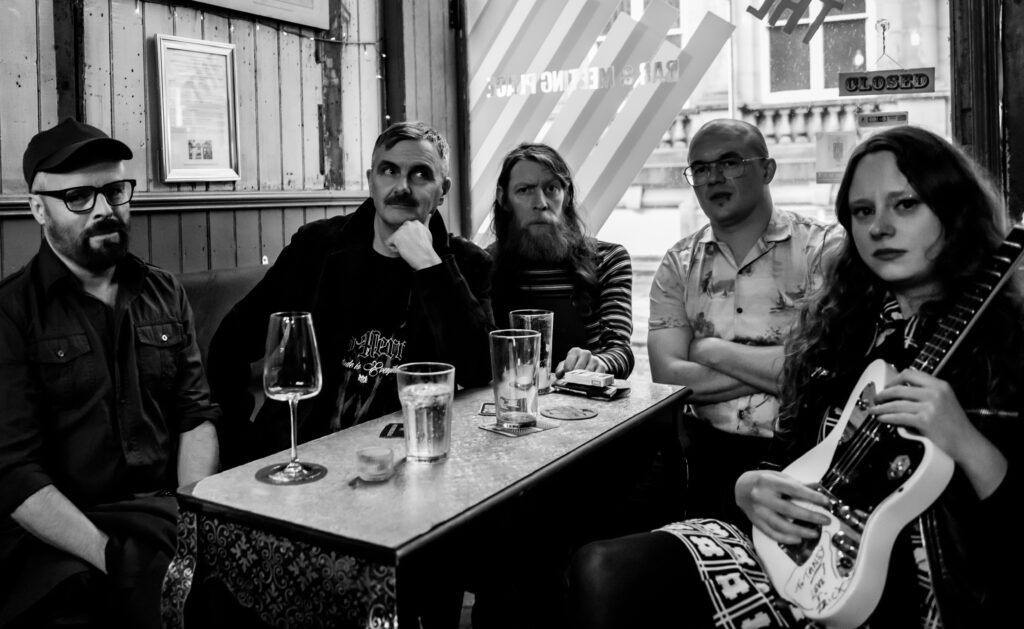
Blue Orchids’ mordantly bewitching current album Magpie Heights is their third in a year. Frontman and prime mover Bramah ascribes this burst of productivity to “decent support” from his record label Tiny Global: “They’ve given me the opportunity to follow my muse wherever she leads,” he asserts contentedly. “Maturity has brought me an insight into the writing process which has somewhat accelerated my output”. He’s also recently been involved, as part of a cabal of venerable ex-Fall members, in a communal exploration of their shared improvisatory heritage (and presumably personal trauma) called House of All.
Their 1982 debut album, The Greatest Hit (Monkey Mountain) has transcended its cumbersome title to become an enduring landmark of the post-punk era. Among the many still-captivating songs on this haunting and poetic record (soon to be reissued in expanded form, and I envy anyone who hasn’t heard it before the chance to experience it for the first time) one in particular stands out. Bad Education’s sardonic spoken word refrain of “I’ve read too many books, and seen too much TV…” marks it out as an especially prescient early warning of the dangers of cultural overload. “Even back then there was an overstimulation of subtle propaganda via the media and education system,” Bramah remembers. “Dodging those bullets is an ongoing problem”.
Just a quick practical question before we move on – should his unusual stage name be pronounced to rhyme with ‘drama’ or ‘grammar’, and could he tell us what its origins were? “Drama, dear chap. Always drama! Bramah is my stepfather’s name. My mother remarried when I was six and we moved to Prestwich in North Manchester. We were originally from Droylsden in East Manchester. I copped for the name at that point, being a Beddington by blood. Such is life.”
Bramah first came into the orbit of oracle-in-waiting Mark E Smith as a friend of the latter’s sister, and played a key role in establishing The Fall’s sonic template (later memorably defined by ardent disciple John Peel as “always different, but always the same”) as guitarist on their debut album Live At The Witch Trials, and co-writer of such career-defining early material as Frightened. He returned to the band briefly around the time of their excellent Extricate album, as a replacement for Smith’s departing (soon to be ex) wife Brix.
Bramah’s Wikipedia entry ascribes both his own departures from The Fall to Mark E Smith’s unhappiness about his relationships with women in the band (in the first case Fall keyboard player turned original Blue Orchids mainstay Una Baines, later with Marcia Schofield) . An attempt to find out whether he agrees with that explanation, and if so if he is proud to have gone down in history as a sexual threat to Smith’s famously cult-leader-like hold over his ensemble, is met with a diplomatic silence.
Rephrasing the question in less sensationalist terms, assuming a form of afterlife could exist which would have room for him, how does Bramah think The Fall’s famously splenetic and imperious frontman would be responding to the proliferation of self-directed creativity by former bandmates? Might Smith think the song Replica of Me on the new album – an arch meditation on the creative process built around the resonant line “I wanted to see God in the studio” – was about him?
“I like to imagine Mark E Smith sat on a little fluffy cloud, fag in hand, looking down on his remaining acolytes with a contented smile on his face, his work done and no longer giving a **** about what we get up to, but sending his support and trust in the lessons we learned at his feet.
The idea that he wrote Replica of Me and sent it to me psychically, is very appealing.”
The final question has a broader historic reach: what are the most significant changes Bramah has noticed in the etiquette of playing and/or going to gigs in the forty-plus years between the original release of Blue Orchids’ classic debut, and the expanded reissue? “Haha, well back then there was no etiquette. The very question tells a story. Back then we were free to be ignorant, loud and stupid, and anyone who complained would have been laughed at. Now it seems you have to be quiet and attentive as you watch the show discretely via your handheld interface.”
Handheld interfaces should be lodged firmly in back pockets on Friday 2 December, when Blue Orchids play The Piper with stellar support from The High Span’s “uncynical guitar pop to express suburban awkwardness” and Silchester Road post-punk supergroup BEAU.

We hope you have enjoyed reading this article. The future of our volunteer led, non-profit publication would be far more secure with the aid of a small donation. You can also support local journalism by becoming a friend of HIP. It only takes a minute and we would be very grateful.

Leave a Reply