
Coast is Queer
David Milton
Forty-odd years ago, the most important gay artist of that era, John Yeadon, suggested that the then New Painting should be boldly confrontational and transgressive. His luminous depictions of young men with oversized erections, snogging rent boys and the occasional ape with a pitchfork (The Shining City on the Hill, 1986) were denounced, pre-Section 28, as “smut”.
Yeadon retreated into teaching and the creation of more oblique artworks – latterly, portraits of ventriloquists’ dummies, entities requiring others’ tongues to give them life. A retreat into silence then; but still suggestive of a primarily physical instrumental engagement with the artwork.
It’s a form of engagement largely missing from Queer Art, a new ‘Art Essentials’ handbook from Thames & Hudson written by curators Mollie E. Barnes and Gemma Rolls-Bentley. Their brisk introduction grandly eschews the depiction of “bodies, specifically sexually explicit bodies… That approach feels outdated and reductive.” Displays of genitals are no longer desirable; and today’s art-lover should instead engage intellectually with “a queerness that may have been unconscious or coded.”
Though it makes claims for universality (“queer art has always existed”) and provides a nifty globe-trotting overview of current practice, theirs is a strangely British position, an aesthetic austerity which insensibly appears as a concomitant of recent economic policy. Obliged to walk a thin line between the 21st century’s torrent of internet porn, the entrenched juvenility of the YBA-led market and the populist panic over paedophilia, Queer Art sidesteps many of the knottier issues raised by Laura Guy and Theo Gordon in last summer’s queer art edition of British Arts Studies. Here prurience appears as sober sophistication, self-censorship as a prerequisite of solidarity.
Through the Queer Lens

It’s a stance which speaks of the increasing power of the curatorial class. Meaning that artists are placed firmly in the hands of entrepreneurs and that discourse is foregrounded while the artwork offers a screen on which to project one’s ideas. This approach takes attention away from content or technique and from one’s encounter with the work itself to focus on the ‘queer lens’ through which images are not just interpreted but reconfigured. From it arises a certain aesthetic incoherence which, by laying claim to encyclopaedic reach, pitches globalising vision against individuated and localised lived experience.

Queerness, the duo write, “can be expressed through unconventional aesthetics, subject matter or artistic strategies that challenge dominant and artistic norms. The scope of queer art is expansive”. By this definition, perhaps of those mentioned in the text, only Andy Warhol, Robert Rauschenberg and Hélio Oiticica truly articulate a queer trajectory, working widely across media and in multiple contexts – circumstances surely only afforded to them as men.
Even they are ultimately framed by Art History and the Art Market, the latter forming the over-riding ‘dominant norm’. And you’d be hard pressed to find an artist who wouldn’t swap their place in history for a place in today’s market. Most badly want both.
Quagmire of Kitsch
Multifaceted Mexican modernist martyr Frida Kahlo is inevitably on board in her role as the world’s new favourite artist and (dominant norm alert) “internationally recognised commercial icon,” to quote Tate Modern. Alongside her is the sine qua non of queer qulture’s fine art wing, Claude Cahun, whose oeuvre puts pretty much everything else here into perspective if not into a cocked hat.
Her vividly oneiric tableaux, realised as tiny monochrome photographs, articulate not just a refined sensibility but an entire more-than-real double life realised through art. Hers is a benchmark that others featured simply do not meet. The stale flatness of their output becomes readily apparent, the two-dimensionality of their artworks a sign of their essential ornamentality.

Other symptomatic figures are omitted, including Apollonian/Asclepiusian actionist Rudolf Schwarzkogler; kinky video trickster Ryan Trecartin; materially promiscuous sculptor Ty Locke; and boring AI bot botherer Emily Martinez. Performance Art, the queer practice sans pareil (Anne Bean, Franko B., Loo Zihan) is almost entirely absent.
Absent too are such national treasures as gimmicky inappropriate kidults Gilbert & George or ham-fisted polymorphous TV personality Grayson Perry. They, and other apparently all too heteronormative-adjacent has-beens, are in a stroke consigned to the naughty step of history. But if, in the wake of woke, they’ve unloaded a lot of dead wood, our curators sink all the same in a quagmire of kitsch, of bowdlerised Classical and Renaissance imagery repurposed as narcissistic mock-heroic schmaltz not a stylistic stone’s throw from the iconography of mid-20th century fascism.
This comes via a vanguard of fig-leafed feminist figureheads: one trick pony Gluck; self-infatuated fashionista Tamara De Lempicka; third-rate surrealist Toyen; and Groucho Club-grizzled syrupy schlocksmith Maggi Hambling. In the interests of balance, and demonstrating they can easily eclipse the womxn when it comes to bad taste, Tom of Finland, Erwin Olaf, Rotimi Fani-Kayode and Paul Cadmus bring up the rear. Literally.
At Intervals
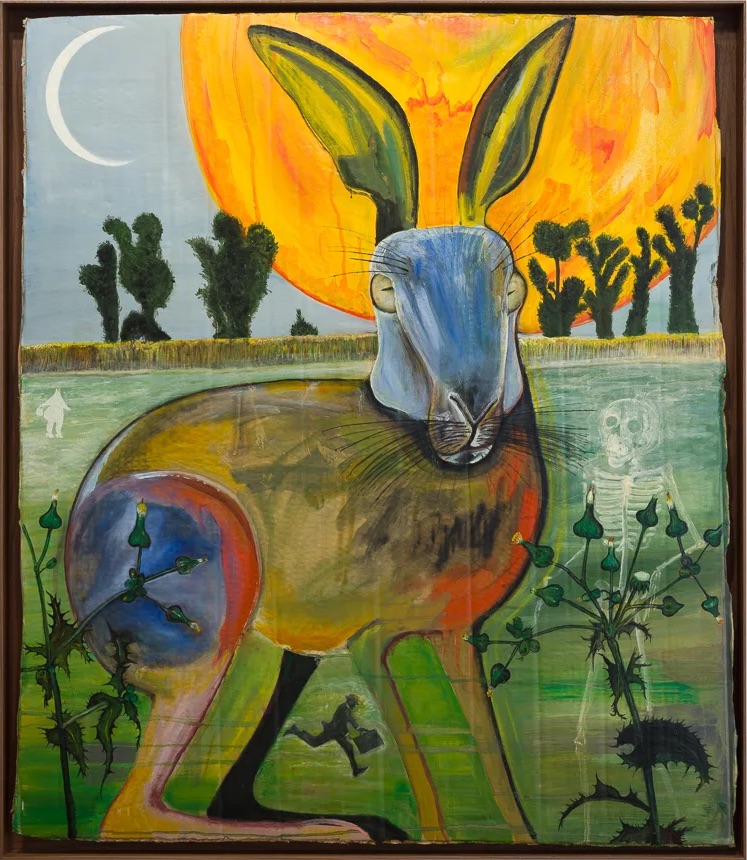
The publication coincides with a recent exhibition at Amici Studio. Queer Painting: Intervals, curated by Katie Tomlinson and Chester Tenneson, both painters and lecturers, provides a timely textbook illustration of the theoretical parameters of Queer Art and indicates their limitations. David Harrison’s magic realist nocturne Blue Hare, with its shades of Palmer, Dadd and Watership Down, lacks the satirical bite of his earlier work (2004’s Bad Fairies with its naked David Blunkett and John Prescott) and after a century of surrealism, after Garbo, Genet, Bowie, Gaga and Beckham, it’s hard to discern anything tangibly queer in it. Garth Gratrix’s Flamboyant Flamingos, Cheeky Felicia meets the layperson’s expectations of a standard abstract, but also conforms to Queer Art’s intellectually convoluted dictum that such impersonal works positively “resist the demand for visibility that is often placed on queer artists”. That’s a sleight of hand too far.
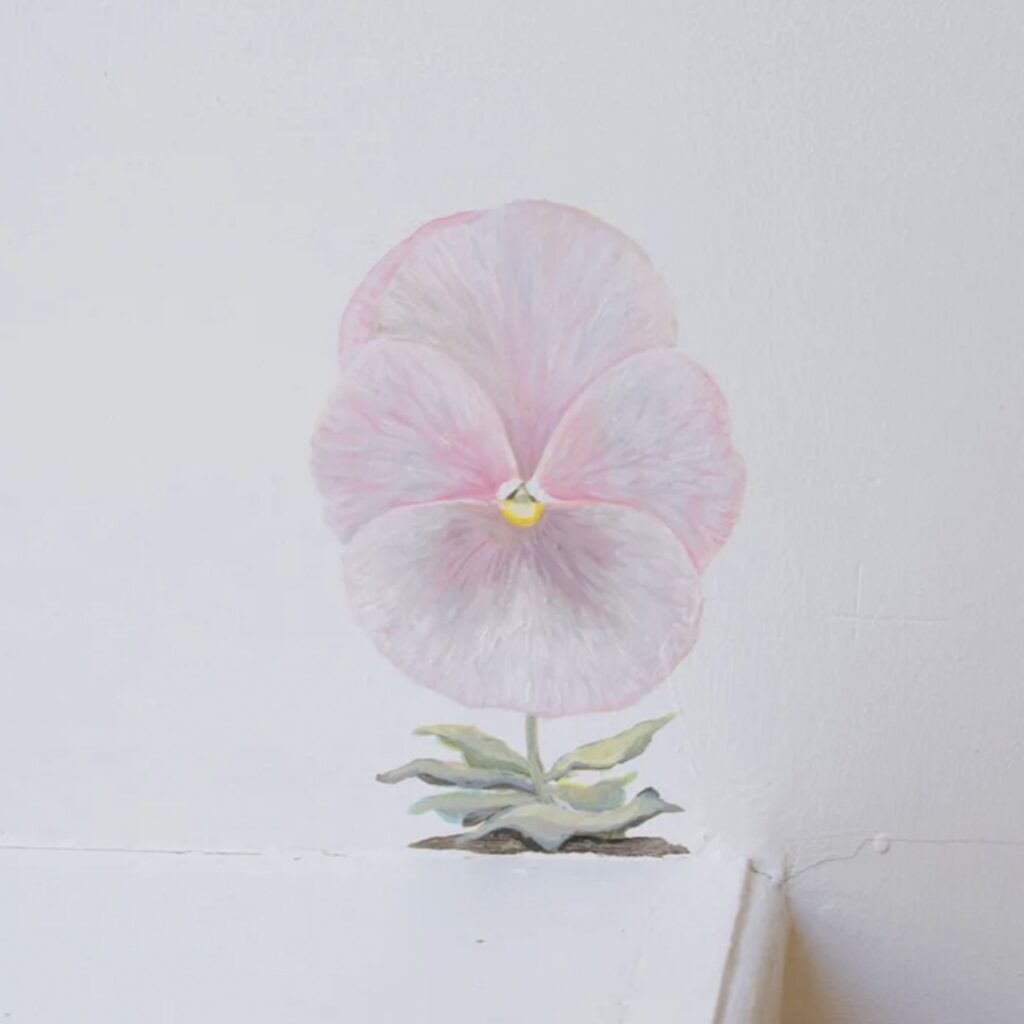
Paul Harfleet’s “F***ing Fa***t” (Hastings) is an exquisite pansy painted on the wall, a dislocated memorial. It’s the most significant piece in the show, a quietly radical work which refers in its subject matter not to classical models (touchstone for all the aforementioned purveyors of kitsch) but to the domestic paintings of flowers typically undertaken anonymously, as far as Art History is concerned, and by women; and having a low- or folk-culture status. It’s fugitive, site-specific so can’t readily be bought, but also allusive and pointing towards the reality outside the gallery. Its power derives from its metonymic status; and it’s this too which cuts through Queer Art’s inchoate thesis around gesture and perception.
Through its absurd title, Victoria Cantons’ Untitled (If you want something you’ve never had, you must be willing to do something you’ve never done) (after Velázquez) takes a tendency towards supplementarity to an extreme, but the art-about-art image itself barely merits attention. Olivia Sterling’s Bar Maids is sub-Beryl Cook trivia while Chester Tenneson’s Untitled (A sandwich) offers a weak joke about acronyms. It’s all so bloody polite. Only James Cabaniuk’s Piggy which, in a riot of flesh and blood and shit and piss impasto, recalls Leon Kossoff’s excremental outpourings of existential angst (seen a while back at Hastings Contemporary), manages to transcend the overly restrained qualities that characterise the exhibition.
Queer Painting: Intervals, curated by Katie Tomlinson and Chester Tenneson, showed at Amici, 12 Claremont, from 26 June-11 July. Images of most of the work are still on view, however, at the Amici website at amici.art/collaborations/queer-painting-intervals-curated-by-katie-tomlinson-chester-tenneson along with details of the gallery and studio. A highly recommended gallery, combining collaborative exhibitions with a community studio.
We hope you have enjoyed reading this article. The future of our volunteer led, non-profit publication would be far more secure with the aid of a small donation. You can also support local journalism by becoming a friend of HIP. It only takes a minute and we would be very grateful.

Leave a Reply