
Tested by the Waters
Sea-swimmer, dog-owner, and relative newcomer INGRID ALLAN dips her toe in the waters around Hastings
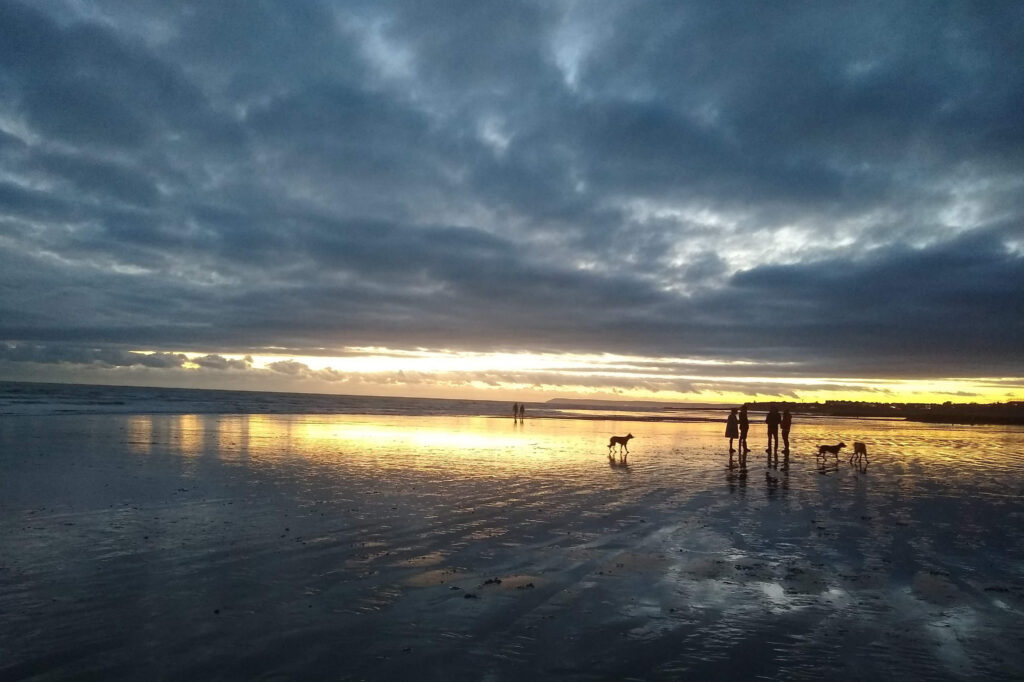
With the recent Blue Flag and Seaside Award given to Marina and Pelham beaches respectively, many residents will have a little less trepidation about taking a relaxing dip in our salty stretch of the Channel. Questions remain, however, about our town’s persistent difficulties with nature’s greatest resource.
Southern Going South
Water outages remain common, despite chipper emails that land in my inbox every few months from our supplier insisting improvements are being made to the creaking infrastructure. However, it has been a while since I encountered the kind of unspeakable detritus which was once common near the overflow pipes between Bexhill and St Leonards.
Having moved to Hastings a week before the devastating floods that caused widespread water outages in October 2023, I was initially unfamiliar with the spectacle of a gent from the water company dropping off a multipack of 2L bottles at my door and assumed the whole thing must be a one-off. Three years on, that same gent now knows to crouch down and prevent the escape of two exuberant Samoyed dogs every time he stops by.
Hastings and St Leonards are currently served by two large water supply works, and one major sewerage treatment works, and it’s not about the age of the facilities: the burst pipe that left 32,000 homes without water for days in 2024 was installed in 2007.
But with credible mutterings in the corridors of power that Thames Water could be brought back into public ownership, and multi-million-pound improvements promised for both Brede and Beauport supply works, could the tide finally be turning on a particularly crappy chapter in our town’s history?

Southern Water itself has admitted that pollution remains a problem and that it has fallen short of standards at several wastewater sites. While the vast majority of incidents listed for the region in the government’s 2024-25 data are category 4 (spills the environment agency claims have ‘little or no impact’), anyone who watched Channel 4’s grisly docu-drama Dirty Business will know that downgrading sewage leaks which should have been given a category 1 or 2 rating is a practice that can and does go on behind the scenes.
Either way, the sheer number of incidents listed makes for depressing reading, as does the £7 million fine Southern Water was recently issued for repeated instances of sewage dumping in Kent four years ago.
Those Plastic Beads
However, it would be optimistic and naïve to assume Southern Water has entirely cleaned up its act. When ten tonnes of plastic beads washed up on Camber Sands in November of last year, the company initially failed to alert anyone of the incident; it was left to community groups to instigate the clean-up. Even after Southern accepted responsibility, the company provided no further information to residents about the potential risk to dogs or wildlife from ingesting the beads.
It was the worst instance of plastic pollution ever to hit the Sussex coast. The beads tested positive for lead and arsenic, and our MP knocked on the door of 10 Downing Street with a 10,000-strong petition. The clean-up crews eventually dispatched by Southern Water did a half-arsed job (with beads still being found at the Dungeness and Rye Harbour nature reserves long after). Outdated infrastructure was apparently to blame, but most of the treatment works in our area are not, as the water companies would have us believe, ‘Victorian infrastructure’ (Freshfields was commissioned in 2003).
I had hoped that a disaster on this scale would force someone, somewhere to do something (and I wouldn’t count the Environment Agency releasing a statement confirming they might upgrade the spill to a category 1 event as that ‘something’). I had hoped the same when the company received a £90m fine for nearly 7,000 incidents of illegal discharge across the Southeast in 2021. Southern has claimed repeatedly, while being handed further convictions (now totalling 174) that a change of leadership in 2022 has led to an overhaul of these negligent practices, but the signs are not promising.
Surfers to the Rescue
It has therefore fallen largely to our friends at Surfers Against Sewage to keep the community alert to any hazards posed by swimming on our local beaches. The group maintains an active presence in East Sussex and in May staged a huge ‘paddle out’ demonstration, in both Hastings and Seaford, against the continuing pollution. Corresponding similar events in coastal communities up and down the country received favourable coverage across both local and national media.
Many of us have chosen to make our homes here beside the sea despite the highly seasonal economies and reduced job prospects of most English coastal towns. Beyond being a fitting reminder of this love for our waterways, the recent Walking on Water event welcomed not only members of Surfers Against Sewage, but another champion of holding Southern to account, in the form of our MP, Helena Dollimore.
Action from our MP
Though Helena’s had a busy month securing priority tickets for residents to see the Bayeux Tapestry and hosting a public consultation on improvements to our seafront, her persistence goes above and beyond expectation. Even if you’re not a keen enough political aficionado to be keeping tabs on her crucial Select Committee work, when Southern were unwilling to investigate reports of sewage pollution at Hollington stream, Helena was happy to head down there and spotlight their negligence.
Helena told a recent Clean Water Action Group demonstration: “It’s only because of the work of those citizen scientists, because of the volunteers, because of people in towns like this, that we have been able to expose the scale of this scandal.”
Other factors have contributed to improved conditions on our beaches. And while we may feel powerless in the face of the endemic criminality blighting our water supply chain, it’s heartening to know that smaller steps, like the increase in seafront bins, particularly during the summer peak, have made a big difference.
Excluding Dogs?
Among the council’s more controversial measures are two large dog-exclusion zones, which between them encompass about a kilometre-and-a-half of beach (and roughly line up with the areas awarded). The St Leonards stretch, which reaches from Bottle Alley to the Royal Victoria Hotel, is around half the size of the Hastings section, which extends across the whole of Pelham beach, from the Pier to the Harbour Arm. In place since 2024, the measure is likely to have had an impact on the recent Blue Flag and Seaside Awards, but remains controversial and poorly enforced.
The use of dog-exclusion zones on British beaches can be traced to an Irish study monitoring their impact, and it makes a solid case. Dog-fouling is a huge problem in many areas of Hastings, and the risk, particularly to children, cannot be overstated. That said, the solution the council has reached isn’t without its problems.
There’s the risk of discarded fishing equipment embedding itself in paws or toes. Despite the risk of a £1500 fine for leaving fishing hooks unattended, I still found myself having to remove a vicious hook from my dog’s tongue with a set of pliers after some idiot felt the need to leave it, baited, just below the tideline.
We’ve tried the mercifully small sliver of beach between the pier and the east end of Bottle Alley, but unlike Rock-a-nore, it lacks any clear barriers to mark the start and end of the exclusion zone. Faced with the risk of an on-the-spot fine and a dog whose recall depends entirely on whether there are gulls nearby, we resolved not to return until October.
Dog vs Human Mess
Dog-fouling on our beaches will never be acceptable, but it’s also a literal drop in the ocean compared to the amount of raw sewage that has been discharged into the same stretch of seawater over the past few years. After all, when Pelham and Bulverhythe beaches were closed to the public in 2021 and 2022 respectively, it wasn’t the fault of anyone’s dog.
Going Swimmingly?
At this point, you’re probably thinking “that’s all well and good, but should I be worried about dunking my head under when I go for a swim or not?” to which I can only repeat the guidance of the borough council: check conditions on the day, particularly through the Surfers Against Sewage app.
Calm conditions at the end of June allowed the silt to settle, making the sea appear much clearer, but appearances can be deceptive; following reports on the app of a 5 am discharge within walking distance of the lifeguarded zone, I decided not to risk it. A few days later, the lure of the azure proved too great, but I kept my head firmly above the surface.
We hope you have enjoyed reading this article. The future of our volunteer led, non-profit publication would be far more secure with the aid of a small donation. You can also support local journalism by becoming a friend of HIP. It only takes a minute and we would be very grateful.

Leave a Reply