
BOOKBUSTER REVIEW
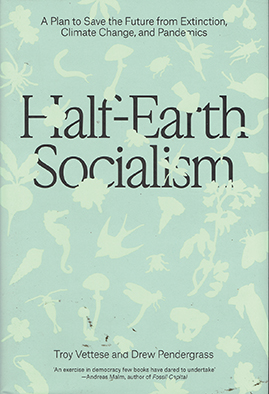
Half-Earth Socialism
By Troy Vettese & Drew Pendergrass
Published by Verso, 2022
Available at Bookbuster, 39 Queens Road
Review by Tim Barton
Recommended by Andreas Malm, author of How to Blow Up a Pipeline, this book offers ‘a plan to save the future from extinction, climate change, and pandemics’. Unlike many books on how to fix our mess, the authors have no truck with mega-projects under capitalism, such as geoengineering. They also abhor a contemporary establishment ‘colonial’ version of ‘rewilding’, ‘half-earth’, and ‘wildlife corridors’. They take a very critical view of livestock and the meat industry, one that allows greater land to be freed up for their project, and that alters the ground from which many contemporary viruses emanate, such as avian flu. An important stance taken here recognises that capitalism and animal husbandry are inextricably linked, which motivates the authors to be particularly outspoken on issues such as veganism.
Many of us have heard at least a little about rewilding in recent years. The principle of creating animal migration corridors is also well established, although few countries have enacted them on an appropriate scale, if at all. The half-earth philosophy takes both rewilding and wildlife corridors and paints them on a vaster canvas – literally, half of the landmass and ocean is proposed to be given over to Nature. This is to allow Nature to bounce back and to reform its complex ecologies, restoring balance to our biosphere. It is here deemed that a half-earth strategy is a far ‘better way to sequester carbon’ than hubristic interventions such as BECCS (bioenergy with carbon capture and storage).
LEARNING TO LIVE IN BALANCE

‘Colonial’ plans for such a project are already under discussion: economic profit and social hierarchy planning are imposing it from the top, and with ‘the market’ as its pilot. As Hegel puts it, quoted here in the chapter ‘Binding Prometheus’, the market is a dangerous choice of pilot, ‘a monstrous system […] the life of a dead body that moves itself within itself, one which ebbs and flows in its motion blindly’. Just as with earlier thinkers, such as Murray Bookchin, the authors here do not believe a balanced relationship between humans and nature is possible without human society learning to live in balance with itself. Bookchin fought hierarchy and domination in all its forms, and saw this battle as integral to ‘greening’ our world. The authors here add ‘socialism’ to ‘half-earth’ in a similar vein. As it becomes increasingly obvious to a greater and greater proportion of our populations that an ecological catastrophe is brewing, this discussion of how to navigate change is necessary, if rather late in the day.
Right from the off, Vettese and Pendergrass accept that there is a utopian element to their projections, as how to get from ‘here’ to ‘there’ remains problematic. It is refreshing to see this admitted. Now and again, their critique of capitalist and scientistic technophilic ‘solutions’ fails to offer the same latitude in judging the optimism of the profiteers and their technicians, but they present their argument in a short book, so we can overlook that: especially as there is already so much gung-ho technophile nonsense already out there.
WITH ELECTIONS HERE IN MAY…THE ‘LEFT’ DIVIDES
Environmentalists have been largely unsuccessful in getting over to a lot of people the interlinked nature of the web of life, and of the toxic acceleration many small failings together can synergistically cause. The authors here add that they also have failed to ‘articulate what a post-crisis society might actually look like’, and add that ‘the ruling class had long been clever and ruthless, but they were also fortunate to face such hapless opponents’. It is, then, the authors’ task, and ours, to become less ‘hapless’, and with some urgency. Until this is achieved, ‘the only real competition the neoliberals face will be ‘racist-libertarians’ – the architects of Brexit, the alt-right, and [organisations such as] Alternative für Deutschland’. Presently, ‘neoliberals have not needed to divide and conquer their enemies because liberatory movements have obliged with their own interminable feuds’. With elections here in May, the likelihood of a lot more Tory council seats, as the ‘left’ divides between feuding post-Corbyn (Blairite) Labour
and an opportunist Green Party, no matter how much it is understandable, illustrates well the problem.
A chapter analyses some of the salutary lessons learnt due to the ‘failure’ of the Biosphere 2.0 experiment to create a self-sufficient mini-ecology under glass; with an eye to both weathering the storms ahead here ‘at home’ and to possible colonies in space. Elon Musk’s plans may be out of place under present conditions but the failure to have a follow-up Biosphere 2.1, to get it right, and at the same time learn and teach about the fragility of even the most complex ecology (Earth’s itself) is one reason why his plans are ‘too late’. Interestingly, Trumpian propagandist, cynical climate-change denialist and early CEO of Cambridge-Analytica, Steve Bannon, was instrumental in suppressing the data and stopping a follow-up: another ecology, a political one, we would do well to notice.
STILL POSSIBLE TO REPAIR OUR BROKEN WORLD

A long chapter on ‘Planning Half-Earth’ deals with some of the obstacles and, as is so often the case with contemporary literature about our near-future, uses fictional presentations of ‘tomorrow’ to illustrate what the future might look like. As I noted earlier, they are not blind to the enormous obstacles to their radical suggestions, as illustrated in a low-key local example from recent issues of HIP about Ecclesbourne Glen, the ‘bypass’, and most recently the ‘land clearance’ at Barley Lane: but they might well succeed in convincing you, the reader, that these radical changes are necessary.
Here is a summing up of the concept of half-earth, ‘the task of unbuilding makes clear that environmentalism isn’t so much the idealization of ‘pristine’ nature (though it is vital to protect intact ecosystems) but the recognition that it is still possible to repair our broken world.’
We hope you have enjoyed reading this article. The future of our volunteer led, non-profit publication would be far more secure with the aid of a small donation. You can also support local journalism by becoming a friend of HIP. It only takes a minute and we would be very grateful.

Leave a Reply