
Behind the Scenes at the Museum
Continuing the domestic scene, the pleasant and rather cosy ceramics gallery at Hastings Museum & Art Gallery has recently been rearranged. In what they call a ‘special intervention’, a newly-kilned series of rather disquieting pottery is currently interspersed among the museum’s beautifully random collection of hexagonal Japanese teapots and rare 18th century fuddling cups.
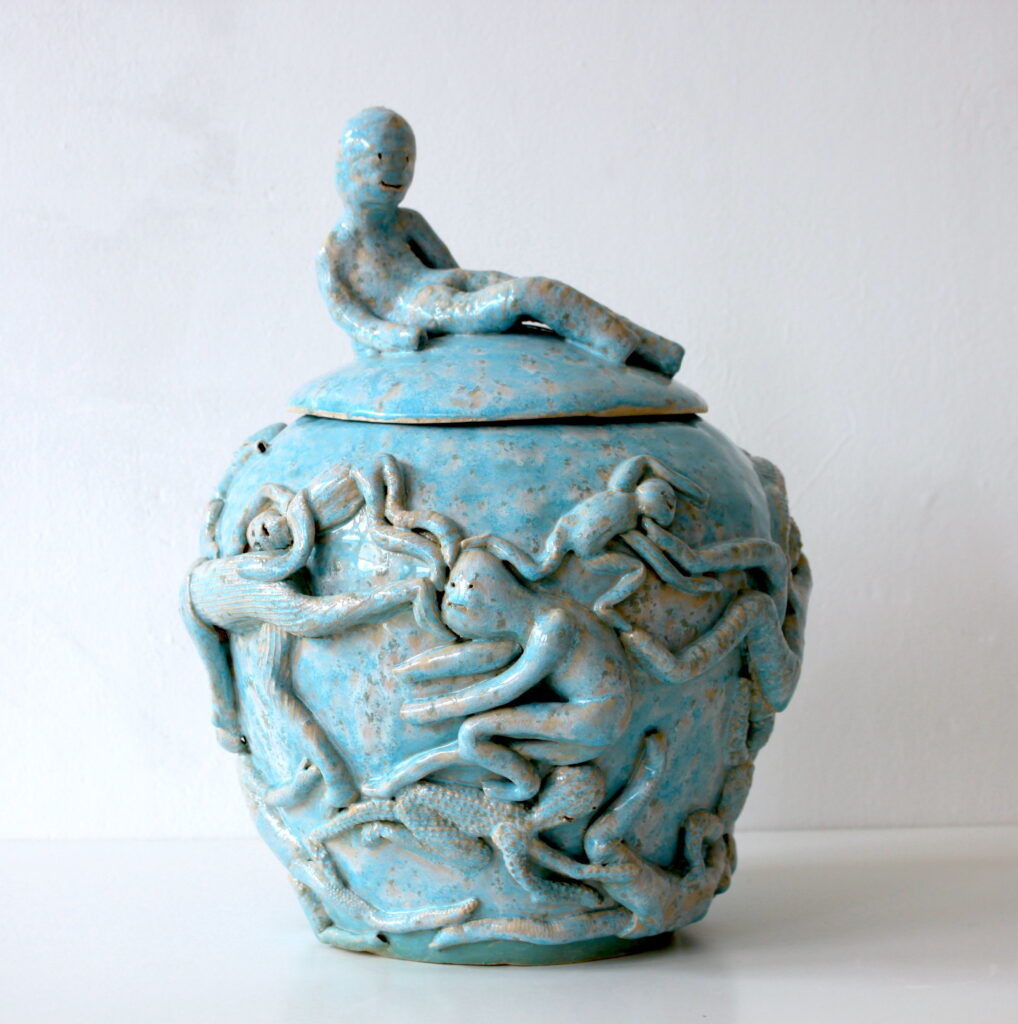
Kim Pace, Vessel for Family Secrets, 2024
Precisely why Kim Pace’s tureens and bowls are so unsettling is a complex question, and apart from the immense skill of making, this is partly why her work is so celebrated. Boldly cast, in modern designer colours, these pots look, at a casual glance, as though they would grace a table or ‘island’ in someone’s Farrow-and-Ball-decorated kitchen-diner. Look closer and there are people, or not-quite-people, crawling all over them. A tureen handle, for instance, is made in the shape of a conquering leek with a little sword, his foot on a prostrate parsnip. Around the outside float chopped vegetables and bits of shrimp, in predatory attitudes.
Whether or not they display vegetal characteristics, Pace’s figures are partly tentacular, partly insectile, always humanoid, their minimalist faces eerily expressive. They cling around bowls, sit smugly on the lids and snigger at the concealed contents, he-he-he, you’d never guess what we’ve got in here, or drown one another in the middle of bowls of soup. Pace calls it her ‘shame’ series, hinting as it does at the secrets contained within ostensibly ‘nice’ families. Or not-so-nice families, or perhaps every family.
Jane Millar is a Brighton-based artist inspired by earlier years working in psychology research. “I spent years studying how people and groups construct their sense of self and construe memory. Now I use paint instead of data, intuition instead of hypothesis,” she writes of her work. Here among the memorabilia in the museum’s Seaside Gallery are placed souvenirs, objects that recall and combine present and past, magic and mundanity. She uses traditional methods of hand-building and glazing to create new objects that resemble or recall found objects. Souvenir – French ‘remember’ from the Latin subvenire, to occur to the mind. It’s a bit more than that, though: separate the syllables and you have ‘sub’ – under, and ‘venire’ – to come, to go, to approach. So a souvenir is literally something that reveals, or perhaps conceals, that which is under the surface.
Oxymoron spoiler alert: Family secrets are on display at Hastings Museum & Art Gallery, Bohemia Road, until 25 January. hmag.org.uk/see-and-do/exhibitions/family-secrets
We hope you have enjoyed reading this article. The future of our volunteer led, non-profit publication would be far more secure with the aid of a small donation. You can also support local journalism by becoming a friend of HIP. It only takes a minute and we would be very grateful.

Leave a Reply