
A Forgotten Hastings Hoaxer
HELEN MURPHY & NICK PELLING investigate a curious case
Have you ever heard of Charles Dawson? I suspect not. He was a well respected Victorian gent who was brought up in St Leonards and later became one of the bewhiskered, worthy founders of the Hastings Museum and Art Gallery in 1892. So far, so boring. But it seems he was also a hugely successful con man, responsible for one of the great hoaxes of the early 20th century.
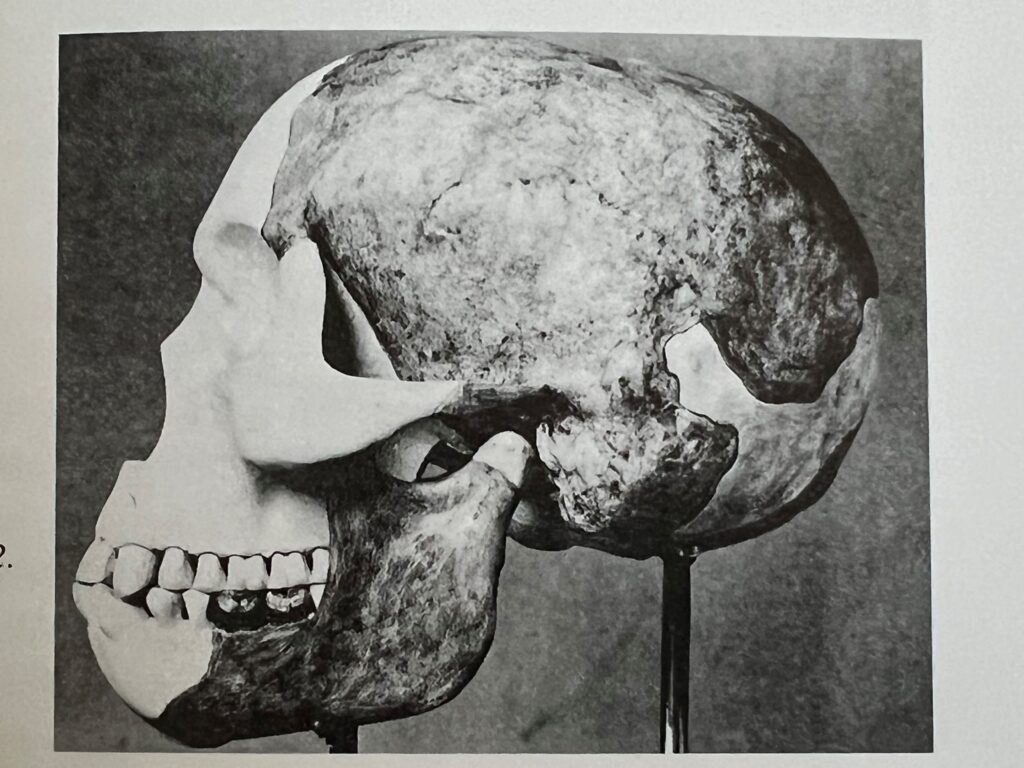
In 1912 Dawson ‘discovered’ an ancient skull that seemed to be the ‘missing link’ between ape and man. This became known as the Piltdown Man; it sealed Dawson’s reputation as one of the great amateur scientists of his time; a reputation that lasted far beyond the end of his life in 1916. It might be slightly embarrassing for the town, but one of the key founders of the Museum, was essentially an inventor of archaeological lies. So, who was this esteemed gentleman faker?
Charles Dawson was brought up in St Leonards in the later nineteenth century and became a well regarded solicitor, but most importantly, he also became an amateur paleontologist and antiquarian. He built up quite a collection of supposedly ancient artifacts, such that he was welcomed into the Sussex Archaeological Society and was soon giving ‘important’ academic papers about his ‘finds.’
A VERY BRITISH HUMANOID
His already growing reputation escalated into national fame when, in 1912, he ‘discovered’ the skull in a ditch in the tiny hamlet of Piltdown. Dawson claimed that the skull fragments were in fact the ‘missing link’ in the evolutionary chain: the skull was apparently the vital evidence of the transition from Ape to Man. (That such a transitional link might one day be found had been a Victorian supposition ever since Darwin’s evolutionary ideas were largely accepted.) Absurdly, the notion that the first half-humanoid should turn out to be British made the public seize on the story with nationalist glee.
From this discovery onwards, Dawson was seen as probably the best amateur scientist in Britain: in the dusty realm of bits of old bone and pottery, he was a sort of tweedy celebrity. When he died in 1916, he was still ‘a great man’.
You might assume that such a genteel fraudster would essentially be an unpleasant chap, but that does not seem to be true. A fellow archaeologist from the Natural History Museum, Arthur Smith Woodward, said he was a “delightful colleague” and Dawson’s wife, Helene, said he was “the best and kindest man who ever lived” .
RATHER RUBBISH FAKERY
It took forty years for the archaeological world to prove, definitively, that the skull was fake. In fact, modern forensics revealed that the skull was something of a bodge job: it was a combination of half a medieval human skull and an Orangutan’s jaw, with some crudely filed down teeth to make it fit. In many ways, the hoax is a piece of rather rubbish fakery.
Why did the apparently upstanding member of the Hastings community stoop so low? Perhaps Dawson can be seen as just another of this town’s eccentrics. He does not appear to have been a bad person or even a profiteer. He has been described by the historian Miles Russell as “a genial Jekyll and Hyde”: a loveable enthusiast whose genuine love of antiquities pulled him into inventing that which he passionately hoped to find. Later research also found that many of the artifacts that he generously donated to Hastings Museum were a bit dodgy. The Museum now has a little display about the whole curious tale. But why this man of science chose to betray his calling remains mysterious and probably always will.
We hope you have enjoyed reading this article. The future of our volunteer led, non-profit publication would be far more secure with the aid of a small donation. You can also support local journalism by becoming a friend of HIP. It only takes a minute and we would be very grateful.

Leave a Reply