
Immortality, Eternity, Angst
VICTORIA KINGHAM on the moving experience of the Still Life
The new exhibition at Hastings Contemporary that opened last Saturday must be one of the more significant shows so far presented there. Immortal Apples, Eternal Eggs (named from an apt quotation by Virginia Woolf) combines items from two important UK Art collections, the Ingram Collection and the Roberts Institute. Together, these house significant works made over a span of more than 100 years, and this exhibition is made up of a selection of more than 50 of them.
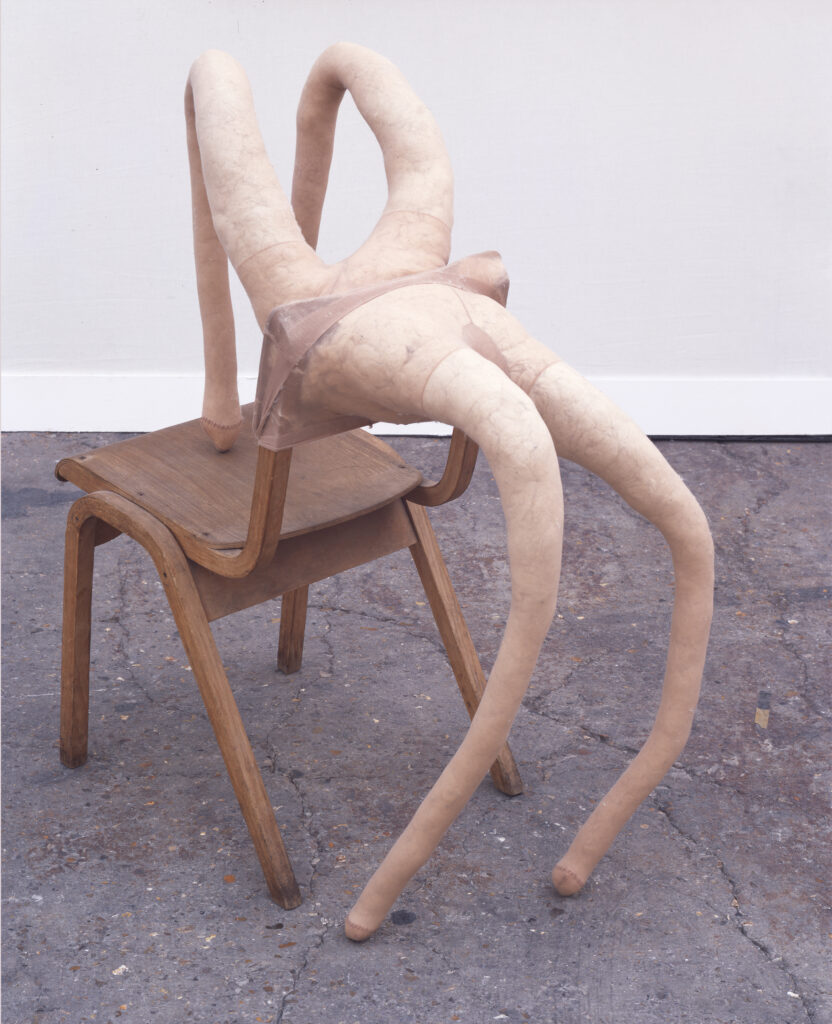
There is something deeply unsettling about these carefully chosen paintings and sculptures. Nobody will come out of the exhibition still naively thinking (if you ever did) that a still life is somehow just an extension of an art class, an academic exercise. Consider, for example, Sarah Lucas’ sculpture Grace (2006). It’s anything but graceful. Two pairs of unfinished ‘legs’, joined at the centre, lean back over an old-fashioned wooden school chair of the kind used in the 1940s. Stuffed with kapok, bound with something that looks like bandages and dressed in tights, this singularly graceless and unfinished humanoid calls to mind countless other ‘human’ activities and artefacts, from serious injury medical treatment through ‘penny for the guy’ ideas to bodily mutilation, from dreary school classrooms to cross-dressing to gender ambiguity. If you think this is a fanciful extension of ideas please go and see the exhibit: I defy anyone who examines it to not emerge with a head full of ideas.
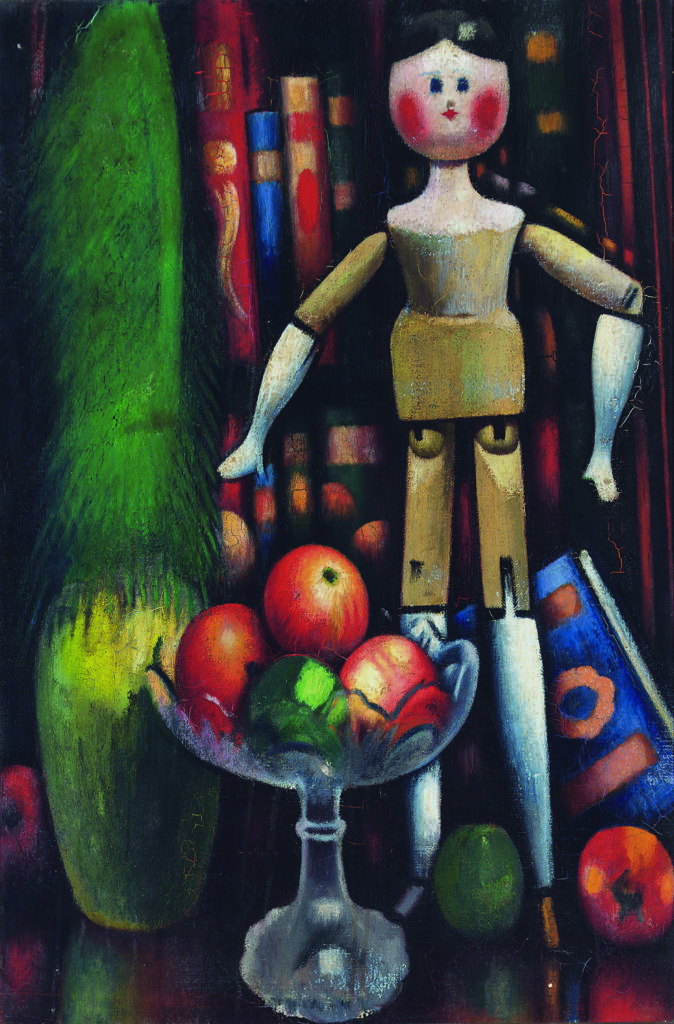
Mark Gertler’s picture was, of course, painted more than a hundred years before. I have always liked his work, so modernist, so intense, beautifully ornamental and design-oriented in unique bold colour combinations but at the same time always redolent of something sinister. The work in this exhibition, The Doll (1914) is typical. Humanoid obviously, Gertler’s Dutch Doll stares out directly at the onlooker, synthetically rosy cheeks are echoed by the ‘real’ bowl of apples below. The lower sections of the doll’s arms and legs, crudely constructed, look dismembered, and the whole composition is, like Gertler’s most famous painting: The Merry Go Round, a figure playing at real life, a parody of the actual, yet infinitely more than a collection of inanimate objects. Though Gertler was essentially a realist painter, he was at pains to create an overall design and pattern. But we can see, retrospectively, premonitions of the eerie De Chirico ‘Mannequin’ paintings done ten years later. Questions are inevitably raised, in the mind of the viewer, about the nature of reality, and of humanity within that reality. Gertler gassed himself in 1939, the onset of war; Virginia Woolf, a friend and contemporary, a year later.
The exhibition is highly intelligently curated in three sections, raising three different categories of thought: nature and culture, trace and absence, and production and consumption. There is nothing still in these still lives: there are darker undercurrents of death, violence, and exploitation. Woolf called the still life a token of “a spiritual reality immune from destruction, the immortal apples, the eternal eggs”.
This important exhibition, not to be missed, shows at Hastings Contemporary until 16 March 2025. More details: hastingscontemporary.org

We hope you have enjoyed reading this article. The future of our volunteer led, non-profit publication would be far more secure with the aid of a small donation. You can also support local journalism by becoming a friend of HIP. It only takes a minute and we would be very grateful.

Leave a Reply