
Hastings Jazz Festival – A Dedication to Joy
VICTORIA KINGHAM
Last weekend’s Jazz Festival was a sell-out, hugely successful, supremely managed and organised, with some of the best performances from all across the genre. Musicians and audiences alike were on top form. Importantly the success of this festival will put Hastings in the frame nationally, for an even bigger weekend event next year.
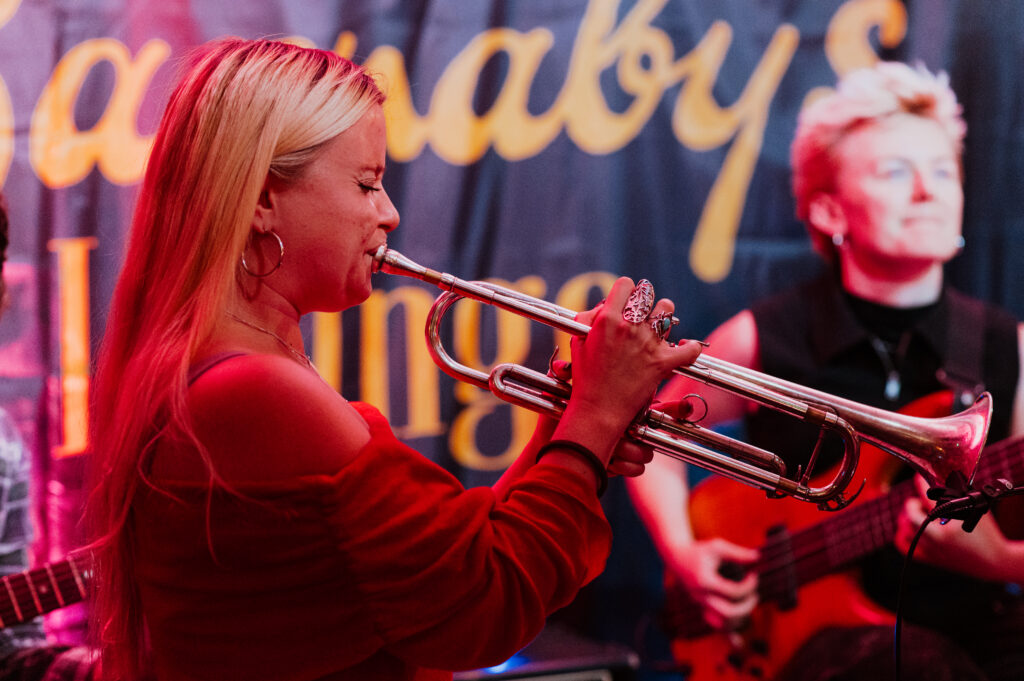
Poppy Daniels
The event showcased the best in British jazz, across the genre from tested vintage to vin de primeur. Over 100 musicians took part and it’s impossible in this brief round-up to mention all of them by name; details and links are given at the end.
MORNING
Liane Carroll began the day with resounding voice and instant musicality, honed through years and years of national and international performance, recording, and session work. Her inexhaustible repertoire ranges from hundreds of jazz standards through to blues and rock-and-roll. A born performer, she lends her own personality and style to composers as diverse as Hoagy Carmichael, Laura Nyro, and Don Fagan (of Steely Dan), while always remembering and crediting composers. She’s also very funny – what could the ‘cuddly ram song’ be but Embraceable You? Barnaby’s Lounge was full at 10:15, and people were eating delicious breakfasts.
Rory Ingham’s Trombone Assembly is a unique five-trombone outfit. For the most part they played standards in inspired arrangements that showcased their individual styles. Joined by multi-instrumentalist Ross Stanley, whose technical skill and invention lend any keyboard a whole-band sound, bass and drums, and for the first time by virtuoso trombonist Harry Maund, they packed out Henry Ward Hall. Outstanding number that brought me to my feet: Gvoove, by bass player Laurence Cottle.
Will Barry led a beautiful trio: bass and drums were father-and-son duo Jeremy and Louis Brown, and perhaps the family rapport (they are also Barry’s cousins) lent a warm glow to everything the band did. Barry’s pianism is clearly inborn: his solo introduction to the classic Eckstine ballad, I Want to Talk About You (immortalised by John Coltrane on Soultrane) was a complete joy; the casual brilliance evidenced by the band’s entire set, Barry’s careful acknowledgements to the originators, and their instant musicality, clearly captivated the audience.
AFTERNOON
Simon Spillett’s performance was partly in celebration of 30 years in the music business – a steadfast rock on the British jazz scene. Absolute torrents of fluent tenor sax demi-semi quavers make you think of (too-short lived) Tubby Hayes, and it comes as no surprise that Spillett readily acknowledges Hayes’ classic hard-bop as a primary influence, and that his 2023 album is entitled Dear Tubby H. Amid the fast and furious tunes – Clark Terry’s completely frenetic Opus Ocean among them – was Hayes’ perfect ballad, A Dedication to Joy. And it was.
Fliss Gorst leads an all-female swing ensemble. Tenor saxophone player, teacher, composer, arranger, and band leader, she has been pleasing crowds in London and the south since 2011. The band played at The Printworks, in a hall which accommodated the accompanying dancers, Grounded Movement, who encouraged the audience to dance with them. The room was full, and people were standing at the door for a set that started with When the Saints Go Marching In. It’s a real feelgood dance band, ideal for a late summer afternoon.
Poppy Daniels is an extremely talented trumpeter. Her speciality is a heady mix of contemporary jazz that pays tribute to the greats while incorporating today’s universal influences: latin, funk, beatbox, hip-hop, R&B. Her set at Barnaby’s – a half-hour improvisation by an accomplished quartet – was based on lovely jumpy bass riffs in alternating time signatures laid down by bass player Alley Lloyd. There was an infectious freshness about this performance, and their evident enjoyment of their own musical inventions and interactions was almost palpable. A lovely set.

Samaki collective recreates the sound of 1970s African musicians like Fela Kuti, Tony Allen, and Oscar Sully. Relentless grooves and soaring melodies, very much driven along by local legend, teacher, arranger and promoter Julian Humphries on hand-drums and percussion. The biggest surprise of the day was this team-up of Samaki with Barnaby Davies’ Big Band, playing Afro-beat arrangements for a 12-person horn line-up (including guest trombonist Trevor Mires). These arrangements lent space for short improvised breaks (notably by Mires and trumpeter Joe Auckland) and were played with great musicianship, plus that intangible thing that I’ve come to love, Hastings joy.
EVENING
As a highlight, the festival was privileged to present long-running Canterbury outfit Soft Machine, absolute bastions of the 1970s prog-rock/jazz fusion scene and still going strong – the festival here is part of a tour of the UK and Europe. Guitarists’ guitarist John Etheridge has been touring, mentoring, and teaching for something like 50 years but has never stopped inventing. His music is as full of fresh riffs and phrases now as it was in 1975 and is at the forefront of this band’s current work. What they do is still marvellously off the wall, in fact, Out-bloody-rageous.

UK jazz aficionados will need no introduction to Soweto Kinch. His career spans hip-hop, jazz, classical composition, teaching, mentoring, and broadcasting and he effortlessly manages Dolphy-type riffs along with 21st century electronics. He played most of his recent piece Soundtrack to the Apocalypse, the final part of a trilogy of works begun in 2019. This had its debut with the London Symphony Orchestra at the Barbican last year. In Hastings he performed with rising-star bass player Josh Vadiveloo and drummer Louis Hamilton-Foad. It’s ambitious and unique, and Kinch used loops and samples to fill the large hall (full to capacity) with an essentially orchestral sound, over which he played, in his customary controlled-anarchic alto style. He also featured an electronic mouth-blown machine called an aerophone, which produces a sound oddly reminiscent of Weather Report’s funk years. Like Courtney Pine he has become almost venerable, and also like Pine he encourages audience participation – in this case a rap loosely based on words like ‘Hastings’, ‘tension’, and ‘seagull’ randomly supplied by the audience, who loved it all.
Veteran musician Jim Mullen is one of the founding luminaries of the UK jazz scene, and one of the best jazz guitarists in Europe. He played a predictably tasteful set with his customary sidemen Ross Stanley (back on the Hammond this time) and Tristan Maillot (drums). His playing has only improved with age, and frankly I love his elegantly-presented sets and his spot-the-tune-type solos. This skill of inserting lines from (in his case) My Favourite Things, Bewitched, Bothered, and Bewildered, Tiptoe Through The Tulips, and Dixie, among several others, into the improvised line, is given to relatively few jazz greats. The band’s last number, in which this skill was highlighted, was a version of the theme from University Challenge.
The festival’s final performance was that of Bucky Leo, with a vibrant and joyful set at The Printworks that had the crowd on their feet and dancing. With a brilliant full band, and a talented backup singer, he played a mixture of his work. He ended with the song very familiar to fans of Fela Kuti (his former bandleader), Water No Get Enemy.
Next year’s Hastings Jazz Festival will be even bigger and even better. I’m looking forward to it already.
Full details and lineups at hastingsjazzfestival.com
We hope you have enjoyed reading this article. The future of our volunteer led, non-profit publication would be far more secure with the aid of a small donation. You can also support local journalism by becoming a friend of HIP. It only takes a minute and we would be very grateful.

Leave a Reply