
Foxtrot Echo: ComfortablyOut of Stepwith the World
NICK TUCKER
Less than three minutes into my interview with the roguish, counter-culture iconoclast, Foxtrot Echo, I realise that the word ‘interview’ isn’t going to contain what is clearly going to be a sprawling narrative, coiling in and out of itself like a snake on ayahuasca.
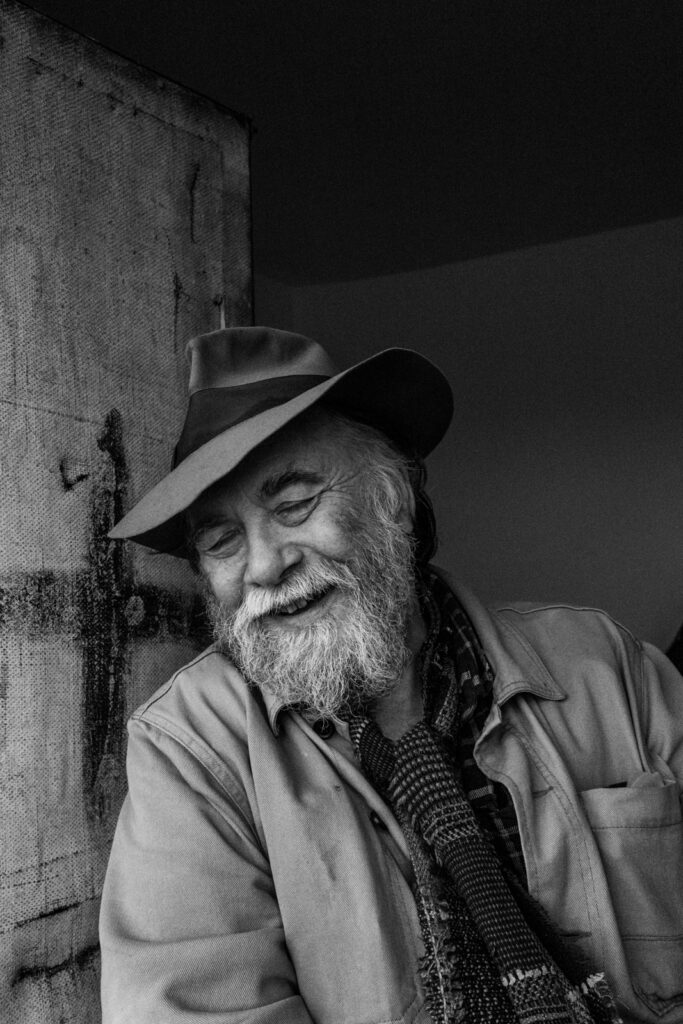
Foxtrot has lived a shape- shifting, brilliantly chaotic life that seems to have unfurled in a metaverse between chance and design. A life which has existed on the fringes of society while simultaneously at the heart of a largely lost, undocumented British underground scene that began in the early 1970s; a scene informed by movements such as Fluxus and the contrarian impulse of the outsider. Talking to Foxtrot is like trying to keep your bearings on a giant whirligig as half-developed musings swirl around you. But, in actuality we were simply sitting in the bay window on the top floor of his flat in St Leonards, his residence for the last two years.
What followed was a hugely good-natured omni-directional conversation, full of sudden abrupt shifts in direction, frustratingly brilliant half-told anecdotes holding the promise of endpoints that never materialised and discarded revelations, and metaphysical wisdom worn as lightly as his fedora and clothes – hinting strongly at the life of a crumpled restless dandy. In short, Foxtrot Echo’s recollections are deeply erudite shaggy dog stories that never quite reach their destination. Is it possible to make sense of all this?
A BROKEN SAINT
Let’s start with ‘Syd’s Last Stand’ at The Piper – an annual event held here to commemorate Syd Barrett’s last live performance, at the Pavillion Ballroom on Hastings Pier in 1968. Syd Barrett, founder of Pink Floyd, psychedelic casualty and mystical figurehead, made one pioneering album with Pink Floyd and two stuttering, darkly ethereal solo albums before drifting into that liminal space of cult legend and broken saint.

Rob Chapman, the author of the Syd Barrett biography A Very Peculiar Head, had to pull out of the Q&A in the pub due to ill health. Foxtrot Echo materialised seamlessly as a last-minute replacement. Syd had been a lightning rod for the young Foxtrot (then Gregory) who had found himself drawn to the burgeoning London underground psychedelic scene as a curious 15 year-old down from Brighton for the day.
The 60s are remembered as a vibrant drug-infused wonderland. But you only have to look at the footage of The Beatles’ last performance on the rooftop of Saville Road and the bemused onlookers to realise how much that has been exaggerated in its subsequent retelling. Of course it existed, but the real scene, ‘the happenings’, were still very much part of an almost cultish underground.
As Foxtrot recounted vividly, over a forgotten, darkly brewing coffee, to experience this early iteration of Floyd live – before Sgt Pepper’s Lonely-Hearts Club Band had even been released – was like “stepping off the edge of the known world” into an uncharted space of music, lighting and, if you knew the right crowd, LSD-25. Those shows at the UFO Club were loud and immersive with kaleidoscopic lights straight out of San Francisco or Andy Warhol’s Exploding Plastic Inevitable. There was nothing like that in Britain then and it instantly propelled Foxtrot into a lifelong immersion in art and life lived as art.
DISRUPTING REALITY
It’s difficult now to fully comprehend any time in history without the context that history subsequently accrued. Now ‘radical’ art is absorbed almost immediately by the mainstream. The word itself has become more of a branding term; a safe, muted, containable thing. But back before it had not been robbed of its power and co-opted by advertising, ‘radical’ was unsettling – a real threat to the safe, domestic complacency of the public at large.
As a young man Foxtrot wanted to be a film-maker, but a film-maker in its truest sense: a maker of images that existed in their own modality – not at the service of what he saw as an already dated set of narrative points on the way to an ending. Gregory moved from the then conservative St Martin’s to Bradford Art School, which had one of the only film and media courses in Britain at the time. However, he was swiftly disillusioned when he found out each student could make just four minutes of film each, per year.
This led Foxtrot (then still Gregory) to an early encounter with COUM Transmissions, the outsider outfit formed by nascent provocateur Genesis P. Orridge. The intention of this art collective was to disrupt established belief systems. They believed that such disruption could connect people to a far stranger, darker, less knowable world. Although COUM Transmissions, with the increasingly messianic ego of Genesis P. Orridge at its helm, eventually mutated to industrial post-punk of Throbbing Gristleand then again into Psychic TV and the The Temple of Psychick Youth, the collective stuck always to radical performance art – an evolving entity of music theatre and provocation. Intentionally unsettling, transgressive and subversive, they set out to upset, anger, infuriate and provoke.
Their experiments with chaos magic and the occult, coupled with Foxtrot’s hypnotic lightshows and atonal frequencies, were a deliberate and systematic attack on societal conditioning. They set out to antagonise even their own audiences in an attempt to break them out of echo chambers or ‘reality tunnels’, as Timothy Leary put it. All of which sounds like both a deeply irritating night out and a fundamentally important one.
Foxtrot Echo, now in his seventies, is a relaxed, convivial raconteur with an easy smile. He wears his age in the way an old Persian rug acquires more value the older it is and the more history it has absorbed. An apt metaphor for a man who has managed to continue living his life as a form of art by co-existing as an antiques dealer – a profession that he regards as far more creative (he describes it as “willed curation of and harmonising of objects”) than is usually assumed.
THROUGH THE PAST DARKLY
While he may not be the agitator and antagonist of old, there is still something remarkable about this whiskery, roguish, dapper gentleman. He once lived next door to the counter-cultural legend William Burroughs, from where he was also able to look out on a house once occupied by Aleister Crowley: the man once dubbed ‘the wickedest man in Britain.’ He has, perhaps, lived at the heart of the alternative vortex.
So what are we talking about here, in the story of Foxtrot Echo? Is this an article about a twinkly eyed roustabout who has lived a full life, filled with an engagingly odd number of strange coincidences? Or a deeper assertion that if you use outsider art to genuinely confront and disrupt the dominant mode of reality, you really can open yourself up to a confluence of energies that operate outside of what can be quantified and measured? Take off the “mind-forged manacles”, as Blake called them. Or, as Foxtrot sums up: “It’s less important to understand the world you know than to catch a glimpse of the world you don’t.”
We hope you have enjoyed reading this article. The future of our volunteer led, non-profit publication would be far more secure with the aid of a small donation. You can also support local journalism by becoming a friend of HIP. It only takes a minute and we would be very grateful.

Leave a Reply