
INDOOR CURLING: A Sport to Break the Ice
HUGH SULLIVAN
Citius altius fortius – faster, higher, stronger – is the Olympic motto, and the blueprint for most sporting contests of our youth. But as we age, our bodies become naturally slower, less agile, less athletic: those who once excelled at football or ski-jumping or gymnastics need to find alternative arenas for their competitive instincts.
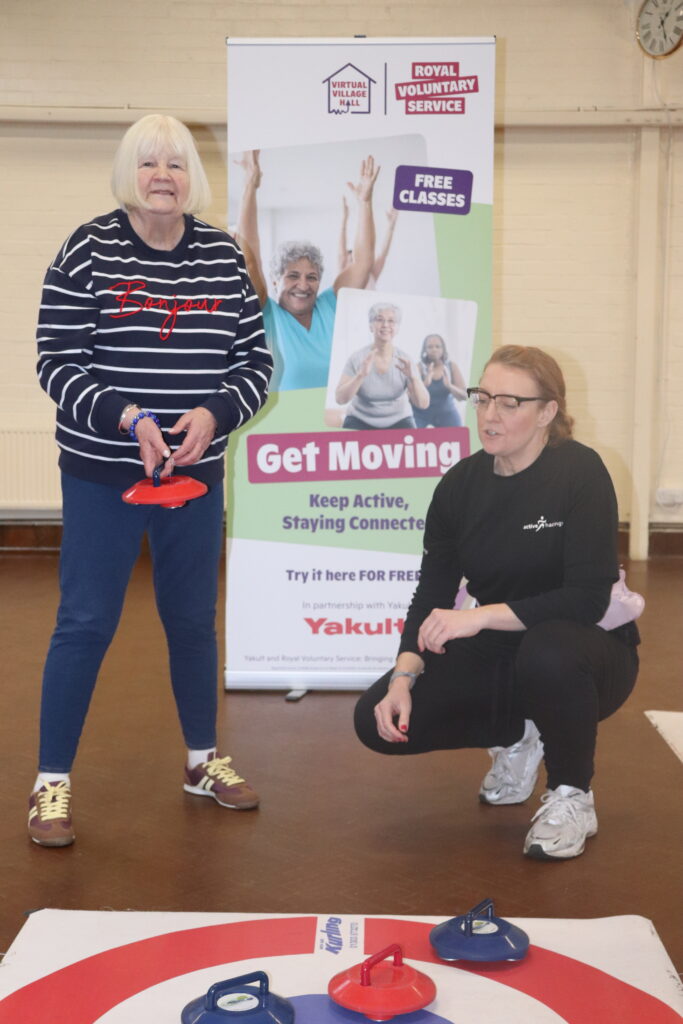
Credit, then, to Active Hastings, whose Get Moving campaign targets opportunities for physical sport and fitness amongst the whole local population, and to the Royal Voluntary Service, which runs a community health and wellbeing initiative for the over-55s, First Time For Everything. They combined last Thursday to offer to this age group three introductory sessions of indoor curling at St John’s Church Hall in Brittany Road, St Leonards, funded with sponsorship from Japanese probiotic milk supplier Yakult.
As far as the English armchair public is concerned, curling is a sport that’s unwrapped from its mothballs every four years to give Britain its best chance of appearing in the Winter Olympics medal table. (At Beijing in 2022 our skiers, skaters and snowboarders couldn’t muster a medal between them but the women’s and men’s curling teams won, respectively, gold and silver.)
It’s essentially bowls or boules on ice, the woods/balls replaced by granite stones. Two competing teams “throw”, in effect slide, the stones in turn across a sheet of ice to a circular target, with the aim of bringing them to rest closest to its centre. Once at rest they are displaceable by subsequent throws from either team. Points are scored on the basis of final placements.
SMOOTH TILED FLOOR
The sport originated in Scotland and has gained keen adherents in other countries such as Canada where ice is a regular feature of winter climate. Not so much, therefore, in mild and sunny Hastings (recent weather notwithstanding). But substitute the smooth tiled floor of a church hall for a surface of ice, and a round, flattish, weighted disc mounted on ball bearings for the granite stones, and you have the conditions for an equivalent sport playable indoors in all weathers and temperatures.

There are differences here from the outdoor Olympic variant. Missing from the indoor version is the assistance of two members of the thrower’s team armed with brooms, who by sweeping the ice alongside the sliding stone are able to adjust the pace or trajectory of its route to a final resting place. On the other hand, the indoor thrower has the option of using a cue-stick from a standing position to impel the disc forward across the floor rather than bowling it out of hand – a blessing to those of us whose limbs don’t readily bend to or from a kneeling position.
Participants in last week’s sessions in St Leonards divided in roughly equal proportions between those who used a cue-stick and those who didn’t. Human beings are natural tool-users, and the former seemed on average more successful in controlling both the degree of impulsion and the accuracy of direction. What golfer would opt to roll a golf-ball across a green into the hole rather than putting it?
Active Hastings organised three separate sessions of an hour each last Thursday for groups of 12 to be taught the basic skills and receive an introduction to competitive tactics. We aimed to land our discs on or around the target area – a thin mat marked with concentric circles and a bullseye. We also learnt that leaving them short could block a future throw, while a stronger delivery could be used to shove a well-placed rival out of contention.
First efforts were tentative and erratic, but once we were divided into two opposing teams (six players each – in my session, five women and one man on either side) and lined up to take alternate throws, our natural competitive instincts came to the fore, and the team bonded. Accurate placements were clapped, displacements of opposing discs cheered and, as the scores mounted over six rounds, social inhibitions relaxed into a party atmosphere. It’s a great game, we decided, once the ice has broken.
We hope you have enjoyed reading this article. The future of our volunteer led, non-profit publication would be far more secure with the aid of a small donation. You can also support local journalism by becoming a friend of HIP. It only takes a minute and we would be very grateful.

Leave a Reply