
Importance of Being Arthur
By Nick Pelling
How much does it matter what names we use? Evidently, quite a bit. Take the Royal Family for example. They are, of course, the Windsors. But actually, they just gave themselves that name because their actual name,
Saxe-Coburg-Gotha, was a trifle too Germanic – given that British soldiers were being slaughtered by the Kaiser’s guns at the time. So, in 1916 they decided to call themselves after a medium-sized market town in Berkshire.
One can’t help wondering what other possible names they considered. If they had gone for the full Englishness, maybe they might have dubbed themselves the Teapots. But at least the royal re-brand sort of worked. Sometimes it goes wrong. How on earth did the Post Office decide that Consignia would be a better name? And who can explain why Jif became Cif?
Of course, the world of famous rock and film stars is littered with attempts to cool up the name tag. Elton John is the obvious example, I suppose. Can you really be a Rocket Man as Reg Dwight? But people can qet quite angry about these issues. When Cassius Clay changed his name to Muhammad Ali, his first opponent, Ernie Terrell, in 1967, kept calling him Cassius. In the fight Ali defeated Terrell whilst asking him, in time with several punches, “What’s My name?” And Ali’s inspiration, Malcolm X, chose the letter X to throw off his given surname (Little) because it was probably, originally, a name conferred on his antecedents by a slave owner. It is surely quite something to make your surname an indictment of history.
Using a name to make a political point actually has a long history. There was, I believe, a man who changed his name to ‘Margaret Thatcher’ and then attempted the stand as a candidate under that name in the Iron Lady’s constituency. In the event he was not allowed to. Not sure why. Obviously, there is the great British tradition of standing for election under a silly name. I suppose Screaming Lord Sutch was one of the first actively to seek out the silly vote. (His policy of a five-day weekend remains a dream) Names can be used to puncture political pomposity. Theresa May had to share a platform with the ‘intergalactic space lord, the honourable Lord Buckethead.’ She never really recovered.
Other countries do things differently. Stalin, for example, was not actually called Stalin. His real name was Joe Dzhugashvili, but Stalin has the slight advantage that it means ‘man of steel.’ That does sound a bit like a revolutionary, I suppose. Compare it, for example, to one of this country’s least well-known revolutionaries: Arthur Thistlewood. In 1820 Arthur and his conspirators hatched a plan to kill the entire cabinet. But his plans went badly wrong; he was arrested and hanged outside Newgate prison. He was also beheaded, just to be sure. There are good reasons why he failed; his band of men had several informers within it. But, maybe you just can’t be a revolutionary with a name like Arthur Thistlewood. It’s not exactly Che Guevara.

And how strange it must be for so many women when they marry and lose their birth name. Does that entail a change in a sense of identity? Is that a loss? Clearly there is some weird power in a name. In the Jewish tradition,
I believe, a family that has lost several children, may choose to leave a child without a name, for a period of time, so that the Angel of Death will not know it. This is name as magic and fate.
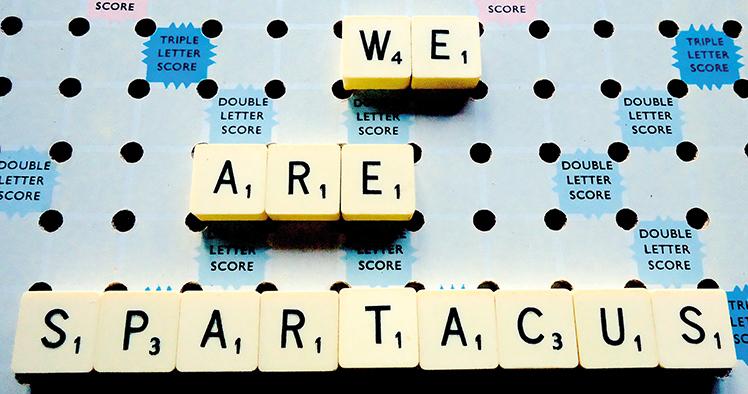
And then of course there is Spartacus. As the wonderfully named screenwriter, Dalton Trumbo, told us, we are all Spartacus.
We hope you have enjoyed reading this article. The future of our volunteer led, non-profit publication would be far more secure with the aid of a small donation. You can also support local journalism by becoming a friend of HIP. It only takes a minute and we would be very grateful.

Leave a Reply