
HIP REVIEW: The Eyes Have It
Cancelled Confessions, by Claude Cahun Translated by Susan De Muth
Thin Man Press, new edition 2024, £27
VICTORIA KINGHAM
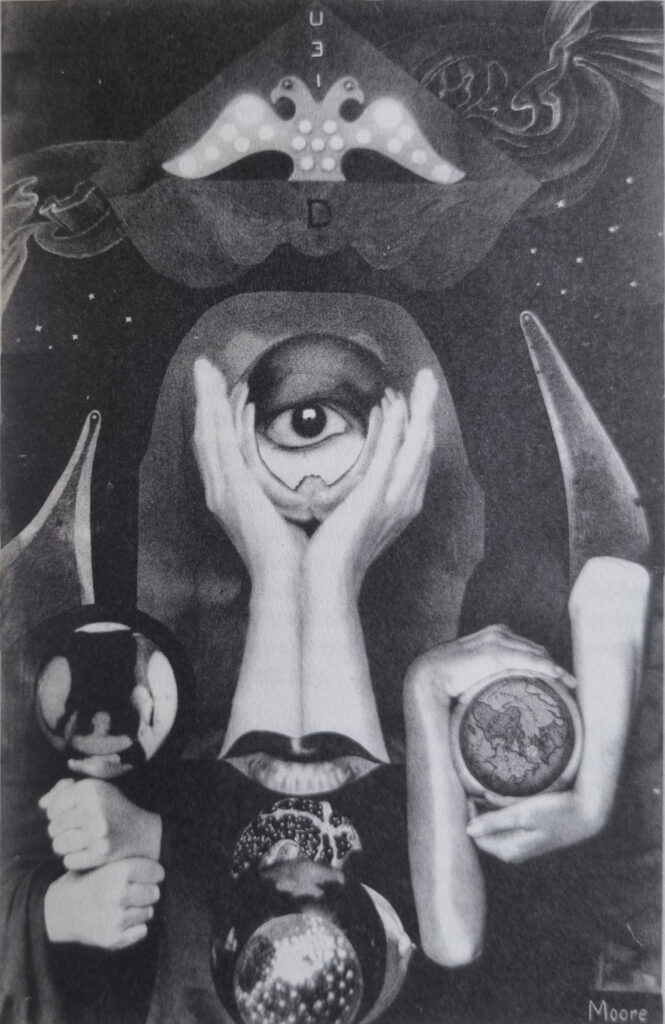
The first image inside the new edition of Claude Cahun’s Disavowals, more literally retitled Cancelled Confessions, is a complex photomontage by Cahun’s partner, Marcel Moore. That name was the alias for illustrator, designer, and photographer Suzanne Malherbe. Cahun was born Lucy Schwob. Malherbe and Schwob met at their local art school in Nantes, and lived in Paris, associating both intimately and artistically, for the next forty years.
THE CONSTRUCTION OF MYSTERY
The centre of this montage (cut out here) is obviously the eye – this vision is cupped by two graceful hands which end at the forearm with a pair of lips. In other parts of the image, another pair of hands cradles a globe, and a pair of cloaked fists grasp something that looks like a lens gazing into a confined world of classical sculpture.
Cahun’s text is a long, fascinating, not always easy read. Presented more-or-less chronologically, the chapters of her ‘narrative’ are all preceded by similar photomontages. The beginning of each chapter appears to correspond roughly to its preceding image, but the text soon veers off in all directions, often following no discernible sequence and sometimes adopting a different form of address paragraph by paragraph. It is objective and subjective, metaphorical and literal, poetic and prosaic. “When the mechanism has been completely deconstructed, the mystery remains intact” writes Cahun.
This intentional creation of mystery, along with the prominence of hands and eyes in the images, broadly suggests a Surrealist intent. In addition, (after stars and hearts in other chapters) the sections of the last chapter are separated by small eyes. Think of Max Ernst’s unforgettable Eye of Silence, Man Ray’s Glass Tears, Magritte’s False Mirror. To the Surrealists, the Eye represented a gateway to the Subconscious, a tool for revealing hidden truths. André Breton’s Manifestoes of Surrealism (1924) refers 91 times, literally or metaphorically, to the eye.

In Breton’s Manifestoes there is also un chien – the “Alsatian that has one blue eye and one yellow eye, the dog of the anaglyphs of my dreams.” One of the lasting projects by arch-Surrealist Salvador Dali was his input (with Louis Buñuel) to the film Un Chien Andalou, an acknowledged milestone containing a wealth of Surrealist references, including the famous sick-making razor eyeball-slitting scene. A clear gel emerges from that wound: death, hope, or liberation? In dreams these are often one and the same.
Like many of her literary Modernist contemporaries, Cahun pays homage to her Classical antecedents. For example, she devotes a whole chapter to herself as an ‘aurige’ (Latin Auriga, charioteer). Cahun’s wordplay, throughout the book, assumes readers’ ready familiarity with the classics. She references Christian texts and ceremonies, philosophers and historians ancient and modern, Greek, Roman, and Norse mythology. She refers, too, to works by more recent luminaries, and her contemporaries: Apollinaire, Oscar Wilde, Molière, the symbolism of Rimbaud, the Da-da and Surrealism of Breton.
ART AND QUEERNESS
Another feature of this unique text, especially relevant in recent times, is a connection between Art and Queerness. Bring to mind famous artistic couples (and triangles): Michaelangelo and Cavalieri, Gertrude Stein and Alice B. Toklas, Virginia Woolf and Vita Sackville-West, Vanessa Bell, Clive Bell, and Duncan Grant, Oscar Wilde and Bosie, Benjamin Britten and Peter Pears, Tennessee Williams and Frank Merlo. Think also about the present-day activity that is (still) called cross-dressing. Marcel Duchamp, Grayson Perry, David Bowie, Beyoncé, Marilyn – all have created gender-defying alter-egos. Dali, too, was happy to wear a dress. Cahun and Moore were an unconventional couple; like a number of the aforementioned, they lived slightly outside regular society, but their kind of relationship was far from unknown among artistic radicals. So the fluid, unclassifiable writing of Cancelled Confessions is Modernist, Surrealist, of its time, but simultaneously infinitely contemporary. Its blend of reality and fantasy, the (Freudian) Conscious and the Subconscious, is unique, the intellectual reach, extraordinary.
As a most courageous work even for its time, the book’s disjointed form seems very relevant to today’s copious fragmentary literary blogs, and also perhaps to the now heavily blurred association between the physical and the digital. It is a biography, though not at all as we might expect. Some sections could be called self-examination, but the text is so varied in form that the self being assessed becomes divided, fluid, and indistinguishable from its accumulated intellectual background.
This is, therefore, a timely reissue. As a physical object it is supremely well-produced, tissue-bound, reverse-engineered to look very like it might have looked in the original edition by Editions du Carrefour (a copy of which, incidentally, recently sold at Christie’s for £3,500). It is perhaps important to notice, though, that while the original cover contained a few jolly neolithic nudes, the newer, more anodyne cover has cropped them out. Is nudity somehow less acceptable now? The eyes, though, are everywhere.
Available from thinmanpress.com
We hope you have enjoyed reading this article. The future of our volunteer led, non-profit publication would be far more secure with the aid of a small donation. You can also support local journalism by becoming a friend of HIP. It only takes a minute and we would be very grateful.

Leave a Reply