
HIP REVIEW: In Harm’s Way
By Teresa Thornhill
Published by Harper Collins, 2024 £10.99 (paperback)
REVIEW BY HUGH SULLIVAN
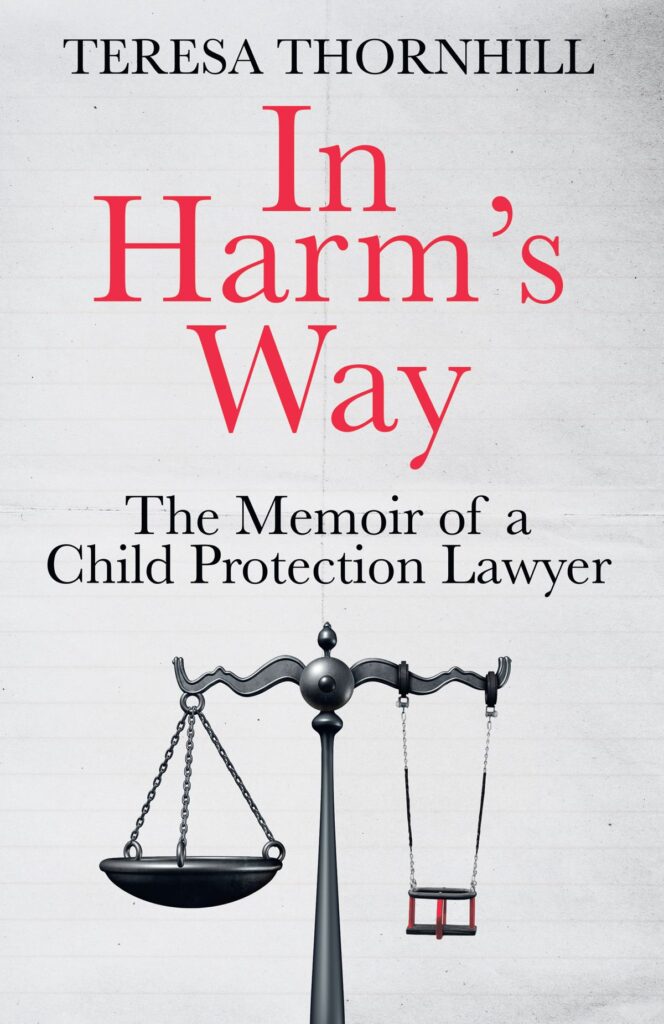
This book is subtitled The Memoir of a Child Protection Lawyer. The writer lives locally, having recently retired from practice as a barrister specialising in care proceedings. Without sensationalising, soft-pedalling or patronising, she paints at first hand a devastating picture of the legal process that ensues when local authorities intervene in situations of family trauma.
Lawyers, like doctors, are bound by strict rules of confidentiality that aren’t relaxed by time or distance. Ms Thornhill is barred not only from citing the true names of the adults and children involved but also from providing any physical descriptions, including of courtroom or council locations, that would allow readers to guess identities. She tells us at the outset, therefore, that the cases which she will recount in compelling detail are “fictitious creations… I’ve combined, for example, elements of the background of real family A with elements of the trauma suffered by the child or children of family B with a little of the courtroom experience of real client C”. Names, ethnicities, ages, genders of both children and adults have been altered accordingly.
That does create a problem for a literal-minded reader. Given the artificial construction of both the characters and their circumstances, how can we judge the verisimilitude of the events she narrates? Wouldn’t it be cleaner to embrace the fictional elements whole-heartedly and turn the reportage into an autobiographical novel?
POTENTIALLY HEARTBREAKING
On the other hand, Ms Thornhill’s experience as a jobbing barrister also limits the extent of her narrative. She is called in, often at no more than an evening’s notice, to present a case for a mother or father whose children are at risk of being put into care, whether for fostering or for outright adoption. She may have no previous knowledge of the client and will have no ongoing responsibility for what happens after the court has made its decision.
Subject to these limitations, however, Ms Thornhill describes both with admirable clarity and with human feeling the issues which the court has to deal with, and how the different actors – parents, guardians, social workers, lawyers, judges – present their points of view or react to others. The process of any court in action is intrinsically dramatic, and the subject matter – the future lives of traumatised and vulnerable children – is potentially heartbreaking. Ms Thornhill enhances the intimacy of her professional experience by counterpointing it with scenes from her own private life, having to balance her legal career against her own responsibility as single mother of a son who moves through adolescence to adulthood through the course of the book.

In the background, but having increasing impact as the years of economic austerity turn into the experience of Covid-19 lockdown and beyond, is the sense of mounting pressure on local authorities and their financially squeezed social services departments to cope with the ever-rising tide of family breakdown. In the book’s grimmest chapter, ‘Locum’, Ms Thornhill takes a temporary job as the senior in-house lawyer in a local authority child care team, required to progress multiple casework in a hot-desking open plan office under oppressive strip-lighting with a recently digitalised case management system that keeps going down. Most of the social workers around her are fellow locums. Reading her account, you have to wonder how children whose lives lack above all the ingredients of stability and reliability are going to be satisfactorily served by this chaotic environment. The potential for more child victims like Victoria Climbie or Baby P is palpable.
ENGROSSING, INSTRUCTIVE AND ENTERTAINING
There is a bigger question, though, which Ms Thornhill only faces up to in her epilogue: how could any child protection system, however well funded and professionally staffed, cope with the extent of family breakdown which is now occurring. She notes that the number of children in care in England increased by 30% between 2010 and 2023 (and at a still higher rate in Wales). She adds: “A lot of the children who come before the Family Court in public law cases are being raised by lone mothers, who could parent better if they weren’t constantly struggling to keep a roof over their children’s heads, food on their plates and money for heating in the pre-payment meter. Many of these women are struggling with their mental health and it’s not hard to see why.”
She suggests that better support for families living in poverty plus better children’s social care would end up not only reducing human misery but saving the higher social and economic costs incurred in dealing with the fall-out: prevention would be cheaper than the cure.
That may be so. What she doesn’t comment upon is the prevalence of lone mothering in the first place. A recent statistic: 50% of first-born children in this country are no longer living with their two original parents by the age of 14. That’s not to say that lone parents cannot bring up healthy, functioning and well-adjusted children. Not only was Ms Thornhill raising her own son in the absence of his father; her own parents too, she relates, had a “troubled” marriage which ended in a long-drawn-out divorce overshadowing her own childhood. But she perhaps feels that she’s not in a position to endorse the virtues of joint parenting in a single household. None of her sample cases exhibit such a set-up.
On the other hand, she rightly laments the absence of properly conducted research into outcomes of care decisions, including adoptions. However unpromising the prospects of a child being left within the household of a drug-addicted, abusive or otherwise feckless parent, what’s the evidence that being shuffled in and out of a local authority care system has better long-term consequences?
Ms Thornhill writes that at the start of her career as a barrister she felt “like an imposter in the legal world”, wondering whether she shouldn’t have pursued a career as a writer or activist instead. Fortunately, she seems to have kept these alternatives primed for eventual deployment. Her book is engrossing, both instructive and entertaining, and should appeal both to other professionals within the system and to the general reader.
We hope you have enjoyed reading this article. The future of our volunteer led, non-profit publication would be far more secure with the aid of a small donation. You can also support local journalism by becoming a friend of HIP. It only takes a minute and we would be very grateful.

Leave a Reply