
BOOKBUSTER REVIEW: Fighting for Life
By Isabel Hardman
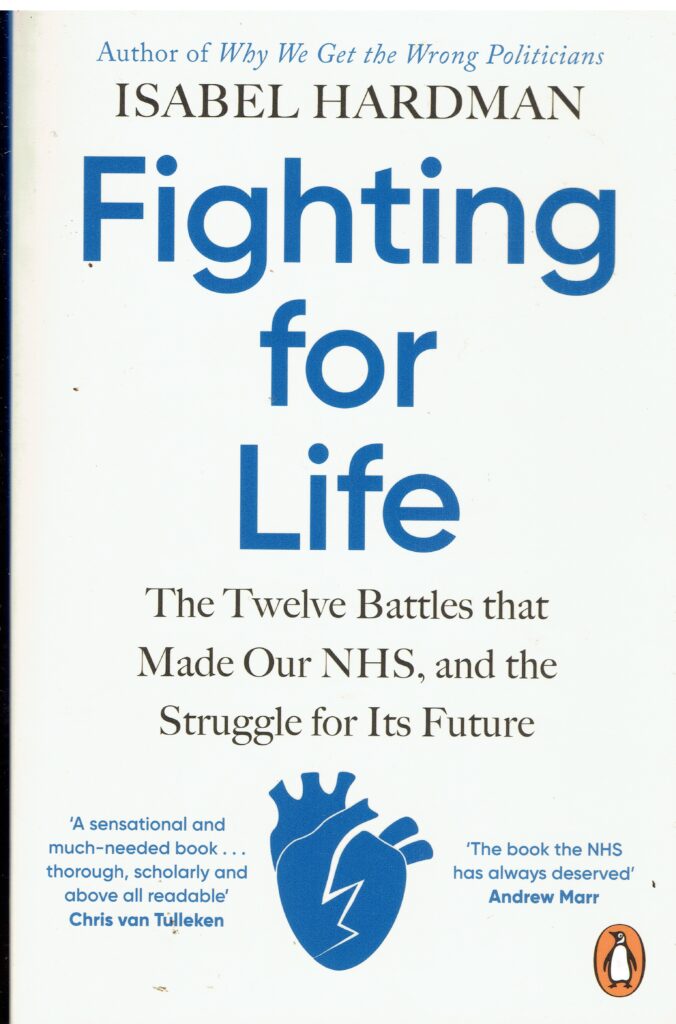
Published by Penguin, rrp £10.99
REVIEW BY TIM BARTON
Edna Thomas gave birth to the first baby born under the aegis of the National Health Service, almost on the stroke of midnight July 5th 1948, the doctor urging her hold back until the clock struck. Her daughter was named Aneira after Labour MP Aneurin Bevan, often seen as the man that made the NHS happen. Previous to the founding of the NHS, there were already good medical services, but access was difficult to those without money.
As Aneira put it in her family biography, this new post-war miracle, access to healthcare free at the point of use, meant a great deal. Hardman quotes this passage – ‘If my father had been injured, we’d have starved. And if one of my siblings had fallen seriously, critically ill, they most likely would have succumbed to their sickness. Edna has lived with this knowledge all her life: hearing the stories of limbs withering away, cancers left untreated, hacking coughs slowly turning into something more sinister until, one day, they’d stop and there’d be silence.’
Hardman’s book gives a detailed account of the context within which the NHS was formed and a history of hospitals in Britain before its founding. It is more complex than some might think, and compromised in many ways from day one. The famous Beveridge report laid the last foundation stones, and the post-war struggle to get the country back on its feet gave the opportunity to start building the NHS. Labour MP John Dugdale said that ‘the purpose of victory is to live in a better world than the old world’.
There was, despite the common view that Labour fought the Tories bitterly to get it done, actually a pretty wide cross-party consensus, with the greatest static coming from the British Medical Association. The devil, naturally, was in the details. One of the first compromises was to appease the BMA, thus ‘consultants and GPs [were] allowed […] to treat private patients in ‘pay beds’ in NHS hospitals, and the [GPs] to remain independent contractors.’
THE 76-YEAR HISTORY OF THE UPS AND DOWNS
Cost cutting exercises pretty much began on day one, too. Chancellor Stafford Cripps put great pressure on Bevan to cut spending; Hugh Gaitskill pushed for ‘dentures and spectacles’ to be excluded; and despite a wish on the part of both Bevan and Clement Atlee that ‘no health charges would be imposed’, prescription charges were very soon on the menu as well, and in 1949 a shilling charge was imposed. In 1960 Enoch Powell raised it to 2 shillings, though to be fair he also ‘regarded the NHS as an essential social service’. One wonders what Bevan and Atlee would think today, as charges approach £10?

Hardman talks of a ‘fear of an existential crisis, which is always part of our relationship to the NHS’. Bevan having to go cap in hand to the Treasury was a sign of things to come. Her book is subtitled ‘The Twelve Battles that Made Our NHS, and the Struggle for Its Future’, and over 12 chapters, and a bit over 300 pages, she gives a sobering account of the 76-year history of the ups and downs the NHS has gone through.
One strand that typifies every decade since 1948 is the lack of capital, the choice between staff, equipment, or premises. Hospitals post-war were in a sorry state, and house-building trumped NHS funding. A plan to build large regional hospitals saw the closure of much local provision. The 1960s vogue for brutalist architecture saw concrete monstrosities that succumbed all too quickly to ‘concrete cancer’. The AIDS crisis is covered in some detail, as well, as is, naturally, Covid.
THE BIGGEST FIRE SALE SINCE THATCHER
The book looks at the low priority mental health has always been given, and describes the problems caused in the 1990s by the shift towards ‘care in the community’, with Minister of State for Health, John Hutton, famously saying that it had become ‘couldn’t care less in the community’. Hardman also gives a nuanced account of the labour shortages the NHS perennially struggles with, and that sees a regular influx of immigrant labour to take up the slack.
When I worked in the further education sector, in student services, I noted with surprise the very small number of students expressing an interest in nursing or medical qualifications, instead opting for childcare, health and beauty, or hairdressing. When I was their age a much larger cohort aspired to nursing and medical careers. The consequences of that shift are, frankly, terrifying, especially when one considers the demographic shifts that are occurring. But, one way or another, ‘Plus ça change, plus c’est la même chose’…
Government after government reorganised the service, adding new structures and new layers of management. The chapter ‘Control freaks’ says it all. Blair’s PFI funding privatised hospital builds, and saw an increase in newbuilds, done on the cheap, with the finance creating mountains of debt for future generations, whilst once again pitching funding for staff, beds and other equipment up against construction. Not least, the contractors knocking down old buildings to build one new one often sold the land for profit to private developers, a subject covered in George Monbiot’s excellent Captive State, and a phenomenon familiar in the more recent academisation of education.
The post-2008 Tory assaults on the NHS have left a tattered framework visible to the public, but with a bare cupboard. Jeremy Hunt comes in for some particular hatred by many of us, and rightly so. The pandemic and Brexit seem to have weaponised the sale of our assets, in what is clearly the biggest fire-sale since Thatcher.
THE NHS STOPS AND THERE IS SILENCE?
‘Just because a national health service was inevitable by the time 1945 came along doesn’t mean it will inevitably service’, says the author. Here is the ‘first ‘nationalised’ NHS patient, ‘Sylvia Beckingham, thirteen’ with a liver condition, ‘surrounded not just by nurses but also by the Minster for Health, photographers and reporters: ‘Mr Bevan asked me if I understood the significance of the occasion and told me that it was a milestone in history – the most civilised step any country had ever taken. I had earwigged at adults’ conversations and I knew that this was a great change that was coming about and that most people could hardly believe this was happening.’
As our politicians give lip-service to ‘Our NHS’ whilst stabbing it in the back and allowing in, by stealth, Americanised health insurance et cetera, do we, today, ‘understand the significance’? Will we, when it finally is dissolved into the private sector and many of us find ourselves, like Aneira’s forebears, succumbing to our sickness in poverty, ‘hardly believe’ it is happening when one day, the NHS stops and there is silence?
Fighting for Life is available from Bookbuster, 39 Queens Road, Hastings TN34 1RE, 01424 539726
We hope you have enjoyed reading this article. The future of our volunteer led, non-profit publication would be far more secure with the aid of a small donation. You can also support local journalism by becoming a friend of HIP. It only takes a minute and we would be very grateful.

Leave a Reply