
Shockwaves From Gaza
GUY HARRIS, the Hastings Liberal Democrat spokesman on national affairs, says Keir Starmer and other British politicians must do more to address the Israel-Palestine conflict – as must the wider international community.
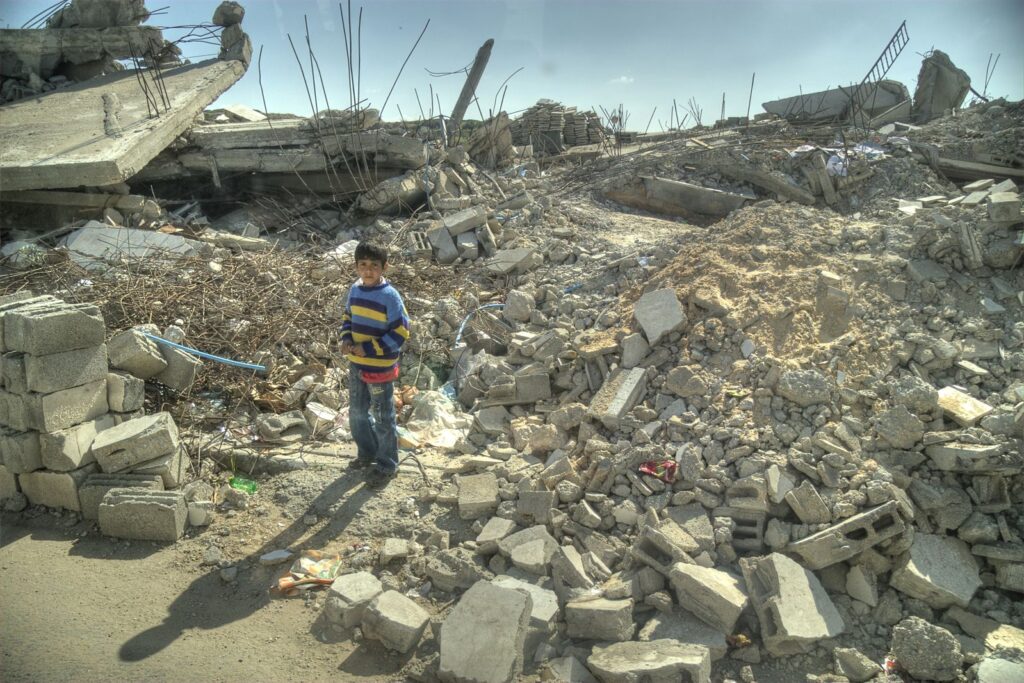
War in Gaza
The brutal Hamas terror attacks of October 7 seem destined to become what commentators call an ‘inflexion point’ in Middle East history. It wasn’t just Israel caught flat-footed by the attack, many of our own politicians seemed disorientated and overwhelmed. They defaulted to predictable mantras whilst weighing short-term political calculations. Even over the cries of human pain and the crash of bombs, I fancied I heard cans being kicked down the road.
This time, however, politicians must rise to the occasion. As South Africa’s motion in the International Criminal Court forces Israel to rebut charges of genocide, a compassionate British public is paying more attention to the long-standing plight of Palestinians and looking to our parliamentarians for some moral leadership.
In the wake of the attacks, Sir Keir Starmer was first through the mill. His raison d’etre in previous years has been to remind us that he’s not Jeremy Corbyn. This obsession confounded his response to Israel’s increasingly disproportionate assault on Gaza, placing him at odds with swathes of his own party and a growing constituency beyond. He was so fuddled as to claim on LBC that Israel had the right to impose collective punishment on a civilian population. I’m glad to say the Lib Dems were amongst the first to call for a ceasefire, and Layla Moran, in particular, led the conversation in Parliament and nationally. With honourable exceptions, the Conservative position was predictable, but frankly, this is bigger than party politics, and consensus should be sought.
Compassion aside though, why should we care about what happens in Gaza? Well, because it really does touch our lives, and its part in the fracturing of Hastings Labour Party is but one minor example.

COLONIAL BAGGAGE
Connecting the dots though, Britain helped give birth to the State of Israel, and our colonial baggage influences relations with all countries of the region, not least Iran. We’re also a permanent member of the UN Security Council, the ‘arbiter’ of international peace, law and security.
We trade with Israel too. In the Spring of 2023, James Cleverly, busking as Foreign Secretary, signed the UK-Israel bilateral ‘roadmap’, which signalled a deeper trade and security alliance and, incidentally, seemed to endorse Israel’s far-right government – some of whose ministers live in illegal settlements and are vocal opponents of the ‘two-state solution’:a position which fundamentally contradicts UK policy. Trade with Israel is worth about £3bn a year – not inconsiderable given the UK’s straightened circumstances. Britain has strong religious and social connections to Israel too, via 350,000 British Jews, who represent one of our oldest minority groups – one that has been traumatised and tormented by the scenes in Israel and by some words and deeds at home. Lastly, Tel Aviv’s close political and defence ties with the US are also of significance to the UK.
So Israel is important to us. As, by extension, is its treatment of the five million Palestinians over whom it presides. Their plight is felt acutely by British Muslims, and with over 20,000 Palestinian men, women and children killed since October by the Israeli Defence Force, it begins to corrode social cohesion here and provide narratives to the radicalisers.
But there are other consequences of letting this fifty-seven-year-old sore continue to suppurate. The displacement of two million Gazans from their homes would not seem to me to lessen the global problem of migration – a cause presently dominating British politics. Similarly, allowing the conflict to escalate will ultimately hit hard-pressed families in Hastings and elsewhere. Few give much thought to trade through the Suez Canal, but they may when its interruption begins to inflate the price of goods or fuel.
Another corollary is defence spending. As the MoD decommissions destroyers and recruitment falls, can we afford Grant Schapps’ threats of military action against Houthis in Yemen? The Iranian-sponsored militias have weathered years of Saudi bombing. Like Hamas and Hezbollah, their dark light has not been dimmed. Islamic State are getting in on the act too. So, what’s the scope of this operation and where’s the money coming from? Plunging Britain into open-ended counterinsurgency would suit Iran just fine. Tehran is shrewd enough to know further escalation is unnecessary if it can simply bleed Israel, Britain and America physically and financially through proxy wars. Putin would be delighted too.
CYNICAL ASSERTION
A deeper context is that, for many, October 7 highlighted the fallacy of Netanyahu’s cynical assertion that Israel’s occupation could be managed into mundanity by military means. A succession of British politicians have accepted this prospectus because it was easier than taking tough moral decisions, even those which accorded with our own values, policies and legal obligations. Now it’s painfully clear there’s no military solution, and it’s not in Britain or America’s interest to support Netanyahu’s endless war – or his ultra-nationalist coalition.
Our political leaders cannot apply short-term electorally expedient logic to long-term foreign policy issues. We cannot afford to continue to give an increasingly immoderate ally diplomatic cover when it threatens our social cohesion, compromises our principles and corrodes the public’s faith in the rules based international order which complements our democracy. If we endorse the basic tenets of international and humanitarian law, we have to uphold them – and promote them most powerfully to our friends. But, I’m not naïve. That’s easier said than done.
Do we expect Israel to talk with the people who murdered over a thousand civilians? Do we expect Palestinians to sit calmly round the table with their ears still ringing and their dead unburied? The answer is no. Not now at least. But, in the long term what’s the alternative? Both sides need to take a huge leap of faith. As does the international community and its partners in Turkey, the UAE, Qatar, Saudi and Egypt. That’s what diplomacy is for. It’s hard, but the alternative is endless suffering and a denial of self-determination. And the truth is, in the cause of peace, we do talk to terrorists, nationalists and insurgents.
The greatest aid we can provide to our ally is wise counsel. We must convince Israel that peace is incompatible with occupation. The ‘day after’ cannot just be the status quo. It must acknowledge Israel’s security needs and, finally, realise Palestinian sovereignty and statehood. It’s in our interest and in Israel’s to cease the violence, and find honest brokers to free surviving hostages, advance peaceful coexistence and free both peoples from their own history.
We hope you have enjoyed reading this article. The future of our volunteer led, non-profit publication would be far more secure with the aid of a small donation. You can also support local journalism by becoming a friend of HIP. It only takes a minute and we would be very grateful.

Leave a Reply