
OPINION
Totalitarian Tears
By Nick Pelling
Is it safe to come out yet? I don’t know about you, but I have spent two weeks or more hiding from the BBC. The bloated Corporation has been behaving rather like the mad medieval Habsburg Emperor Charles V who spent his last years trying to make his vast collection of clocks tick in time. The Corporation has been trying to force us all to believe that we are a nation mourning and weeping in step. I for one have found myself feeling a little nauseous about this attempt at national pseudo-grief-puppetry. It might seem a treasonable thing to say, but surely when we distill the great sentimental gloop of groveling we only have one simple fact: a very old lady died.
Worse still, after the initial fact had been conveyed, and endlessly repeated, absurdly slowly, the approach mutated into a sort of lavender fog of anecdote. Vox pops in which everyone was saying the same sort of thing. You know, the sort of mono-messaging you get in totalitarian regimes.
A SPECIAL SORT OF BOREDOM
I should confess that at times I switched on the BBC just to see how the ghoulish talkathon was going. One of the absurd things about the attempt to keep the gloom-chat going for so long, is that, as David Hare said, “the Queen spent 70 years perfecting her technique of hiding her thoughts.” She became very skilled at being boring. So inevitably, deciding to drone on about a deliberately dull individual for weeks was always doomed to descend into drivel. And indeed, the river drivel burst its banks.
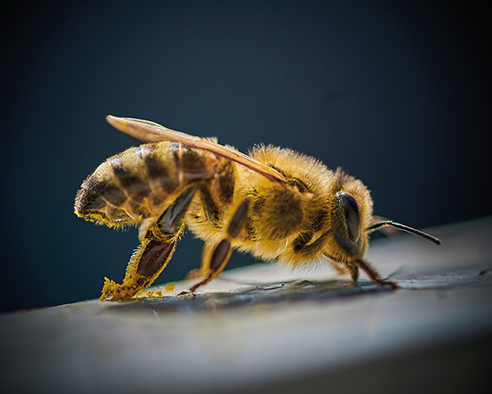
A sad bee
Particularly irritating has been the BBC competition among its announcers to do the best ‘special’ voice. The sombre-reverential-self-important-local-vicar voice. Huw Edwards gave it his wet-day-in-Llanelli tone but Clive Myrie edged it with his holding-back-the-tears pauses. Most strangely, the supposedly hard-hitting Laura Kuenssberg – dressed in widow’s weeds – announced, with icy menace, that we would all watch the final journey of the Queen’s coffin “forever.” Perhaps the only sane story to emerge over the days was that the royal bees had been solemnly informed of the Queen’s passing and black bows had been attached to their hives.
CRAWLING CREATURES
Don’t get me wrong, it was a little sad that the Old Lady died. And she was pretty good at being the Queen. And there was a twinge of History about it. But the BBC version of History seems to be that it is an endless pageant in which the British people are all gurning peasants crawling along behind the chosen one. But real History is full of dissent and dispute and certainly has other lessons to teach about our relationship with the Crown. If we go back to the nineteenth century, the death of the monarch did not engender anything like our current fawning. When George III lay dying in 1819, Shelley began a poem on the state of England, in the year of Peterloo, with a reference to “an old, mad, blind, despised and dying King.” On the very day of the funeral of his son, the grotesquely self-serving George IV (the former Prince Regent) The Times declared that “there never was an individual less regretted by his fellow creatures than this deceased king.” When Queen Victoria’s husband, Prince Albert, died in 1861 the Queen hid herself away from the public for so long that people began to ask what the point was in this absent woman. Flower beds in Hyde Park were trampled at Republican rallies. But in the 20th Century, we entered the Age of Sycophancy. Why?
SALUTING THE TV
I would like to advance the theory here that it was the creation of the BBC, a century ago, that began the transformation. The dullard George V became popular only after he began making pre-scripted radio broadcasts to the nation. Elizabeth II was, of course, the first TV monarch. Her televised coronation was probably the seminal event in creating fairly widespread loyalty. Royalty has always depended on imagery, and TV put the images in your front room. In short, the modern monarchy and the BBC have sort of become entwined around each other. It is perhaps even the real ‘special relationship’ upholding what we used to call ‘The Establishment.’
I could chunter on about the Charter of the BBC which speaks of a commitment to “impartial news” and an aim of reflecting and representing the “diverse communities” and “values” of the people of the UK, but evidently the views of us who don’t care about or don’t want this stuff, just do not count. When the BBC touches on the subject of royal people, clearly the opinions of bees matter more.

We hope you have enjoyed reading this article. The future of our volunteer led, non-profit publication would be far more secure with the aid of a small donation. You can also support local journalism by becoming a friend of HIP. It only takes a minute and we would be very grateful.

Leave a Reply