
Sea change Win Planning Appeal in Bexhill
Building of up to 84,000 square feet of further business floor space at Bexhill Enterprise Park is set to proceed following a successful legal appeal by Sea change Sussex (Sea Change) and industrial property developer Westcott Leach against planning conditions previously set by Rother District Council (RDC).
Sea Change, the not-for-profit company tasked with applying public funds towards economic regeneration in East Sussex, claims that this development is needed to fulfil a “longstanding and identified need for employment floorspace” in Bexhill, and that it will enable successful businesses to move in and expand. It calculates that an additional 500 local jobs may be created, though previous reports in HIP (see Link Road Attracts Office Relocations in HIP 174 earlier this month) have suggested that such jobs may arise from local relocations rather than fresh enterprises.

Design impression of new buildings
PICTURE: Westcott Leach
Permission had already been given in principle by RDC in May 2018 for light industrial or office development of 33,500 square metres (around 360,000 square feet) on the north side of the link road Combe Valley Way, matching the buildings – Glovers House and High Weald House – erected on the south side. In combination, the two parts of the Enterprise Park encompass 42 acres of a previous greenfield site. However, the north side permission was outline only, with details of design, layout, landscaping and scale yet to be determined.
Detailed proposals
Industrial property developer Westcott Leach, instructed by Sea Change, then proposed in October 2018 a set of light industrial units covering around 84,000 sq ft of floor space with associated parking and landscaping on a part of the site. Sea Change were to develop a supporting access road and provide the necessary utilities. RDC sought to apply conditions to these proposals, including in particular, a demand that the applicants should provide a detailed masterplan showing how the whole site would be developed rather than only the partial area for which details had been given.
Sea Change objected that a masterplan would unreasonably constrain the future development of the site. They argued that flexibility was essential to meet future occupier needs, and that the requirement to commit to a full design at this stage would unnecessarily constrain their future marketing. A phased approach would also allow development to be brought forward in financeable packages without prejudicing future phases of development.

RDC refused to accept this and turned down what was proposed. Its planning committee report complained, in particular, at the lack of landscaping provision: “The road layout and internal site circulation, proposed tree and hedgerow loss, insufficient new structural landscaping, both as buffer and as green space within the development, and cramped development dominated by hard landscaping, all combine to create an unacceptably poor approach to commercial site planning, as if it were in an anonymous urban fringe context rather than a place-specific, landscape-led, rural business park with a high quality design and place-making vision at its heart.”

Design impression of new buildings
PICTURE: Westcott Leach
Appeal
Sea Change and Westcott Leach lodged a joint appeal. This was considered by Planning Inspector Lesley Coffey, acting on behalf of the Secretary of State for Communities, in a four-day hearing, including a site visit, in January this year.
At the appeal Sea Change gave evidence that forecasting the needs of occupiers is very difficult. In “a marginally viable location such as Bexhill”, flexibility in the layout and design of development was key to appealing to a wide enough range of potential occupiers to secure investment.
They also contended that, with the impact of the pandemic on working patterns and practices still uncertain, they couldn’t forecast the requirements of future occupiers and the impact which such requirements might have on construction, massing, and site layout. Recent changes in the Use Classes Order might also impact on the demand for particular types of accommodation.
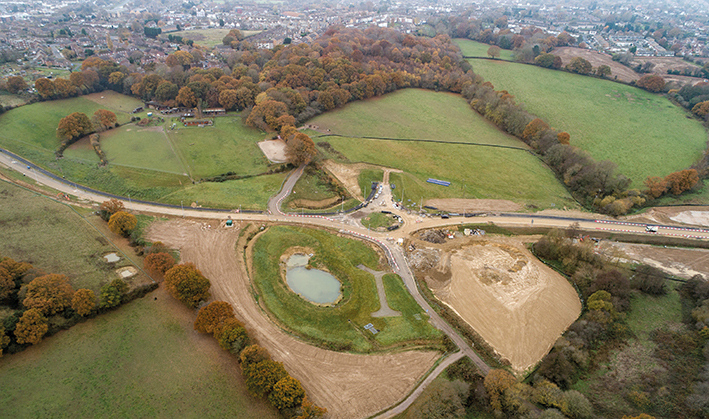
Bexhill Enterprise Park from above

Judgment
Last week the Inspector’s judgment was released. She found in favour of Wescott Leach and Sea Change on all counts, highlighting flaws in the case presented by RDC, including arguments based on what she held to be incorrect plans and failures to take account of current government planning guidance. Costs were awarded in favour of the appellants which RDC will have to pay. Sea Change says that the amount is “likely to run to a six-figure sum”.
Sea Change and Westcott Leach expressed gratitude for the “clear and decisive guidance provided by the Inspector in her decision.”
They issued a joint statement: “While it’s regrettable that the benefits of the scheme have been delayed by over 26 months – despite our repeated efforts to resolve the issues prior to the planning committee decision and the costly appeal process – we remain committed to delivery of the scheme and hope to start construction as soon as possible.”
Despite the outcome of the appeal, they have expressed concerns about the timescales for moving ahead because RDC has advised it may take up to 150 days for its determination of the planning condition discharges, in addition to five-week planning validation delays.
Sea Change commented: “We understand these delays are affecting many applicants, with the council having already suspended pre-application planning services. We’d encourage RDC Council to address these issues as a matter of urgency so they don’t impact local construction jobs and employment.”
Third party reaction
Bexhill Chamber of Commerce fully supported the appeal against the planning decision.
Howard Martin, President of Bexhill Chamber of Commerce, said: “The appeal outcome is important for all businesses in Bexhill and Rother. The planning processes at RDC have been moribund for far too long and have blocked investment at all levels in our community – both domestic and business. We’re very pleased Sea Change committed their resources and expertise into fighting the case, hopefully to make the planning processes quicker and more effective for everyone.”
The council tax payers of Rother may be rather less happy at having to foot the legal bill. And a number of agencies and environmental groups which have opposed the scheme throughout the planning process will also have been disappointed by the outcome. Some have claimed an unacceptable loss of biodiversity from removal of trees and hedgerows; others object to poor facilities for pedestrians and cyclists.
Previewing the appeal outcome, the website of Seachangewatch, a blog which monitors Sea Change’s activities from a generally critical perspective, summed up as follows: “Will Rother District Council achieve their vision of a ‘new type of eco-business park’? Or will Sea Change’s tree-felling, hedgerow-ripping-out, hard-landspacing prevail?” Fair description or not, it’s the latter course which has found legal favour.
We hope you have enjoyed reading this article. The future of our volunteer led, non-profit publication would be far more secure with the aid of a small donation. You can also support local journalism by becoming a friend of HIP. It only takes a minute and we would be very grateful.

Leave a Reply