
Model Take-over?
At the end of last month, following a public meeting, Rye Town Council resolved to close the town’s Heritage Centre on Strand Quay including the Town Model housed there. The visitor information service would be relocated to the Town Hall from April 2020, but the building was to be let, and the Model “placed into storage”.
Town clerk Richard Farhall issued a statement that the council “could no longer delay taking action to address the substantial public subsidy required to support the Heritage Centre” – it needed “to protect the interests of local council tax payers and the council’s other services”. The statement went on to disclose that an unnamed “local charity” – believed to be Hastings Furniture Service – “has expressed interest in renting the Centre for another purpose”.
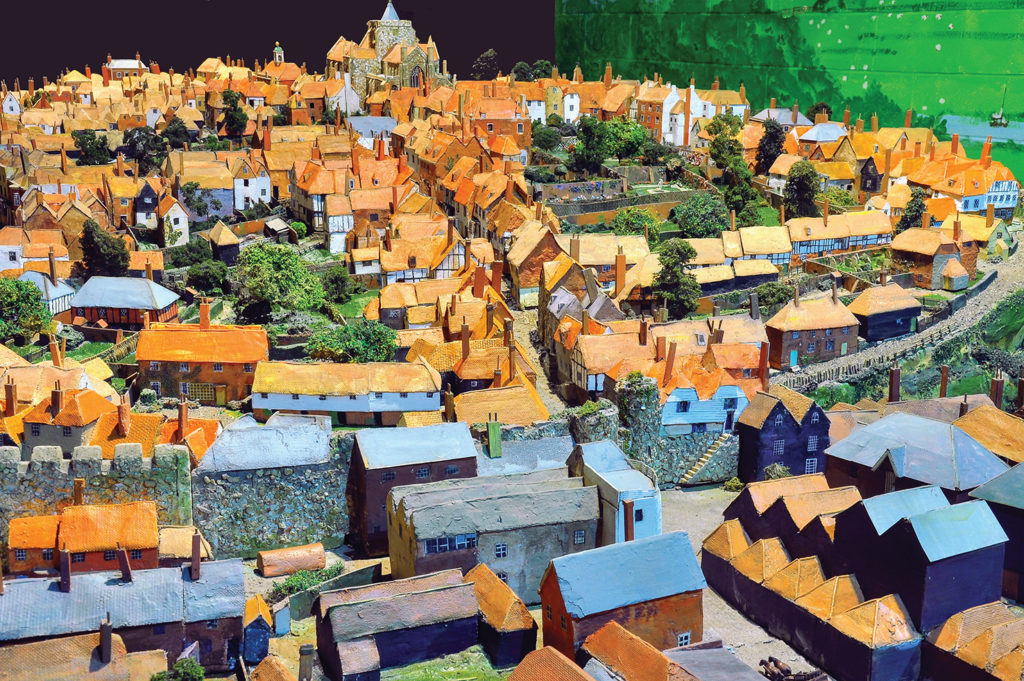
PIC: Pure Creative Design
At the meeting there had been some dissent voiced at the loss of the Model as a longstanding tourist attraction over 40 years and at the prospective impact of a closure of the Centre on neighbouring businesses. The clerk’s statement responded by informing “members of the community” that should any “express a desire to work up a proposal to keep the Model at the Centre, the Council would be happy to provide support and guidance” But, in view of the potential alternative letting, such proposal “would need to be agreed with the Council no later than
31st December”.
Charitable Incorporation
There is at least one community group which aims to do just that. A body calling itself Rye Heritage Centre charity, with a board of seven provisional trustees including local builder Simon Parsons and recently appointed Freeman of the town, Colonel Anthony Kimber, has been preparing a draft business plan for submission to the town council. Subject to the plan’s acceptance at the next council meeting on 6th January, they would incorporate as a CIO (charitable incorporated organisation under the Charities Act 2006) and undertake a formal takeover of the Model with a view to re-opening in April.
In the meantime manager Louisa O’Shaughnessy, who remains under contract of employment by the Town Council until the end of January, is frank in respect of the financial problems that have dogged the Centre in recent years.
The Heritage Centre has always been subsidised – until ten years ago by Rother District Council, since then by the local town council, making up whatever shortfall has arisen on the annual account. For the last three years this has averaged £22,000 per year.
Brexit uncertainty
Ms O’Shaughnessy discloses that visitor numbers have been particularly affected by the twin political issues of uncertainty over Brexit and of tightened border security against illegal migrants. Coach parties of schoolchildren from across the Channel would traditionally book annual visits for the period April to June. Theresa May’s government had been promising a Brexit deadline of 31st March 2019, but without being able to confirm how entry from the EU would be managed after that date. Unsurprisingly, a majority of European tour organisers preferred not to take the chance of serious delays at ports of entry or departure – who wants to be responsible for a coachload of kids held up for two or three hours at a customs border? – and cancelled bookings, or failed to make them at all. (Ironically, Boris Johnson’s delayed date of 31st October led to a modest upturn in business for September and October: this might be the last chance of visiting the UK uncomplicated by post-Brexit arrangements. Now political uncertainty has once again supervened).
A further dip in income has been occurring over a longer period as visitor tastes change. Sales of ‘generic’ souvenirs – the kind of general consumer wares that you can buy in tourist shops the world over – have plummeted. Locally produced goods, and tourist experiences – such as audio walks or accompanied ‘ghost’ walks – are more saleable but also more labour-intensive and therefore less profitable. The price of entry to the Model show (see adjacent column) has not been increased in the last ten years, even though substantial cleaning and re-painting work was undertaken last winter at a cost of £2,000.
The biggest cost item, apart from the staffing payroll, is business rates of £12,500 per annum.

A visitor tax?
How could the books be balanced after a community take-over? One obvious shift would be a replacement of paid staff by volunteers – that has been happening to similar heritage enterprises up and down the country. Another might be significant discounting, if not outright removal, of business rates liability. Pledges made by the Conservative party in the current national election contest seem to point in that direction.
Colonel Kimber would welcome a more radical fiscal move: the levying of a visitor tax, which is lumped onto hotel and other tourist accommodation in many European countries including France, Spain and Italy. Proceeds from such a tax could be channelled back into subsidy for cultural entertainments of the kind that, like the Rye Town Model show, themselves boost tourism.
That can’t happen quickly, though, and won’t form any part of the prospective charity’s business plan for take-over. Colonel Kimber is confident that the Town Council will in any event assess the viability of the group’s proposal in the knowledge that there is wide community interest in saving this important visitor facility.
Rye Town Model – the History
The Town Model is a scale model of the town of Rye as it existed around 1830 – in other words, much as it exists nearly two centuries on. It was hand-built by a retired local couple Joy and Ted Harland in the mid-1970s.
Joy, a retired teacher and amateur artist, got the inspiration from Son et Lumiere shows across the Channel in Belgium and France. She used a combination of written records, building surveys, aerial photographs and the Ordnance Survey Map of 1872 to draw up a comprehensive plan for the model, then spent three years re-producing every detail in polystyrene and enamelled tapioca to 1:100 scale. Ted, a retired electrical engineer, wired in a complex lighting system and created the original audio soundtrack, narrating episodes from the town’s history as a coastal base – French raids, smugglers’ enterprises, naval defence etc – with dramatic sound and lighting effects.
It was constructed in the Harlands’ home but is now installed in a purpose-built theatre within the Rye Heritage Centre that can seat up to 40 people, with a backdrop of the surrounding countryside painted by local artist John Izod.
The original show ran for 47 minutes. Around 15 years ago the soundtrack was re-recorded – in versions of English, French, German and Spanish so as to cater for the variety of foreign coach parties and other visitors – with a duration of only 17 minutes, no doubt reflecting the reduced attention span of modern audiences.
• The Model will be open for showings on Saturdays and Sundays between 10 am and 4pm until 31st December. It will then close indefinitely unless or until alternative provision is made. Adults pay £3.50 per session, accompanied children aged 5-15 £1.50.
We hope you have enjoyed reading this article. The future of our volunteer led, non-profit publication would be far more secure with the aid of a small donation. You can also support local journalism by becoming a friend of HIP. It only takes a minute and we would be very grateful.

Leave a Reply