
May Day Mayday – Public Services in Crisis
PAUL McLAUGHLIN
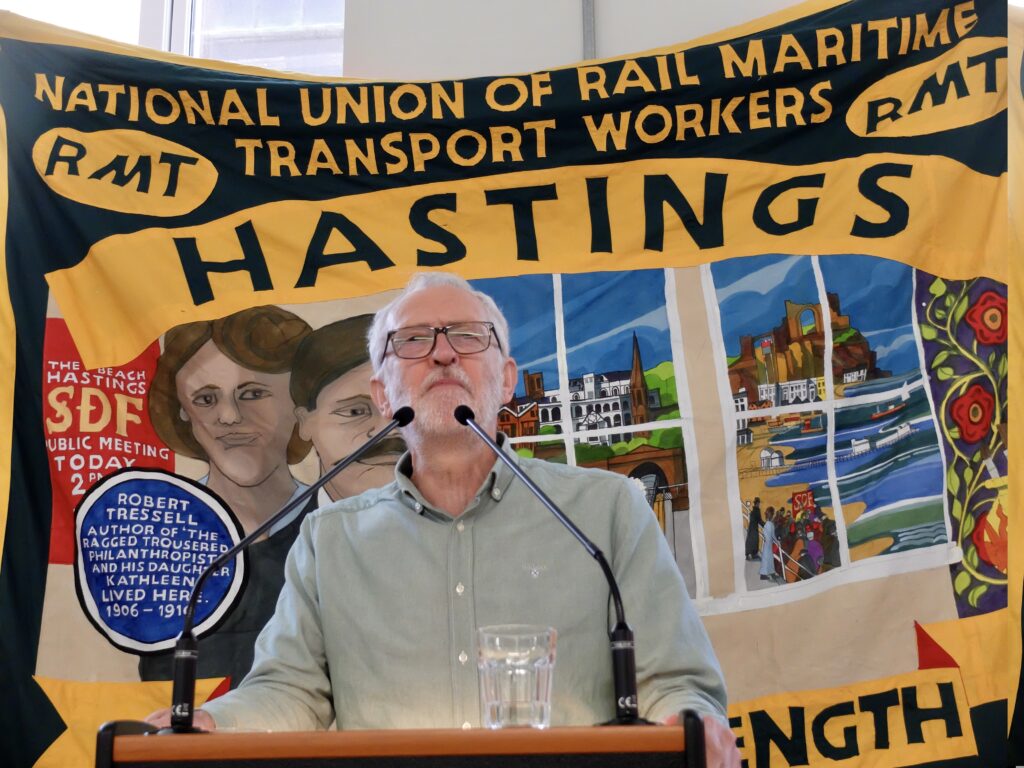
Jeremy Corbyn, the MP for Islington North, was guest of honour at the annual Hastings May Day Workers’ Day March last Saturday (29 April). Several hundred marchers set off from Hastings Pier and walked to the Observer Building in Cambridge Road for a rally at midday.
The march brought the centre of town to a standstill with a cacophony of noise and a colourful display of banners, flags and placards in support of workers’ rights, social and economic justice, and support for migrants.
The former Labour Party leader, who now sits as an independent MP in Westminster, was the main speaker at the rally. He had the Labour whip withdrawn in 2020 because he did not “unequivocally, unambiguously and without reservation apologise” for anti-Semitic comments, and he will not be able to stand again for the party at the next General Election.
Since his exclusion, Mr Corbyn has founded the Peace and Justice Project. This new movement aims to “bring together people to promote social justice, peace and human rights in Britain and across the world.”
Corbyn speech
Mr Corbyn spoke passionately about the need for more dignity at work and to eradicate poverty. He called on the wider union movement to reach out and bring hope to people, and to offer an alternative to the neo-liberalism that has blighted Britain. He called for a crusade to address the housing crisis, to improve education and to support the desperate people who are coming across the Channel in small boats. They are “desperate human beings and should not be demonised”, he said.

He was joined on the platform by Bella Faschola, from the Rail, Maritime and Transport Workers Union; Debbie Davis from the Public and Commercial Services Union; Antonia Berelson from the Royal College of Nursing; Jenny Sutton, from the National Education Union; and Rossana Leal from the Hastings Refugee Buddy Project.
The rally marked the culmination of a week of industrial strife across Hastings. On Thursday (27 April) a number of local schools were affected by the first of two days of strikes (see above), whilst the following day members of the Public Services and Commercial Union took industrial action at Department of Work and Pensions offices, which deal with benefit payments.
Nurses strike
In addition, members of the Royal College of Nursing, the country’s largest nursing union, renewed their industrial action at the Conquest Hospital. The RCN strike was due to begin on Sunday (30 April) until Monday (1 May) in support of an improved pay offer from the Government.
The RCN had recommended a pay deal which would have seen nurses given a 5% pay rise with a bonus of at least £1,250 per person, but the offer was rejected by its members.
Ahead of the strike, the RCN leadership insisted that their action would be managed responsibly, and that structures would be in place to ensure incidents or changing circumstances can be responded to as needed.
Paramedics and ambulance staff are also poised to take further industrial action over the coming weeks as the NHS continues to be engulfed in industrial unrest.
We hope you have enjoyed reading this article. The future of our volunteer led, non-profit publication would be far more secure with the aid of a small donation. You can also support local journalism by becoming a friend of HIP. It only takes a minute and we would be very grateful.

Leave a Reply