
Housing Rebellion in Hastings
Writer Grace Lally is a member of Housing Rebellion, a direct action group of housing and climate activists
We are told – across the nation but particularly in Hastings – that we must choose between providing urgently needed homes and protecting our green spaces. This is an entirely false choice.
The solutions to the environmental and housing crises are actually one and the same: tackling the powerful vested interests of the property industry, which are putting their private gain ahead of the social good.
There are a million empty homes in the UK, so the environmental cost of new construction (currently 10% of carbon emissions) is unjustifiable. The ‘problem of supply’ is really a problem of hoarding and profiteering. Hundreds of homes in Hastings are unavailable for long term rent because they are more profitable as holiday lets. Hundreds of properties sit empty because the market will see them magically rise in value even while they fall into disrepair. Wealthy people keep second homes here, simply because they can.
The environmental cost of heating and lighting our homes (currently 30% of carbon emissions) could be cut dramatically if every house had proper insulation, heat pumps and solar panels. That would also dramatically improve the quality of our homes and reduce energy bills. But still property developers are under no obligation to meet high environmental standards, and private tenants are terrified to ask for these improvements, even when plagued by damp and mould, because there are no limits to how much their landlord could then raise their rent.

Reducing environmental and planning restrictions on developers doesn’t bring down house prices. The cost of housing is mostly linked to the cost of finance, and we have seen how governments use every financial tool at their disposal – from reducing stamp duty to underwriting mortgages for new builds through schemes like ‘help to buy’ – to try to ensure that house prices NEVER fall. The same governments that say we must control inflation by controlling wages say we can never control rents.
The politicians who pay lip service to the housing crisis (and sometimes even pretend to understand the catastrophic environmental challenges we are facing) are primarily only concerned with propping up an economic system that relies on never-ending economic growth – of which construction is a key part – and a financial system that is dangerously reliant on property values.
Housing Associations which could be spearheading the transition to sustainable homes in Hastings have instead been compared to slum landlords.
But fortunately people with secure housing association tenancies have a lot more power than tenants of private landlords and by organising collectively they can use tactics like rent strikes to force change. ACORN, the community union, and Unite Community, have begun working with Southern Housing tenants in Hollington to campaign against longstanding problems with damp, mould and disrepair. This can happen everywhere.
Orbit, the other major housing association in Hastings, has emptied Clifton Court, a block of over 50 flats, and is planning to demolish it. They claim a new development would be more energy efficient, but the environmental cost of rebuilding is always vastly higher than refurbishment.
The real rationale for demolition is usually to unlock the land value by rebuilding on the site at a higher density and flogging off a large proportion at market rate. But why should we accept that public land, and homes that were built with public money and repaid many times over by generations of rent payers, should now be flogged off bit by bit to sustain an ever-dwindling number of affordable social homes? We need to use direct action to expose and oppose these plans, whether that means bringing these flats back into use ourselves or physically blocking any attempts to demolish them.
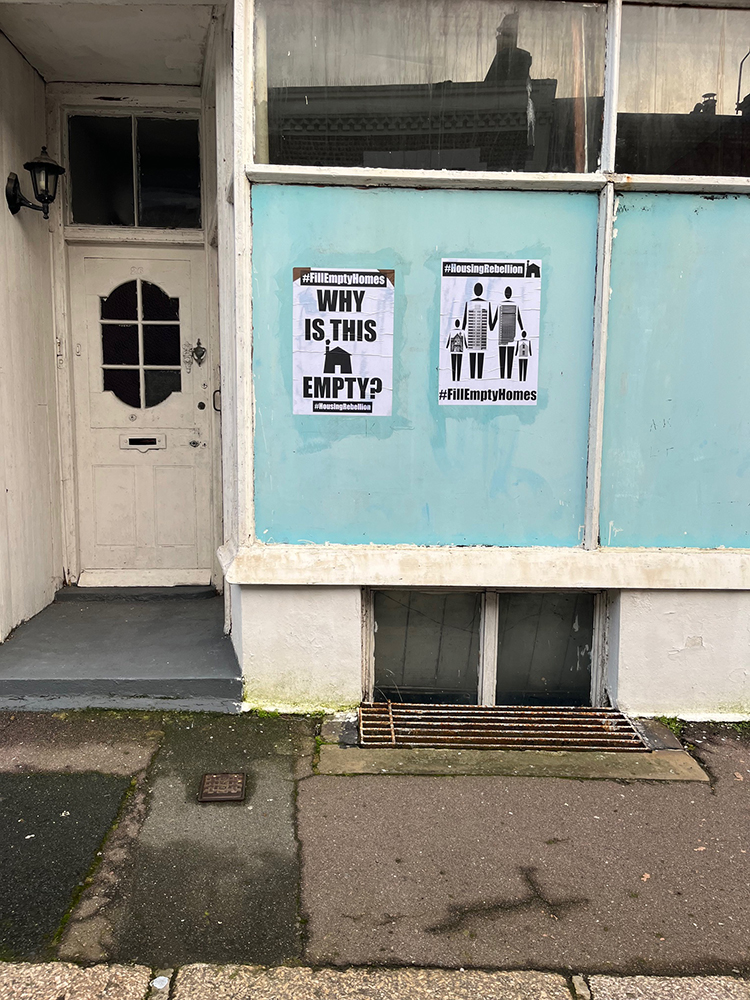
Members of Housing Rebellion recently affixed posters to a house in St Leonards asking “Why is this home empty?”. Some neighbours removed them, saying they feared they might be an “invitation to squatters”. But if a few posters could put people without a home into a home without people, then I’d say that would be a job well done. Or owners might be encouraged to lease more properties to the council for any of the hundreds of families languishing in unsuitable temporary accommodation.

We hope you have enjoyed reading this article. The future of our volunteer led, non-profit publication would be far more secure with the aid of a small donation. You can also support local journalism by becoming a friend of HIP. It only takes a minute and we would be very grateful.

Leave a Reply