
Frozen Assets – Would a Town Council do Better?
HUGH SULLIVAN
Following intended local government reorganisation, a future unitary council – whether it administers the whole of East Sussex or some other territory – will assume responsibility for the services currently performed by Hastings Borough Council (HBC): dealing with waste and recycling, street cleaning, housing, environmental health, planning, licensing etc. But what about the land, buildings and physical assets which the borough council owns?
As former HBC leader Peter Chowney points out in Our Town, Our Council on page 9, there are many industrial estates and retail parks owned by the council which bring in substantial income. On the other hand, current Deputy Leader Cllr Julia Hilton told the full meeting of councillors on 14 January that, whatever the future of the council, “one thing is clear that people really care about: what happens to local land assets, including community buildings, historic buildings, leisure centres, and our green spaces. Will these be a focus in a much larger and probably overstretched council to give true care and consideration to things like our parks and community spaces?”
Cllr Hilton went on to argue that the borough should protect its interest in these assets by taking steps to set up a town council that would survive the reorganisation. More sceptical onlookers might wonder how much care and consideration is currently being given by HBC to a number of these assets that seem to have been consigned to a deep freeze.

AZUR
The freehold of the Azur Marina Pavilion on St Leonards seafront is owned by HBC, with a long lease granted to Sea Change Sussex. Nearly £2 million of regeneration money was spent two decades ago building a restaurant and bar above the older sun lounge and café on the lower promenade, and turning the lounge into a conference centre and other function rooms. But three successive operating companies struggled to make it profitable, each failing to pay due rent to Sea Change. It was repossessed in January 2024, and has been left empty for the past two years.

Some needed roof repairs were carried out in 2024, and Sea Change reported in June of that year that up to 11 potential operators had expressed an interest in taking a fresh lease. At one point the agents instructed to market the premises, Fleurets, marked it on their website as “Sold subject to contract”. However, it emerged that there were more complex issues with the mains electrical supply which is shared with the wider Marina Foreshore complex administered by HBC, including the neighbouring sailing club, public toilets, workshop and car park. HBC agreed with UK Power Networks, the monopoly network operator, that the latter would lay a fresh cable under the street, and its spokesperson admits that it received the money to do this in March 2025. But it avoided undertaking excavation works “during the summer holidays season”, and although a new electrical kiosk was installed in October, enabling HBC to proceed with internal re-wiring, the new cable has still not been energised.
In the meantime, the fabric of the building is suffering from another winter of damp, rust and storm damage, both inside and out.

ST MARY IN THE CASTLE
The former church and arts venue has been empty since November 2022 when the previous leaseholder trust handed it back to HBC. Ambitious ideas to use Town Deal funds to develop it as a potential reception area to be linked with Hastings Castle by a lift or escalator were rejected. More recently, it has been added to Historic England’s Heritage at Risk Register in the hope of attracting national rescue funding.
Two months ago – i.e. three years after it was vacated – HBC launched a formal Expression of Interest process “to identify a new partner, operator or consortium to take forward [its] revitalisation”.
Submissions closed on 15 December. It’s understood that one proposal is to turn the venue into a music resource centre with rehearsal and recording facilities. The council has not made any comment since then on what responses it has received in this process, though Deputy Leader Cllr Julia Hilton told the cabinet in January that the council would need to put money into a long-term strategy to save it.
THE OLD BATHING POOL, WEST ST LEONARDS
The site of the former bathing pool at West Marina, owned by HBC, was earmarked for a mix of housing and leisure use regeneration in the local plan of 2015. In October 2021 HBC granted a 250-year lease for this purpose to West Marina St Leonards Limited (WMSLL), a subsidiary of national developers County Gate Properties. Neither the council nor the developer has been willing to disclose the lease terms.
Following a lengthy period of ground surveys (assessing, among other things, the extent and quality of Southern Water tanks and pipes under the surface), WMSLL’s plans were exhibited as part of a pre-planning public consultation in April 2025. Detailed drawings and visual projections revealed their intention to build more than 150 new homes on the site. They have met vigorous opposition in the form of West St Leonards Neighbourhood Forum, local community activists who last year mounted a counter-exhibition proposing that the eastern end of the site be developed as a leisure destination with low buildings (if any), play and garden areas, and potential for a tidal pool or on-land lido.
No formal planning application has been forthcoming in the nine months since.
Assets Beyond the Council’s Remit
In fairness to HBC, however, there are plenty of other community and heritage assets of the town where needed development has also stalled or seems to be moving at a glacial pace. What might a Town Council do about these?

FORMER DEBENHAMS BUILDING
The building which formerly accommodated Debenhams at 1-3 Robertson Street in the town centre was bought in January 2020 by Moxie Management Two, a company owned by two sisters, Bella Landen and Sophie Hubble. It was dilapidated when they took it over, and renovated with the aid of public funds from the Town Deal. Part (over three floors) was – and remains – let to Freedom Works as office space; the rest, notoriously, to the ill-fated and short-lived Owens entertainments venture. Following the Owens collapse in September 2023, Moxie Management has indicated that it plans to sub-divide that part of the premises to accommodate a variety of commercial activities which may include retail and/or restaurant uses. A recent licence application was granted for a sports bar. Earlier this month Ms Landen told HIP that they “are exploring/working on a couple of potential opportunities for the site”. It seems improbable that any activity will be up and running there in the immediate future.

SUSSEX EXCHANGE
The Sussex Exchange was developed with public funds by Sea Change Sussex as a restaurant, bar, conference centre and restaurant centre on a 1.6-acre site off Queensway. It opened in 2012. Situated near the junction with the Combe Valley link road to Bexhill, it was aimed to serve other prospective regeneration developments in this hinterland area, but few of these have come to fruition. In July 2024 the operating company went bust owing large amounts of tax and rent. After remaining empty for a year, it was announced that it had been sold “to a local manufacturing company” on long lease, but there has been no indication of any commercial activity being conducted at the site over the last six months. A spokesperson for Sea Change told HIP this month that the new leaseholder “is expanding and seeking additional premises for research, development, training and conferencing purposes,” but is still declining to identify itself.
CLIFTON COURT
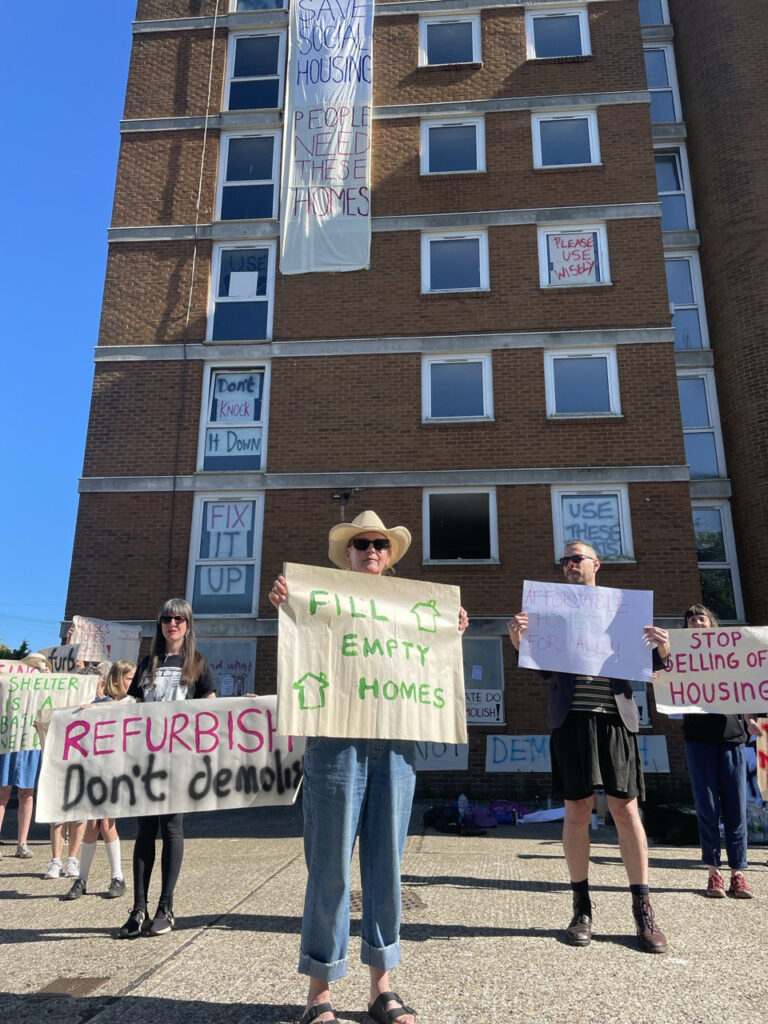
The block of 53 flats owned by housing association Orbit at the top corner of Cornwallis Gardens remains vacant more than four years after its tenants began to be decanted for prospective redevelopment. In the summer of 2024, it was briefly occupied by campaigners in the name of Housing Rebellion protesting at its being kept empty. A spokesperson for Orbit stated in April last year that demolition and rebuilding options were being discussed “in a working partnership with Hastings Borough Council”. Earlier this month another spokesperson insisted that Orbit is “committed to continuing to deliver new affordable homes across the Borough” and that it is “continuing to engage with the local authority to ensure delivery of as many affordable homes as possible to meet local housing needs and support the local authority’s housing strategy.” The council has offered no comment save that it “hasn’t seen any plans.”

HASTINGS PIER
As is well-known, this historic landmark was refurbished a decade ago with £14 million-plus of Heritage Lottery funds and local shareholder contributions, winning the RIBA Stirling Prize for best new building of 2017 (notwithstanding its 1872 substructure). It went bust the following year and was sold off by insolvency administrators Smith & Williamson to Eastbourne entrepreneur Sheikh Gulzar for all of £60,000. By way of justification, the administrators stated that out of the bids received, including from the community group Friends of Hastings Pier (FoHP), Mr Gulzar had demonstrated the best immediate finance capability: “It is anticipated that significant cash for working capital and investment purposes, amounting to over a million pounds, would be required to make the pier sustainable.”
In the seven and a half years since, no substantial investment has been forthcoming. Basic retail sheds were installed with temporary planning permission that has expired along with gold-painted décor that had none. Events have been limited to outdoor hospitality in summer, regularly falling foul both of licensing conditions and inclement weather. Maintenance of the substructure appears to have been minimal, the original engineers having been swiftly (and unlawfully) disengaged.
The pier has been registered by FoHP as an asset of community value and, when Mr Gulzar gave notice last October that he intended to put it up for sale, this triggered a six-month moratorium. MP Helena Dollimore claimed three months ago to have organised a meeting with local councillors and community organisations – “We are all united in our goal of ensuring that the pier is a valuable community asset for generations to come.” – but there has been little indication so far of any attempt to rally fresh public enthusiasm or raise public funds. Asked for a comment earlier this month, a spokesperson for FoHP said: “We are continuing to explore options.”

We hope you have enjoyed reading this article. The future of our volunteer led, non-profit publication would be far more secure with the aid of a small donation. You can also support local journalism by becoming a friend of HIP. It only takes a minute and we would be very grateful.

Leave a Reply