
Becca Horn: a seasoned Green campaigner
In the third of our series of interviews with the prospective parliamentary candidates (PPCs) of the main political parties ahead of the next general election, PAUL McLAUGHLIN talks to Becca Horn of the Green Party.

If central casting had been tasked with finding the quintessential Green Party candidate for Hastings and Rye they would have been hard pressed to find one more suitable than Becca Horn, the recently selected PPC. She is smart, erudite, passionate, and fully committed to protecting the natural environment and improving the lives of people in Hastings.
Born in Surrey, Becca grew up in Dorset and went to college in Stratford-upon-Avon before gaining a place at the Liverpool Institute for Performing Arts (LIPA), the higher education institution in Liverpool founded by Paul McCartney.
She then moved to London seeking fame and fortune. The odd acting stint was supplemented by various temping jobs, and like many 20-somethings new to the capital she was forced to take on multiple employment, working long hours to make enough money just to cover living expenses. It was an exhausting experience, she recalls, which left her with no quality of life. She thought about a law conversion course but decided instead to go travelling to India, SE Asia and Australia. It was a life-changing experience, opening her eyes to other cultures and countries and a new-found appreciation of our shared world.
On returning to the UK, she trained in a Pilates school in London specialising in the lower back. When she moved to Hastings in 2017, she took up a job as a yoga teacher with Active Hastings.
JOINING THE GREENS
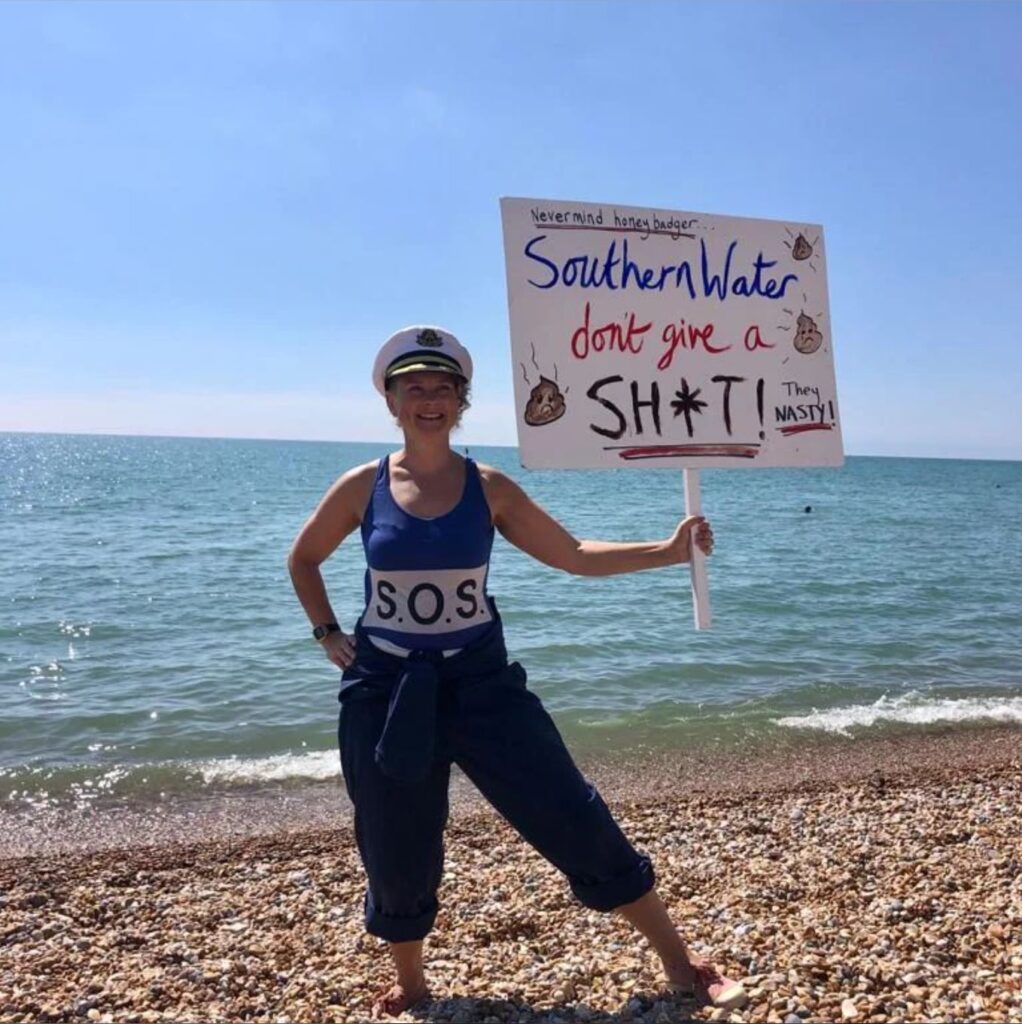
The move to the south coast also coincided with her first involvement in local politics. She joined the Green Party and campaigned for Julia Hilton in the local elections in 2018, but it was in 2021 that she really became active. Outraged by the Bulverhythe sewage leak, she became a founding member of the Clean Water Action Group (CWAG).
CWAG has waged a relentless campaign against Southern Water ever since, raising awareness of the continued dumping of raw sewage into the sea and protesting at the government’s lack of action in holding the company to account.
Emboldened by the success of the campaign, Becca stood in the Castle ward in the Hastings Borough Council local elections in 2022. She came within five votes of defeating Labour’s Judy Rogers in what had been considered a no-hope seat.
THE POLITICS OF WATER
Southern Water’s record of poor performance in recent years has had a major impact on the lives of people living in Hastings and Rye. The seemingly never-ending dumping of raw sewage into the sea, the flooding of Hastings town centre and the numerous misconnections and pollution of the waters in Alexandra Park are also shaping a new politics in the town, and now politicians of all stripes are determined to hold the privatised water company to account.
Becca is adamant that Southern Water and the rest of the privatised water companies should be renationalised. Indeed, she believes all public utilities should be publicly owned with local communities having stakes in power, transport, water and sewage providers. She argues that the privatised utilities have become cash cows for international asset management companies, and points to Macquarie Asset Management’s substantial stake in Southern Water’s parent company, Greensands Holdings, as an example of the poor practice.
She seems less certain, however, when she is challenged on how these businesses will be renationalised or where the money would be found to bring the utilities back into public ownership. Becca admits that there would need to be something of a revolution in the public finances with a fundamental change in the tax system, including a new wealth tax, an end to tax avoidance, and the closing of tax loopholes to bring this about.
She also admits that renationalisation would constitute a huge gamble with the nation’s finances, something akin to what Liz Truss tried in her infamous mini-budget. But, Becca insists, it’s a risk worth taking, as “to do nothing would be to gamble with the future of the planet”.
WHAT HAPPENED IN BRIGHTON?
Inevitably, at this point our conversation turned to the Green Party’s record in nearby Brighton, where the party lost more than a dozen council seats. Was this down to failed gambles and mismanagement?
Becca said her party’s defeat was due to a “combination of certain hyper-local factors”, including problems with the bin collection, the closure of public toilets and a series of unpopular traffic measures. She was also of the view, however, that winning control of the council in 2020 did her party no favours as it allowed Labour to pin a whole litany of council failings on the Greens rather than be blamed for their own failures. Nevertheless, she said that what happened in Brighton was “unfortunate” and that her party would “learn from the experience”.
She identifies herself as a progressive, echoing Sally-Ann Hart, who also insists that she is not a tribal politician. Like the incumbent Tory MP, she says she is prepared to listen to all shades of opinion and that she wants to work collaboratively with other parties for the good of the community. She said she welcomed the short-lived alliance that was forged after the last local election between Labour and the Greens and was “disappointed” when the national Labour Party forced council leader Paul Barnett to end the alliance, under which the Greens were given two cabinet portfolios.
TWO-PARTY CHOICE
This experience reinforced Becca’s support for proportional representation as a means of forcing politicians to work together. She says the first-past-the-post voting system reduces democracy to a narrow two-party choice between “alright and worse” and it actively excludes nuance, leaving millions of voters unrepresented. She is also an advocate of people’s assemblies as a radical way of involving people in the whole democratic process.
One of the key motivations for her standing in Castle ward once again in the next May’s local elections is to play a part in the rejuvenation of Hastings town centre. Becca says she is excited at the prospect of using the substantial funds from the Town Deal, the levelling up money, and up to £20 million from the new endowment-style funds announced by the Prime Minister in September to invest in key priorities in the town. She is equally keen to ensure that the funds are properly managed and that the structure of the new town board is both open and transparent.
She accepts that she starts as an underdog in both the local and parliamentary elections. The general election, in particular, will be “very difficult”, she says, as her campaign will not be getting much support from the national party, which will be focussing resources on retaining the Brighton Pavilion seat. Becca also acknowledges that there will be many people who will not want to split the anti-Tory vote so as to allow Sally-Ann Hart to win. “What would be wonderful”, she says, “would be to build a solid Green vote in Hastings and Rye to challenge the two-party system – if not next year, then certainly in the future.”
We hope you have enjoyed reading this article. The future of our volunteer led, non-profit publication would be far more secure with the aid of a small donation. You can also support local journalism by becoming a friend of HIP. It only takes a minute and we would be very grateful.

Leave a Reply