
Santa’s Naughty List
Alex W is a Hastings resident. He is just six years old. Alex has several environmental concerns and decided to address them to the Prime Minister. He is still waiting for a response. HIP also received a copy of the letter. RICHARD PRICE responds.
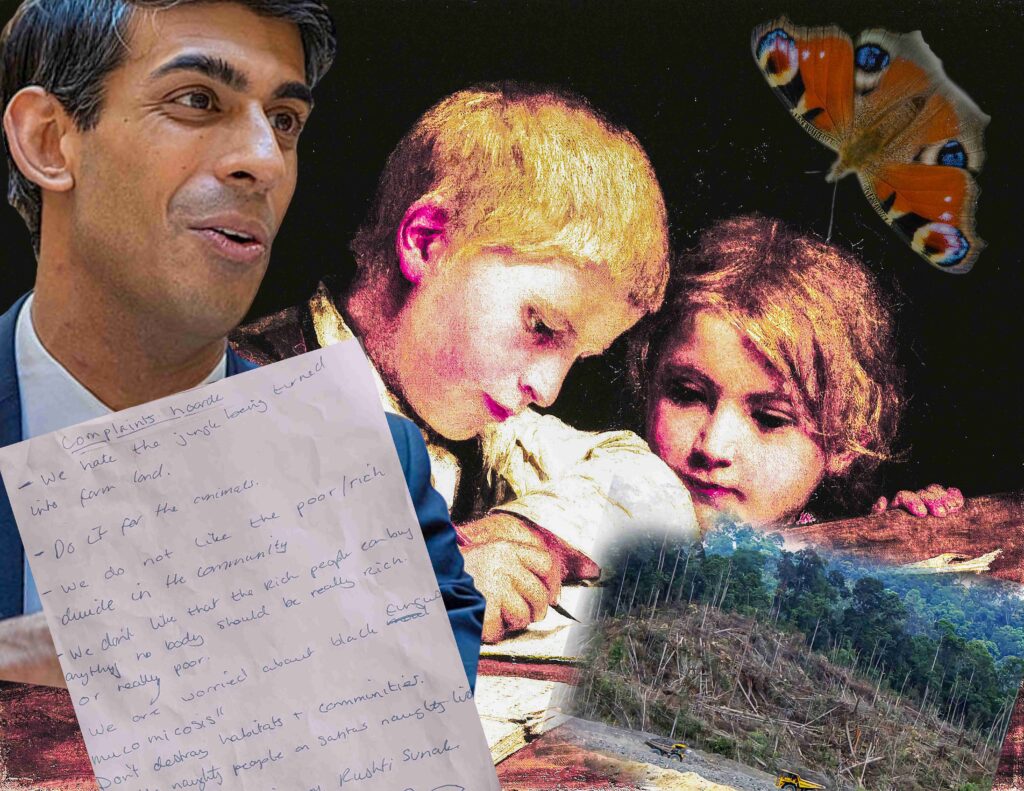
Just prior to Christmas, Alex W, who lives in a Housing Association property in Hastings, told his mother that he was very upset. She asked him why and what he would like to do about it. His reply was that he would like to write it all down into a ‘complaints horde’ and send it to the Prime Minister. His mother wasn’t sure what a complaints horde was, but Alex explained that he was using the word to mean a group of complaints. Sister Evie, aged eight, also got involved and added points three and four. Rishi Sunak may well be too busy to reply but the letter is worth reading as it raises some interesting issues.
Should Alex’s first point: “We hate the jungle being turned into farmland” be a concern?
The Amazon rainforest is a critical part of the world’s ecosystem because it regulates the Earth’s climate and weather patterns. For decades loggers in Brazil have been putting the global ecosystem at risk by cutting down vast areas of Amazonian jungle. The trees are valuable, and this deforestation is a major driver of Brazil’s economy, both legal and illegal.
The GM soy industry is responsible for much of the destruction. It involves very heavy use of herbicides and other chemicals, which destroy other plants and insects, pollute water supplies and damage health of agricultural workers. So Alex is correct; turning the rainforest into industrialised farmland is not good for the planet or the residents of the region. Fortunately there are also many reforestation projects planting millions of trees each year.

Alex’s second point “Do it [protect the rainforest] for the animals.”
This is also correct because the Amazon rainforest is home to an estimated 400 billion trees that represent over 16,000 species. It is also home to many endangered species of plants and animals.
Evie’s and Alex’s combined point three: “We do not like the poor/rich divide in the community.”
This is a difficult one, because to address it would require that the rich/poor divide in Hastings be quantified. However, we do know that there is a divide within communities in the UK. The gap between the rich and the poor (income inequality) has been increasing in the UK in recent decades. The top 1% of households in the UK earned about 10 times as much as the bottom 50 (Office for National Statistics, 2019). Point four: “We don’t like that the rich people can buy anything, nobody should be really rich or really poor.”
This was Evie’s idea, and it is very relevant to Hastings and St Leonards. A 2020 report showed “Levels of poverty in Hastings are higher than England and Southeast averages and significantly higher than across East Sussex”. Well over a quarter of all children living in Hastings were in low-income households. In Baird, Tressell, Central St Leonards and Hollington wards, over 40% of children were found to be living in poverty.
Child poverty exists when children live in households that are unable to provide them with the opportunities and material necessities for a full and healthy development. The UK government’s most recent data set shows that around four million children in the UK were living in poverty in 2020. That is about 30% of all children in the country.
Research has shown that people living in more disadvantaged areas tend to have worse outcomes in terms of health, education, and employment compared to those living in more affluent areas. The gap between rich and poor communities in the UK is a significant concern. And let’s not forget that the world’s 100 richest people earn so much annually that they could end global poverty four times over. The fact that people go hungry when there is such a surplus of money is cruel and immoral. With great clarity the child’s mind can see through to the truth of it.
Point five: “We are worried about black fungus – mucormycosis.”
Alex aged six knew of mucormycosis, which I had never heard of. So I asked HIP Health and Environment editor Susan McFie to comment. She points out: “Alex maybe heard recent reports of a child dying due to prolonged exposure to black mould in his family’s Housing Association flat. The boy died from a respiratory condition and a severe allergic-type reaction probably due to the fungi. The inquest didn’t mention mucormycosis. This condition is very rare because the human immune system is normally able to deal with exposure to moulds. However cases have been increasing in immune-compromised people.
India has by far the highest number of cases of mucormycosis. According to infectious disease expert, Dr Tanu Singhal, speaking at the Indian Science Congress in Nagpur: “In India fungal spore count is high due to decaying rubbish, tropical climate and humidity. The people affected were those with multiple health problems: usually severe Covid-19 combined with diabetes. These people would be taking high dose steroids, which lead to weakened immunity; this then opens the door to various fungal infections. Mucormycosis remains rare: fungi that cause the condition do not normally affect people, and it cannot be transmitted from person to person.”
Point six: “Don’t destroy habitats and communities.”
Alex and his sister Evie might have remembered the ‘assault gardening’ that was carried out on a nearby Local Wildlife Site. Ecological consultants cut down all trees and shrubs prior to carrying out an ecological survey and before a planning application was submitted. The Environmental Law Foundation (ELF) quoted government guidance, which states that when a site such as the Local Wildlife Site is under threat the best course of action is to protect it with a Tree Preservation Order. The Woodland Trust and Sussex Wildlife Trusts both agree on this. The guidance states trees do not have to be very old.

The council’s tree officer responded to the planning application by writing that there are no trees to protect as they have been cut down. The ELF pointed out that they hadn’t been felled, only coppiced, and are alive and well. The tree officer has refused to put into place the preservation order that would protect the site. Hastings Council then notified the developer that the tree officer will not be protecting the site. The borough’s natural resources manager can continue to tell ward councillors that it is not possible to protect a Local Wildlife Site on private land. The council make it so.
And finally point Seven: “Put the naughty people on Santa’s naughty list.”
I think a lot of people will like that idea. The trouble is, in the modern world where capitalism and money rule, it’s going to be an awfully long list!
We hope you have enjoyed reading this article. The future of our volunteer led, non-profit publication would be far more secure with the aid of a small donation. You can also support local journalism by becoming a friend of HIP. It only takes a minute and we would be very grateful.

Leave a Reply