
Power to the People
KENT BARKER
Will Hastings become part of the growing campaign to turn its streets and rooftops into mini renewable power stations? A number of local people have started to circulate news of other projects – particularly in East London – in the hope of generating support here.

The story of the Community Interest Company Power Station in Walthamstow is a quite extraordinary one. Two artists and activists, Hilary Powell and Dan Edelstyn, camped out on the roof of their terraced house throughout November and December a couple of years back to raise money and, perhaps more importantly, to raise awareness of their project.
Their goal is to install solar panels on 150 rooftops in their street and to make the electricity available to residents and local subscribers. So far they have raised £115,000 through Crowdfunder alone, enough to complete Phase 1 of the scheme with panels on 25 properties. The plan is to cooperate with other local organisations – schools, businesses, social housing and community buildings. As they say: “We got tired of waiting for the government to take action and responsibility … we’ve seen the energy markets going crazy. 27% of people in our own borough of London – Waltham Forest – are in energy poverty … We decided we would set about building a renewable power station on our street.”
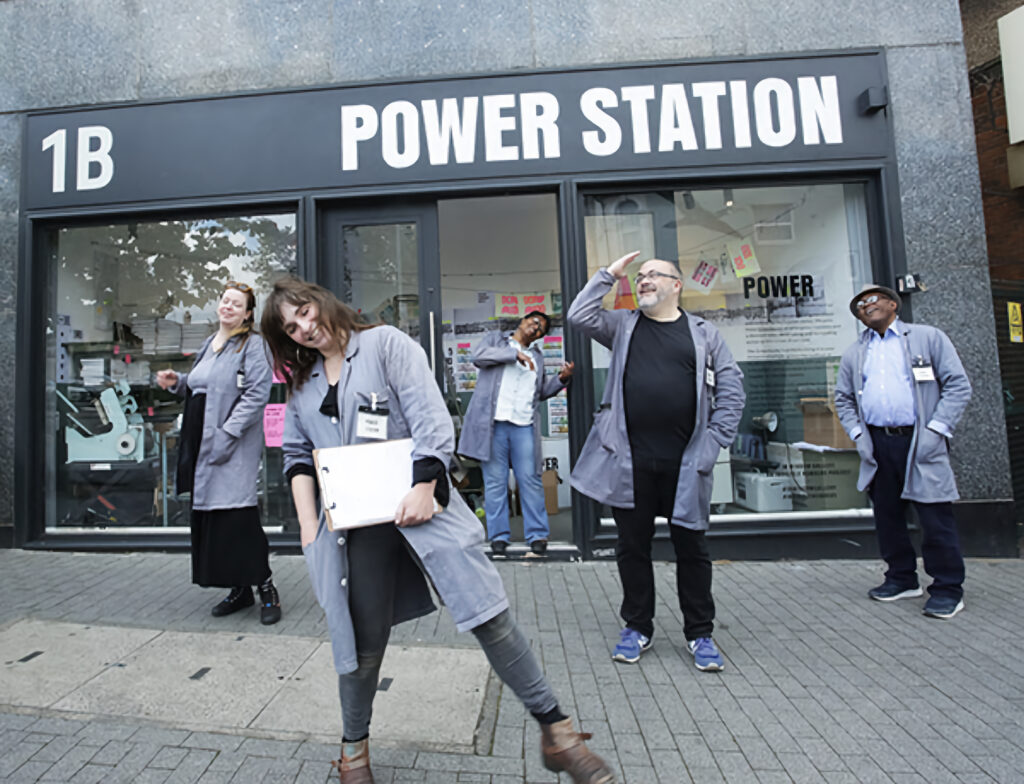
Hilary Powell and supporters outside their HQ
They calculate that with an average retail price of a 3kW solar system at around £6,000, and with just over 22 million houses in Britain, it would cost £133.56 billion to fit every one with solar panels. But that would meet 100% of all domestic electricity needs in the summer months, and nearly two-thirds in the winter. In comparison, Britain has nine nuclear power stations. The latest one being built is expected to cost more than £30 billion. On that basis, nuclear power stations ‘cost’ £270 billion and provide just 15% of our energy needs.

COMMUNITY SOLAR
The local model is already working in the United States with about 1,600 Community Solar projects up and running. There, it seems to be more industry-led with photovoltaic and renewable energy systems shared by a number of electric customers, including homeowners, renters, businesses and non-profit organisations. Electricity savings and other benefits from the solar project are split among its shareholders and solar subscribers at a rate based on the level of investment. It has required a change in the law, and shared renewables legislation–specifically for community solar–has now been enacted in 22 states, with others soon to follow.
In the UK, a Local Electricity Bill is currently making its slow way through parliament. It’s designed to enable local projects here to generate clean electricity and supply it both to local people and to the National Grid companies at a realistic price or, as the bill puts it: “on fair terms”. It would also require larger energy suppliers to work with community schemes to sell the power they generate to local customers for a ‘reasonable’ fee. The parliamentary bill has cross-party support from nearly half of all MPs (326) including Hastings member Sally-Ann Hart. The campaign group behind the bill, Power For People, has also persuaded the government to provide a £10 million fund to help community power groups to start up and expand. However, until the big companies are forced to work with them, they face an uphill battle and might be left with the situation facing Power Station in Walthamstow. They can finance or help get solar panels onto roofs but can’t sell surplus power back to the grid at a financially viable price, and they face formidable barriers even to share the power within their community.

Hilary Powell and Dan Edelstyn Rooftop Fundraiser
Part of the attraction of Hilary Powell and Dan Edelstyn’s vision, though, is the empowerment of the disenfranchised. It’s a cruel irony that the people most affected by fuel poverty are those least likely to be able to afford the £6,000 for a renewable system. And, as they are more likely to be renters rather than homeowners, they have little or no incentive to improve their landlord’s property. Edelstyn admits: “only one private landlord is on board with the scheme so far, and it’s proving difficult to get others interested because – even if the costs are covered – they say there’s not much in it for them. After all, they don’t pay the fuel bill….their tenants do.”
PRINTING MONEY
One intriguing aspect of the Walthamstow scheme is a secondary method of raising funds for the project, and it’s one that might well appeal to the artistic community in Hastings. The concept is simple. Invite artists to design and ‘print’ money and then sell this artwork and donate the proceeds to the project. So if someone created fifty £20 notes and sold them at face value they’d have raised £1,000. Buying a small work of art for £20 isn’t really much of a stretch, especially if you know it’s going to a good cause. And there’s just the possibility that the artist you bought it from will become established, and your banknote might become worth rather more. The antecedents of this idea came in 2018 when Edelstyn and Powell printed their own banknotes, sold them as art works and used the proceeds to buy up second-hand payday-loan debts at heavily discounted prices. This ‘debt’ – worth more than £1m – was stuffed into a van which they blew up near the Canary Wharf Financial Centre in London’s Docklands. Examples of their banknotes have been bought by the galleries and museums including the V&A and the Bank of England Museum, while a documentary about the project raised further revenue and has been nominated for awards.
It may be some time before they realise their ambition of getting solar panels on every house in Britain, but at least Hilary Powell and Daniel Edelstyn have made a start. And with the Local Electricity Bill making its labyrinthine way through parliament, they might just find they’ve hit the zeitgeist. As they say: “If the government really had the interests of the people at its heart and wanted to address the climate crisis and provide energy security, wouldn’t it concentrate on providing renewable, locally produced energy for all at scale and insulating all the housing stock?”
We hope you have enjoyed reading this article. The future of our volunteer led, non-profit publication would be far more secure with the aid of a small donation. You can also support local journalism by becoming a friend of HIP. It only takes a minute and we would be very grateful.

Leave a Reply