
Power From the People
Kent Barker considers a series of simple measures that could be taken to help us achieve carbon neutrality – and asks why the government appears to be not just ignoring them but actively working in the opposite direction.
Just over a hundred years ago a writer living in East Sussex decided to generate electricity for his home by harnessing the power of the local river Dudwell. There had been two watermills at Batemans in Burwash for centuries, but in 1903 Rudyard Kipling replaced one of the water wheels with a turbine. For the next two decades this pioneering technology provided all the light needed for his large Jacobean house.
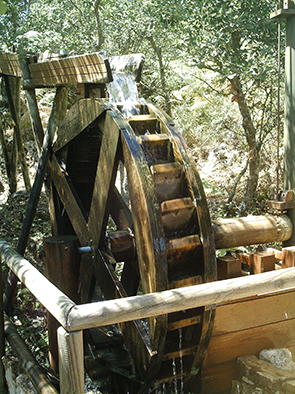
CREDIT: Pia do Urso
No one doubts that Britain is facing an energy crisis as it seeks to de-carbonise its electricity generation. But instead of the government’s preferred option of massively expensive offshore wind farms and nuclear reactors, Kipling pointed the way to a simpler, better solution. Not only is it being completely ignored, but Whitehall is now imposing impossible new financial barriers.
Water Power

In its 19th century heyday Britain had more than 20,000 working watermills, mainly grinding corn, but also providing power for emerging industries. Repurposed as small-scale hydropower schemes, official figures say they could produce 10 billion kWh (kilowatt hours) of electricity per year. Now that may only be some 3% of our overall needs but alone it would save almost 5.5m tonnes of carbon dioxide a year from entering the atmosphere. And Britain’s five longest rivers alone account for almost 1000 miles of moving water. Hundreds more mini-hydro schemes could surely be built along their banks.
The tragedy is that today even Kipling might cavil at the cost. Not only is the government NOT providing financial incentives to help people with micro-generation, but they appear to be actively working to prevent it happening. From April this year, The Environment Agency has increased the start-up fees for small-scale hydropower schemes from £1,500 to anywhere between £6,000 and a massive £13,000.
Nuclear-Free Power
An association of councils supporting renewable energy, Nuclear Free Local Authorities or NFLA, describes the move as ‘outrageous and illogical’. Councillor David Blackburn, Chair of the NFLA, said: “the price hike may well kill off future small-scale hydro projects in England. A 900% rise in fees will deter new projects from being developed and delivered at a time when we should be encouraging more small hydro schemes to power our farms, commercial buildings and sustainable housing off-grid to reduce our carbon footprint and increase our energy security.”
It’s not just water-power that could contribute to Britain’s energy problems–it’s wind and solar too. England alone has 24 million dwellings of which just 20% are flats. So just over 19 million houses have their own roof on which could be placed solar panels or a small wind turbine. And even a block of flats is likely to have a communal roof, which could be used. A 4 kW solar panel system on an average-sized house can produce around 2,850 kWh of electricity in a year, but take that down to a more probable 2,000 kWh, and multiply by the number of houses and you get 38 billion kWh. Sounds a lot until you realise that we need about 230 billion kWh. Nevertheless it would amount to some 17% of our total energy needs, and given that most electricity is used by industry and businesses, it would be as much as two thirds of our total domestic needs.
Roof Power
Now let’s add small roof-top wind generators into the equation. Each could produce 438 kWh per year. A national total of 8.3 billion kWh. Not inconsiderable. Add in 10 billion for water turbines and more for small-scale tidal or wave power plants and you could soon get to a position where Britons were generating almost all the electricity they need for their own use at home.

But there are two fundamental problems to this concept. The relatively high up-front cost of the technology and, crucially, the amount you as an individual can charge for exporting your electricity to the grid. In both instances the government has effectively shot itself in the foot and done exactly the opposite of what was needed. In 2017 Amber Rudd removed all support for solar thermal installations effectively killing a hitherto burgeoning industry. Then the Feed In
Tariff – the price you could sell your home generate electricity back to the grid – was removed and replaced with a much less generous Smart Export Guarantee scheme. In some instances this meant that returns plummeted from 43p per kWh to around just 7.5p per kWh and meant that that the average domestic supplier would now make just £112 a year selling their power.
Small-scale electricity gene-ration doesn’t have to be purely domestic. As far back as 1908 in Herstmonceux, East Sussex, Charles de Roemer installed a local generating plant. Within a few years it was supplying all the power for the village. Community generation is a model that we could be pursuing today. Just a few years ago a farmer I know proposed constructing an anaerobic digester plant that would have been capable of providing the electricity for his entire Kentish village of around 3,000 people. In the end it didn’t go ahead because of the high start up costs and the removal of the Feed In Tariff.
Pier Power
But instead of investing trillions of pounds in new nuclear power stations why doesn’t the government underwrite loans to householders and communities to undertake their own power generation? In Hastings the tide rises and falls about 5 meters twice a day. A series of small reversible turbines on the end of the pier or the breakwater could be producing clean renewable power for the town, and for the country, seven days a week, 365 day a year. It just needs the council to be incentivised. Not a single new house should be allowed to be built unless its roof is covered (or made from) photovoltaic cells. Electricity companies should be forced to buy back power at virtually the same price they sell it – or they should be nationalised. Planning consent for small domestic wind turbines should be abolished. There are a myriad of small changes that the government could make which would transform our Co2 emissions and lead to the goal of every single one of us being largely responsible for cleanly generating the electricity that we use. So far the Conservatives seem hell bent on doing precisely the opposite.
We hope you have enjoyed reading this article. The future of our volunteer led, non-profit publication would be far more secure with the aid of a small donation. You can also support local journalism by becoming a friend of HIP. It only takes a minute and we would be very grateful.

Leave a Reply