
Down to Earth
Writing about the soil in the shadow of Big-Farmer and Big-Pharma, Gwendoline Coates finds inspiration in the writings of Alastair McIntosh and Adam Horovitz.
I write about soil from both a literal and a metaphorical perspective based on my experience as a crofter in the Shetland Islands and as a smallholder in Italy’s Apennine mountains, together with my practice as a homeopath.
Recent publications have taken an increasing interest in the soil. Merlin Sheldrake’s Entangled Life, published in May 2020, tells us through a combination of science and story how fungi are crucial in the making of dynamic soil and essential in the terrain of our bodies. Guardian reviewer Richard Kerridge describes this as a door-opener book: “a genre devoted to connectedness in all directions, and one well suited to our times”. Then in October 2021 we had Matthew Evans’ book: Soil: The incredible story of what keeps the earth, and us, healthy. Evans is a farmer and writes passionately about our shared responsibility to protect and nurture our most valuable resource: the very ground we stand upon.
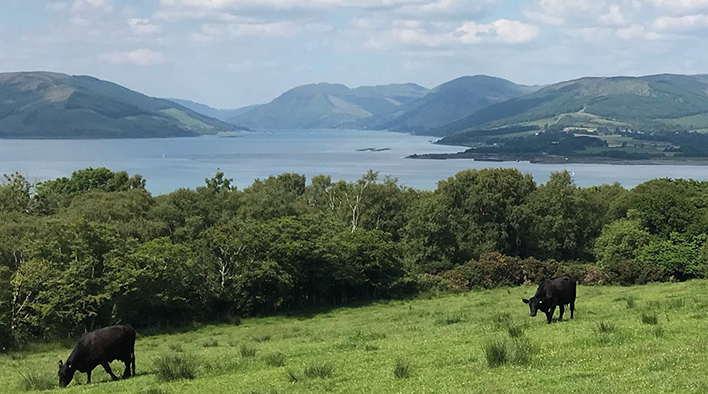
Hebridean Islands
CREDIT: Susan McFie
I will weave my experience together with the works of these two authors who write with great reverence about the soil and the land. The study of the way in which the soil interacts biologically with living things is called edaphology. Our ease, or lack of ease, dise-ase, is inextricably bound up with the soil.
TERRAIN OF THE BODY
Louis Pasteur, the French chemist, developed germ theory in the 1800s, proposing that germs are the cause of disease. At the same time, his friend Claude Bernard, a physiologist, was teaching that while the germ plays a part, the terrain of the body is of greater importance. Bernard has been described as one of the greatest men of science. He was one of the first to introduce blinded experiments in order to ensure objectivity. Bernard maintained that it is the terrain of the body, which creates an environment that is hospitable to a greater or lesser degree to pathogens. It is not the pathogen alone, which causes disease. In other words, the more the body the less it will be affected by the germ. At the end of his life, Pasteur came to agree with Bernard, and one of the last things he wrote was that true health lies in the soil, not the seed; the terrain is everything.
A hundred and fifty years later, conventional medicine is still largely ignoring the teachings of Bernard and other like-minded physicians. This has been brought into sharp focus during the Covid pandemic, when any advice given to the public on strengthening the immune system has been glaringly and, to my mind, criminally absent.
One of the most important ways we can do this is to eat good food, grown in healthy soil. But it is estimated that only one per cent of the British population now works on a farm, and we have become ever more disconnected from the sources of our food. The authors I look at in this piece are deeply connected with the land.
SOIL AND SOUL
The connection between spirituality and the natural environment is captured in the title of Alastair McIntosh’s book Soil and Soul, first published in 2001. A Scottish writer and campaigner on land reform and community empowerment, he was Scotland’s first professor of Human Ecology. In the Foreword, George Monbiot writes: “McIntosh … transforms our engagement with soil and soul… into a new and compelling vision of freedom and social justice… rediscovering the presence of God in nature…” As he admits – it is an extraordinary thing for this ‘old sceptic’ to say. Something has touched him deeply. Monbiot has recently published Regenesis: Feeding the World without Devouring the Planet. “Farming is the world’s greatest cause of environmental destruction… yet millions still go hungry.”
McIntosh makes the connection between the way the soil is maltreated by industrial farming and the way the soul is abused by disconnection from the land itself. It’s all in the terrain. This book tells the shocking history of landlordism in Scotland, as a background to the story of the defeat of corporate power in the Hebridean Islands. There are two interlinked stories. One is about the people of Eigg, who become the first to succeed in taking land back from the lairds, (mostly English and often absent), into the hands of the community. The other is about the people of Lewis, McIntosh’s birthplace, who fight a long battle to prevent the building of a super-quarry on the island which would have destroyed Mount Roineabhal. They do this with the help of the Canadian warrior chief, Stone Eagle, who has spent his life fighting for land rights.
MEASURING PROSPERITY
The social critic Ivan Illich refers to the “vernacular economy.” The measure of prosperity should be sufficiency, where the community ensures that everyone has sufficient. But what happens if we come to value quantity over quality? Cash economy over vernacular economy? Growth over sufficiency? Does this make us more or less happy?
McIntosh felt that the old skills, which emerged from close connection with a specific location, were losing their hold. Reverence and responsibility towards place were being eroded. “Crofting is about poverty with dignity. If you stand on your own four or eight acres you are monarch of all you survey, and it gives you a natural dignity.” But not when the tenure of that land is precarious. The history of the system of landlordism shows how it has affected the soil of the islands and the souls of the people; how it affects the terrain of the mind and the body.
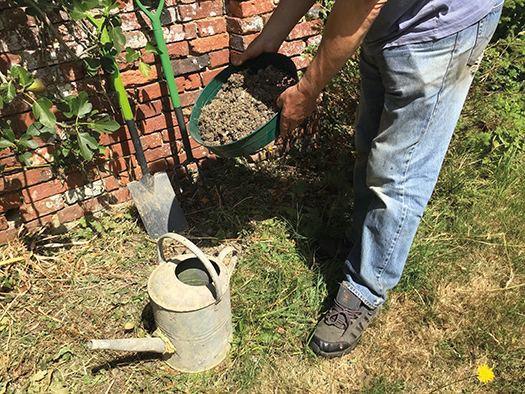
CREDIT: Susan McFie
In 2016, modern-day bard, Adam Horovitz received an invitation from the Pasture-fed Livestock Association (PfLA) to be their poet in residence, living and working on four farms in England and Wales. In the Foreword to the collection, The Soil Never Sleeps, published in 2018, he wrote: “What makes these farms different is their decision not to conform to the post-World War Two chemical-driven farming consensus that has seen soil and food stripped of nutrients, and animal welfare suffer, in the name of remorseless productivity.” They might appear to be sleepy, but a look at the soil through a microscope reveals life as frenetic as any city. It’s all in the terrain. “I began to understand that the land needs the sustenance of stories being told about it as much as it needs to be sustained by good practice.” This is McIntosh’s mythopoesis in action. The farmers need to tell their stories. Not only that, but writers and artists have a duty to help tell the stories of the land itself.
THE GREAT RE-THINK
Before producing much work for the PfLA, Horovitz was invited to be the poet in residence at the 2017 Oxford Real Farming Conference (ORFC). This was started in 2010 by the writer and scientist Colin Tudge, whose books include Six Steps Back to the Land, the delightfully entitled Why Genes are not Selfish and People are Nice, Good Food for Everyone Forever, and most recently, The Great Re-Think: A 21st Century Renaissance, published in 2021.
The argument always forwarded in defence of the agro-industry is that we have no choice; that there are billions of hungry mouths to feed. Colin Tudge does not mince words in setting this straight at the very beginning: “The United Nations tells us that out of the present world population of around 7.8 billion, almost a billion are chronically undernourished while another two billion suffer from diseases of affluence. Unfortunately, the orthodox responses both to world hunger and to excess are horribly misconceived, and so too are the solutions proposed.” Governments are wholly intent on producing more food, convinced this can only be done through high-tech agriculture. “This is the most dreadful destructive nonsense,” says Tudge. Not only because of the catastrophic damage to the soil but also because it is completely unnecessary. The world already produces twice as much food as we need right now. This is enough for 14 billion people, which will never be needed because the human population is reaching its peak. Colin Tudge proposes a system of what he calls Enlightened Agriculture, which is “more or less the complete opposite of what the powers that be now recommend”.

We hope you have enjoyed reading this article. The future of our volunteer led, non-profit publication would be far more secure with the aid of a small donation. You can also support local journalism by becoming a friend of HIP. It only takes a minute and we would be very grateful.

Leave a Reply