
Allotment life – a lesson in patience
EDWINA HUGHES
As I write this piece, it’s raining – we’ve been waiting for rain for a while. My friend and allotment holder, Stella, tells me this year has been about patiently waiting for the rain. Other years, she says you have to wait for the rain to stop or the soil to warm up, but this year, we’re waiting for rain. It was the driest March on record and the farmer in me knows that not all rain is equally useful, this fine soft misty stuff needs a bit more umph to deliver impact to the soil; too much, though, and the land won’t be able to soak it up and it’ll just run off. So, I’m asking for something in between, on behalf of the allotment holders and more importantly the farmers.

The weather on the day I visit Marina Allotments is fine and dry. Stuart Balkam, the treasurer of the allotment committee shows me around. He’s had an allotment on the site for three years and knows many of the people we meet on our tour. I’m immediately impressed to find a pizza oven and composting toilet on site as well as a number of shared resources like seeds, fencing and training materials. In fact, there’s also a nut grove and hazel tree coppicing on site.
Marina Allotments is a wonderful place to spend some time. Each allotment is distinct; some plots have raised beds carefully cleared and prepared for sowing, alongside others with overgrown runner bean plots mixed in with potatoes and wild flowers. At one point I notice a beautiful wrought iron bench that seems to be awaiting its next incarnation, and later I spot a front door too good for the tip but not quite useful at home. Apple trees and blackberry bushes are trained along fences and trellises and unruly rhubarb and chard flash their gorgeous, colourful legs at me as a wander past. I can see why people say gardening is good for your mental health, I’m already feeling more relaxed.
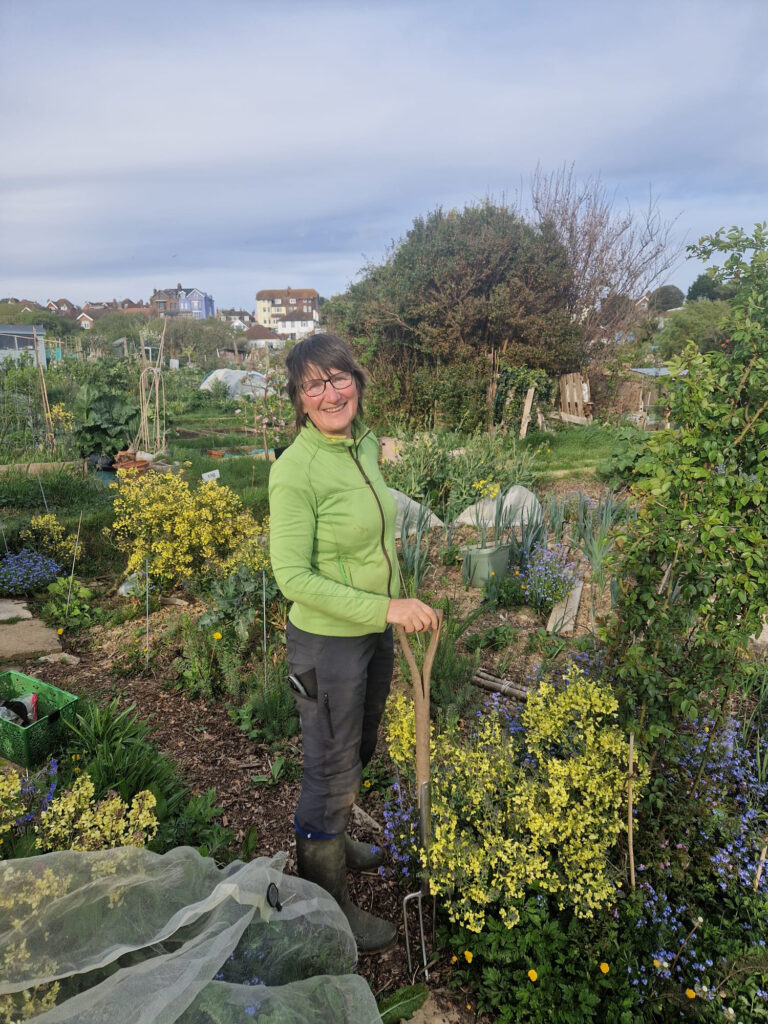
I am here to look around and I am also on the hunt for asparagus – asparagus is in season and features in this edition’s accompanying asparagus, crab and radish salad recipe from Martin. The question is, if we source our crab from the local fish huts, can we hope to grow asparagus in our allotments? Let’s find out.

Regardless of what you decide to plant, Stuart tells me that to maintain an average plot you need to spend about 6 hours a week across the year maintaining it. That adds up to a bit less in winter when everything is cut back and dormant and a lot more in spring and autumn for sowing and then harvesting.
There are fifteen allotment sites in the Borough of Hastings and St Leonard’s. The Council manages 600 allotment plots spread over thirty acres on thirteen sites. Marina Allotments’ land is owned by Hastings Borough Council, but this one is self-managed by a committee and volunteers. It has just over 130 plots and most of these are four or five rods in size – that’s approximately 125 sq metres, or about half the size of a tennis court. The plots were originally about double that size–the idea being a plot would be large enough to feed a family. Their use has evolved over time, thus the reduction in size. Half a tennis court of potatoes, veg and trees sounds doable and from a distance the plots look manageable and quaint. Closer up you sense the enormity of the work entailed in filling that space with something – flowers, vegetables, trees. It’s possible to request a smaller plot to start with, but if you do get a large plot, there are many experienced allotment holders who can show you the ropes. That is, if you are lucky enough to be allocated a plot – right now the waiting list is over two years! So, the good news is that you have plenty of time to think about what you’d grow.
When I visit it’s late Sunday afternoon a few gardeners are still here, digging, clearing, preparing. I see many signs of potatoes, leeks, broad beans, rhubarb and chard. Not so much evidence of asparagus being grown. But I am on a mission to find out more about our delicious featured vegetables. I want to know whether it is a viable allotment vegetable.
Lucky for me, Stuart planted some asparagus last year and can tell me more. I learned that while asparagus can be grown from seed it’s often grown from a crown – a spider web of roots that are sown in springtime. Crowns work hard but relatively quickly underground so that within a few weeks you may see a number of shoots poke up above ground level. In year one, they’ll shoot up into long willowy stems with small buds at the top.These aren’t suitable for eating. Stuart shows me these fragile willowy stems; they remind me of Fresia more than vegetable stalks. It turns out asparagus is a test in patience, and you may need to wait three or four years to get a good crop. Stuart intends to take his 15 – 20 stems and cut them back come autumn. He hopes that subsequent years may yield a more robust crop. I’m starting to think that asparagus might be a good metaphor for allotment life – growing it requires patience and a bit of luck.

Later on, I bump into Margaret Blurton who has had her allotment for a year and a half. Stuart tells me if there was a prize for the most transformed space, Margaret’s plot would be in the running. Her allotment is teeming with life: there’s plenty of potatoes, wild garlic, leeks and broad beans, and clouds of yellow hazy flowers – apparently the purple flowering broccoli got away from her, and these yellow flowers are the result. I might suggest some mistakes are meant to be – the bees are delighted with these pastel yellow buds that make up a glowing brush swaying gently in the breeze. On top of all that, we are in luck, as Margaret is also growing asparagus. This is her first year of growing asparagus and she’s understandably underwhelmed with the result, Stuart is able to offer some consolation and advice.
If I’m honest, neither seem too bothered. Before I leave the allotment, we do find one bed with some more mature asparagus – this bed has several spears poking out from the soil, and the spears have all the right qualities – not too willowy and not very tall, but fat. Who knows if this crop will make the grade and all the way to a dinner plate this year? Time will tell. If not, there’s always next year.
To find out more about the Marina Allotments visit their website marinaallotments.org.uk If you don’t want to wait years for your asparagus but want to purchase local stuff, try local grocers or South Brockwells Farm in Uckfield – they are famous for it. southbrockwellsfarm.com/asparagus

We hope you have enjoyed reading this article. The future of our volunteer led, non-profit publication would be far more secure with the aid of a small donation. You can also support local journalism by becoming a friend of HIP. It only takes a minute and we would be very grateful.

Leave a Reply