
A Taste of the Outdoors
CALEB GEARTY
This year, the UK has experienced the most days over 30 degrees in its recorded history. With five near-continuous heatwaves that decided to concentrate most of their wrath on the south-east, dining al-fresco became more of a need than a want for many restaurant-goers during the summer months. And, as more and more chairs were hauled out of restaurants onto curbsides, and parasols hastily assembled above melting mains, what it meant to ‘go out to eat’ changed across the country.
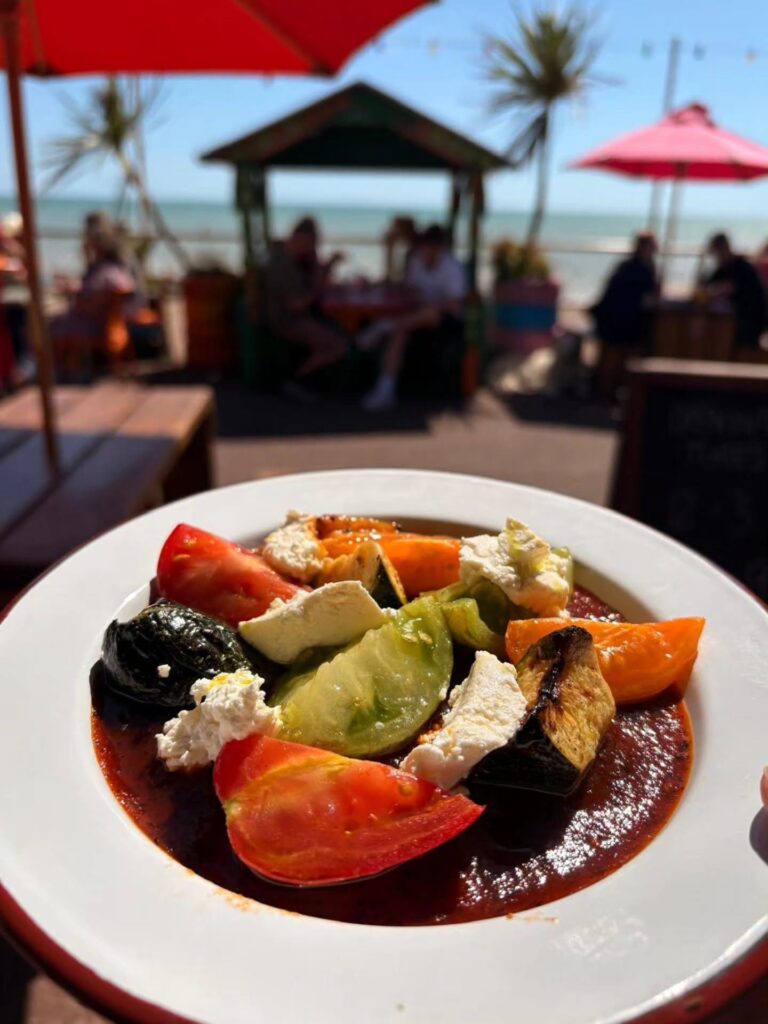
Most of Hastings has been turned inside out this summer. Cosy pubs have turned into sprawled gatherings and the guts of restaurants have crept out from cramped kitchens into vacant interiors to give sweltering chefs relief from the inferno of ovens at midday. But for one restaurant, whose identity has always lain more on the exposed promenade and rocky outcrops beside it, this outward shift has represented a more internal, identity-based change.
St Leonard’s Goat Ledge may have been the town’s most popular restaurant regardless of its menu this summer. Having opened on the Warrior Square seafront nearly 10 years ago, Goat Ledge has spent most of its existence as a cafe-type joint, serving deliciously smashed breakfast baps in the morning, before giving way to fresh fish sandwiches, booze, and a host of incredible, obscure music in the afternoons and early evenings.
Often operating in view of the worst waves, and in the midst of the very worst weather, eating on their Balamory-coloured outside benches, rain or shine, has arguably been the defining part of the Goat-Ledge experience up until now.
But this year, as fine dining filled the pavements of King’s Road and George Street, Goat Ledge decided that the seafront wasn’t to be without an upscale kitchen of its own, and so was born Fire on the Beach. Serving the type of food that makes your mouth drip reading the menu (wood-fired prawns; skate wing with sobrasada and peppers; baked feta and cucumber salad), Goat Ledge has transformed from a place to go for lunch to the place to be for dinner.

And it’s not just the perfectly slow-cooked pigs’ cheeks that have done this; it’s the authenticity of being and eating outside at a place created with that in mind. The Fire on the Beach kitchen spills from a small wooden hut onto the promenade itself. Benches are stacked tightly with chairs dotted loosely around their ends. People sit in sprawling groups next to people they only half know, and food comes out in bowls designed for sharing; with their normal kitchen operating just feet away, sitting at Fire on the Beach feels like you’re being secretly treated to off-menu hits before they go mainstream. Every night is a dinner among friends, even if you’ve just stopped by on your own.
This spirit of being outside has crept from the seafront, through the town’s high streets and back up the hills towards our country pubs and towns. In Battle’s Crafted at Powdermills, nomadic dining became the defining feature of their summertime offerings. Evenings with featured guest chefs weren’t hosted in their restaurant, pub, or bar, but on sprawling tables set for 50 or more, at the edge of their lakeside woodland.
These candlelit evenings culminated in an appearance from hash-brown aficionado and Masterchef semi-finalist James Sharp, whose menu of perfectly grilled mackerel, cannons of sirloin, and charred allium salads turned a patch of woodland into the type of restaurant you dream about for a long time after. Served on large sharing platters, passed down the table family-style, the evening was just as much about food as it was about getting to know those around you, and smiling at the stranger who offered you the last, perfectly cooked piece of sirloin.
The feast was finished in the most delicate way, with a gently charred swiss meringue, made under the light of iphone torches as the sun set over the lake. Bought over in single servings by the team of waitstaff who had floodlit their creation, the little meringue felt like a microcosm of what these evenings were really about: people coming together.
So clear was this feeling, that people stayed on as summer sun turned to a first set of candlelight and then another when they had burned out. A small speech from the chef about how being part of an evening like this was really what his (and his teams) jobs were all about, put a neat bow on the evening, and Crafted’s ‘Forest Feast’ itself.
As the heat begins to relent and tables slowly creep closer to the doors of restaurants with each passing day, it’ll be easy to forget how the simple joys of summer dining can make any meal into a shared experience with place and people. So now, whether it’s sandwiches at Rock a Nore, spritz at The Selkie, or Sobrasada at Goat Ledge, make sure to enjoy the last embers of our scorching summer on dry chairs outside.

Or, if you want to bring some summer joy to your own home, here’s a showstopper BBQ recipe by The Crown’s Jody for fire-cooked pulled lamb flatbreads with roasted pepper sauce. This one is definitely for a special occasion!
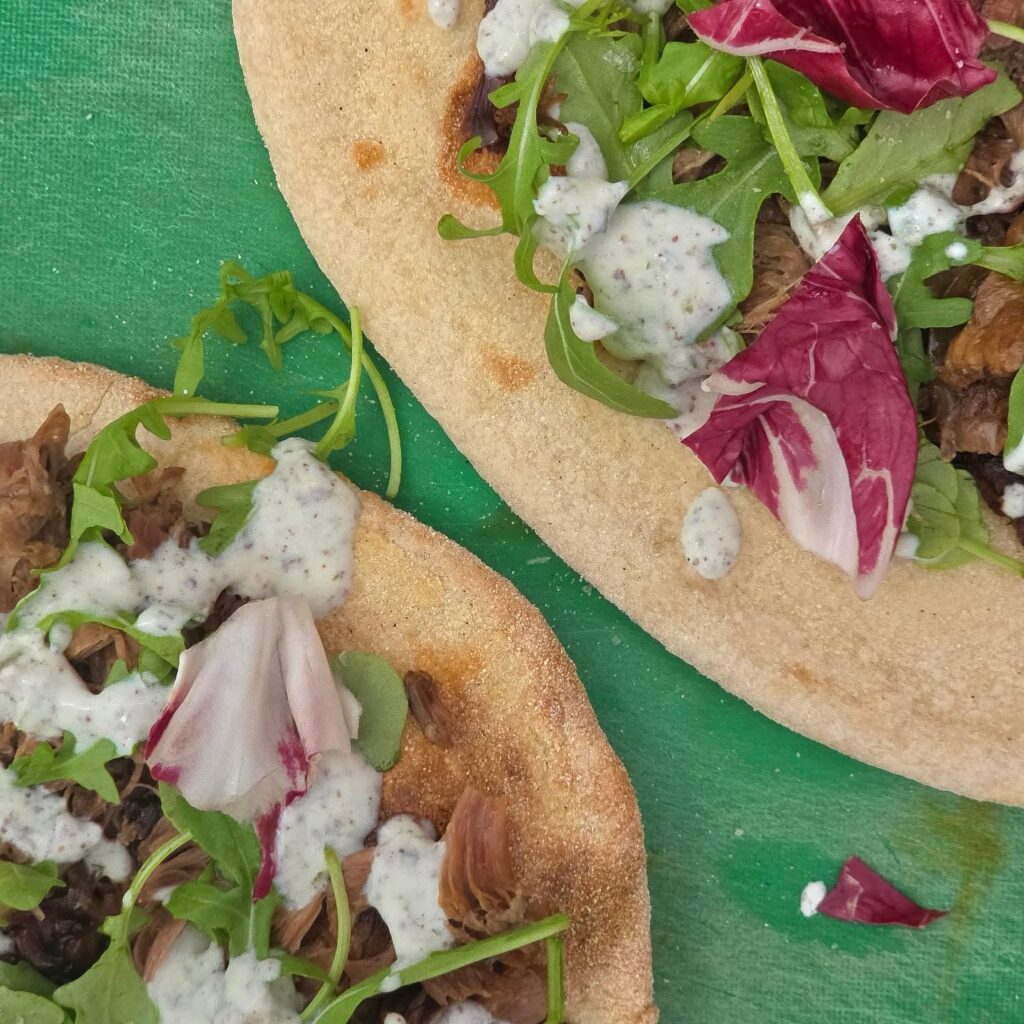
Fire-Charred Pulled Lamb Flatbreads
A RECIPE BY JODY MORTON
Smoky pulled lamb shoulder in a charred roasted pepper sauce, served in charcoal-cooked flatbreads. Expect something between a slow-cooked lamb stew and an enormous, gloriously messy kebab.
Ingredients
For the lamb
- 1.5kg boneless lamb shoulder
- 2 tsp ground coriander
- 1.5 tsp ground cumin
- 1 tsp paprika
- 4 garlic cloves, crushed
- For the sauce
- 5 garlic cloves
- 1 tsp ground coriander
- ½ tsp ground cumin
- 3 tomatoes
- 2 red peppers
- 1 large onion, peeled and halved
- 1-2 red chillies
- 1 tbsp tomato puree
- 300ml chicken or lamb stock
- 1 tbsp red wine vinegar
- 1 tbsp pomegranate molasses
- Handful flat-leaf parsley, chopped
- Handful mint, chopped
For the flatbreads
- 500g strong white bread flour
- 7g fast-action dried yeast
- 1 tsp sugar
- 10g salt
Method
- Light fire: Light charcoal, ideally in a chimney starter, (15-20 min), then place the hot coals on the bbq, concentrating most of them on one side, giving a hot side for grilling and a cooler side for slow cooking.
- Make dough: Mix the flour, yeast, sugar and salt, then stir in 325ml warm water and 2 tbsp olive oil, combining to form a soft dough. Knead for 8 minutes, then cover and prove in a warm cupboard for 60–90 minutes.
- Sear lamb: Cut lamb shoulder into 2-3 large pieces. Mix all the other ingredients (under For the lamb) as well as 2tsp fine salt, 0.5tsp black pepper, 1tbsp vegetable oil and an optional 1tbsp pomegranate molasses, in a bowl. Rub the mixture over the lamb, then sear in a casserole dish over the hottest coals for 3-4 minutes per side until well charred (not cooked through). Transfer lamb to a plate.
- Char vegetables: Grill the tomatoes, peppers, onion and chillies over the hot coals, turning, until blackened and softened. Allow to cool slightly then peel most of the pepper skin, and roughly chop.
- Make sauce: In a cast-iron casserole over the fire, combine the charred vegetables with the garlic, tomato purée, ground coriander and ground cumin. Cook for a few minutes, then add the stock, red wine vinegar and pomegranate molasses; season and bring to a simmer.
- Slow-cook lamb: Add lamb to the casserole pot, cover, and move to the cool side of the fire (roughly 150–170°C). Cook for 2½-3 hours, turning occasionally and topping up liquid or charcoal as needed, until the meat is fork-tender.
- Pull and finish: Rest the lamb for 10 minutes while the uncovered sauce reduces over stronger heat. Pull the lamb into rough chunks and return it into the thickened sauce with the chopped parsley and mint, adjust seasoning.
- Cook flatbreads: Divide the dough into 8 pieces, roll into rough circles, and cook on a hot griddle over the fire, about 60–90 seconds per side, until puffed and charred. Keep warm under a tea towel.
- Serve: Pile warm flatbreads with pulled lamb and sauce. Top with extra herbs to serve, with yoghurt on the side if you like. Fold and enjoy!
We hope you have enjoyed reading this article. The future of our volunteer led, non-profit publication would be far more secure with the aid of a small donation. You can also support local journalism by becoming a friend of HIP. It only takes a minute and we would be very grateful.

Leave a Reply